

Gestational vs Traditional Surrogacy: What’s the Difference?
Surrogacy can be an emotional decision, even for people who usually feel confident making big plans. You might feel hopeful one moment, then overwhelmed the next—especially when you’re trying to sort out gestational vs traditional surrogacy and every site seems to explain it differently.
The difference can sound small on paper, but it shapes the whole experience: how conception happens (IVF vs IUI), what the legal process may involve, and how clear the boundaries feel for everyone involved.
In this guide, we’ll walk you through the main differences between gestational and traditional surrogacy. At Physician’s Surrogacy, we’re a medical-led team, and we care a lot about clarity, especially at the start, when everything can feel like a blur of terms and timelines. As the nation’s only OB-managed surrogacy agency, we build physician oversight into the journey early so you’re not piecing things together on your own.
Key Takeaways
- In gestational vs traditional surrogacy, the biggest difference is genetics. A gestational carrier (GC) is not genetically related to the baby, while a traditional surrogate uses her own egg and is biologically related to the child. That one difference affects the medical process (IVF vs IUI), legal steps, and emotional boundaries.
- This genetic distinction creates clearer legal pathways for gestational surrogacy, such as pre-birth orders, making it the modern standard due to lower emotional and legal risks.
- Both paths are complex and require comprehensive support, so consulting with a reputable fertility clinic and an experienced reproductive law attorney is a critical first step.
Explaining gestational carrier vs. surrogate
People often ask about gestational carrier vs surrogate—here’s the simplest way to think about it.
- Surrogate: A general term for someone who carries a pregnancy for another person or couple. This can refer to either traditional or gestational surrogacy.
- Gestational Carrier (GC): A gestational carrier is a surrogate who carries and delivers a child she is not genetically related to. Medical professionals and legal experts often prefer this more specific term for gestational surrogacy to emphasize the absence of a genetic link.
This distinction in terminology reflects the fundamental difference between the two types of surrogacy arrangements.
What are the main differences between gestational vs traditional surrogacy?
When people compare gestational vs traditional surrogacy, they’re usually trying to understand three things: genetics, the medical process, and legal parentage.
In a nutshell, the main differences between gestational vs traditional surrogacy come down to genetics (no link vs biological link), the medical process (IVF vs IUI), and legal steps (often clearer with gestational surrogacy, depending on the state).
Let’s talk about it in more detail below.
How did gestational surrogacy become the modern standard?
A gestational carrier is a type of surrogate who carries a pregnancy but has no genetic link to the baby. In everyday conversation, people say “surrogate” for both types, but medically and legally, “gestational carrier” is the more precise term.
Gestational surrogacy has become the predominant form of surrogacy in the United States and many other countries, accounting for approximately 95% of all surrogacy arrangements today.
In fact, here at Physician’s Surrogacy, this is the only type of surrogacy we facilitate, as it offers the highest level of safety and legal security for both our surrogates and intended parents.
Is there a biological link in gestational surrogacy?
In gestational surrogacy, the embryo is created using:
- The intended mother’s egg and intended father’s sperm
- A donor egg and the intended father’s sperm
- The intended mother’s egg and donor sperm
- A donor embryo
This lack of genetic connection is the cornerstone difference that shapes the entire gestational surrogacy process.
What’s in vitro fertilization in gestational surrogacy?
Gestational surrogacy requires In Vitro Fertilization (IVF), a more complex medical procedure that involves:
- Stimulation: The egg provider (intended mother or donor) takes fertility medications to stimulate egg production.
- Retrieval: Eggs are collected through a minor surgical procedure.
- Fertilization: The eggs are fertilized with sperm in a laboratory setting.
- Development: The resulting embryos develop for 3-5 days.
- Transfer: One or more embryos are transferred into the gestational carrier’s uterus.
According to the American Society for Reproductive Medicine, this process requires careful synchronization of the carrier’s and egg provider’s cycles and typically takes 2-3 months of preparation before the embryo transfer.
How gestational vs traditional surrogacy changes the legal process
There’s a big difference between gestational vs traditional surrogacy when it comes to the legal process.
Because the gestational carrier has no genetic link to the child, intended parents can often secure a pre-birth order. This legal document establishes them as the legal parents before the child is born, significantly simplifying the process.
A study published in the Journal of Human Reproductive Sciences notes that this clearer legal framework is a primary reason gestational surrogacy has become the preferred method.
However, it’s also important to understand that surrogacy laws vary significantly by state. Independent legal representation for both the intended parents and the gestational carrier is still essential.
What’s traditional surrogacy?
Traditional surrogacy is the historical form of surrogacy that was more common before advances in reproductive technology made gestational surrogacy possible.
Is there a direct biological link in traditional surrogacy?
In traditional surrogacy, the surrogate is the biological mother of the child. Her egg is used in conception, creating a genetic link between her and the baby.
What’s intrauterine insemination (IUI) in traditional surrogacy?
Traditional surrogacy typically involves Intrauterine Insemination (IUI), a significantly simpler and less costly medical procedure than IVF. The process includes:
- Monitoring: The surrogate’s ovulation cycle is monitored to determine the optimal time for insemination.
- Insemination: The intended father’s or donor’s sperm is placed directly into the surrogate’s uterus during her fertile window.
- Conception: Fertilization occurs within the surrogate’s body, using her own egg.
This process more closely resembles natural conception and doesn’t require the extensive medical interventions associated with IVF.
Do surrogacy agencies still offer traditional surrogacy?
Due to the higher legal and emotional risks, very few surrogacy agencies and fertility clinics facilitate traditional surrogacy today. This limited availability can lead to longer wait times and difficulties finding professional support for this path.
How does termination of parental rights happen in surrogacy?
Termination of parental rights is one of the most important topics in surrogacy.
That said, it’s also where traditional surrogacy becomes significantly more complex. With gestational surrogacy, there is no biological link to the child, so the surrogate is legally not the parent of the child.
But because the surrogate is the biological mother in traditional surrogacy, she also has parental rights at birth that must be legally addressed:
- She must legally terminate her parental rights after the child is born.
- The non-biological intended parent (if applicable) will likely need to complete a stepparent adoption to establish legal parentage.
This process carries a higher risk of legal complications if the surrogate changes her mind about relinquishing the child. These legal complexities and emotional risks have led to a significant decline in traditional surrogacy arrangements.
At a Glance: Gestational vs. Traditional Surrogacy
Here’s the quick comparison of gestational vs traditional surrogacy. If you only read one section, make it this one.
| Feature | Gestational Surrogacy (Our Standard) | Traditional Surrogacy |
| Genetic Link | No (Embryo transfer) | Yes (Biological mother) |
| Medical Procedure | IVF (Physician-Managed) | IUI (Artificial Insemination) |
| Legal Security | High (Pre-birth orders) | Low (Requires adoption) |
| Emotional Clarity | High | Low |
| Availability | The standard for top agencies | Rare / Independent only |
Are there emotional and ethical considerations in surrogacy?
Beyond the medical and legal aspects, surrogacy – whether that’s gestational vs traditional surrogacy – involves profound emotional and ethical dimensions that deserve careful consideration.
What are common ethical concerns?
Many people express discomfort with the concept of “renting another person’s body.” This is a valid concern that reflects deeper questions about bodily autonomy and potential power imbalances in surrogacy arrangements.
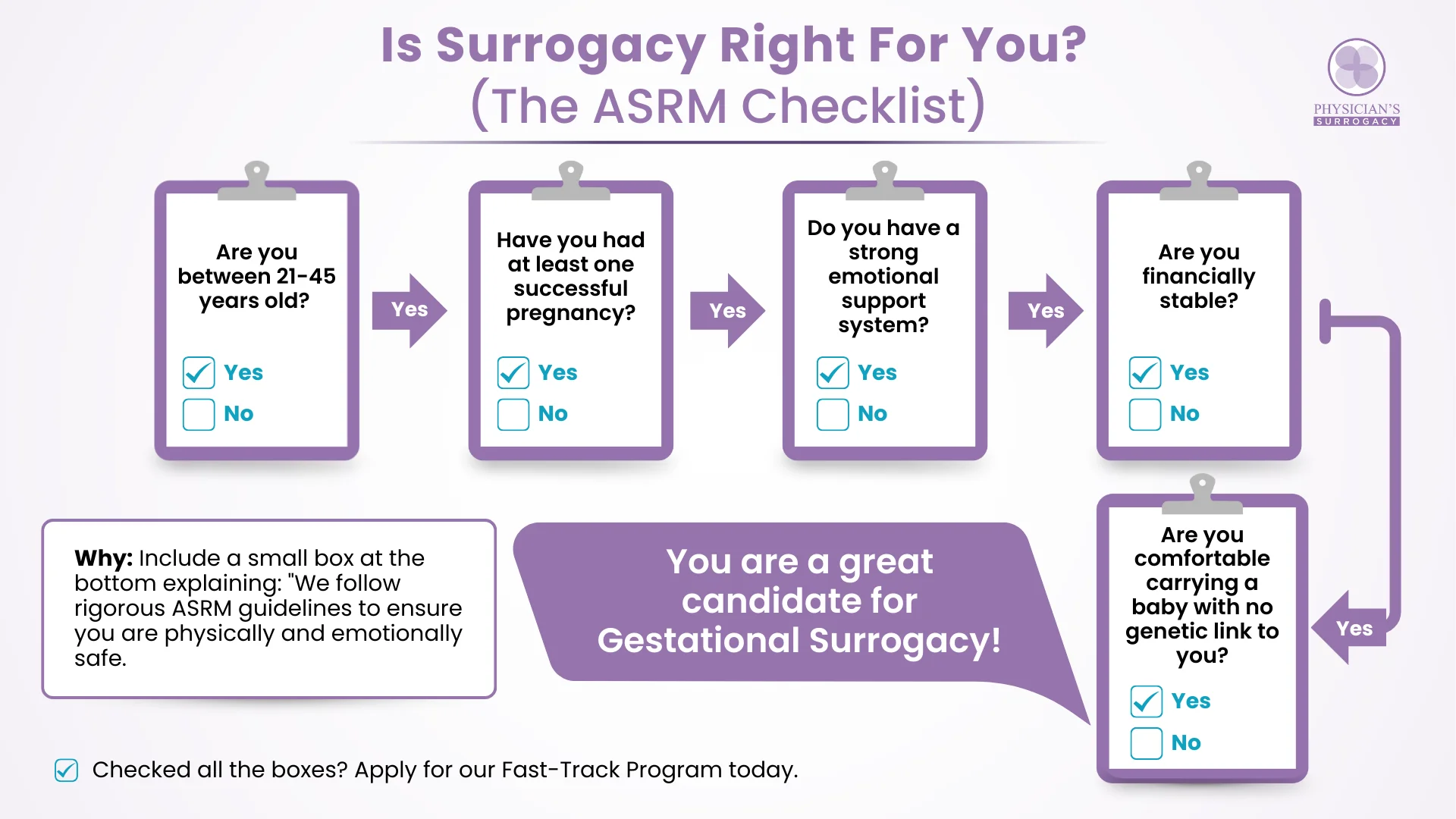
To address these concerns, the surrogacy field has developed rigorous screening processes. According to the American Society for Reproductive Medicine, ideal surrogacy candidates are:
- Healthy women between 21-45 (some agencies specify 23-35)
- Have had at least one successful pregnancy
- Are financially stable
- Have a strong emotional support system
All parties undergo extensive medical and psychological evaluations to ensure they are prepared for the surrogacy journey – and are entering the agreement with full agency and understanding.
Are there maternal-infant bonding considerations?
The concern about “Maternal/Infant Separation Trauma” is grounded in the understanding that pregnancy creates powerful bonds.
As one person in our research expressed, “My desire for my child to be in existence is not a reason to separate them from their birth parent they had been bonding with for the last 9 months.”
This concern is particularly relevant in traditional surrogacy, where the genetic connection strengthens the biological bond. This is one reason why gestational surrogacy has become the preferred approach.
Research from the Journal of Human Reproductive Sciences suggests that a positive relationship between the carrier and intended parents is often a key factor in positive outcomes for all parties, including the child. Many modern surrogacy arrangements include some form of ongoing contact that honors the special role the gestational carrier played in bringing the child into the world.
Could finances impact surrogacy?
The cost of surrogacy represents a significant barrier for many hopeful parents.
Gestational surrogacy is typically more expensive due to the costs associated with IVF, fertility medications, legal fees, and carrier compensation.
Costs can range from $90,000 to over $150,000 for gestational surrogacy, while traditional surrogacy might range from $60,000 to $100,000.
These costs vary based on:
- Geographic location
- Whether an egg donor is needed
- Insurance coverage
- Agency fees
- Legal requirements in your state
Some families pursue altruistic surrogacy (where the surrogate receives reimbursement for expenses only) with a friend or family member to reduce costs, though this approach comes with its own emotional complexities.
Are all parties legally protected in surrogacy?
Perhaps the most critical aspect of any surrogacy arrangement is establishing comprehensive legal protections for everyone involved.
A thorough surrogacy contract should address:
- Rights and responsibilities of all parties
- Compensation and expense coverage
- Medical decision-making during pregnancy
- Plans for potential complications
- Contact arrangements after birth
Luckily, good surrogacy agencies like Physician’s Surrogacy will make sure that everyone’s rights are protected.
Why surrogates choose Physician’s Surrogacy
Becoming a surrogate is a big decision. It’s exciting, but it can also feel heavy. You’re not just signing up for appointments – you’re committing your time, your body, and your energy to help someone build a family.
So, you deserve a team that answers your questions like a human, treats your time with respect, and stays close to the medical side of the process from day one.
Here’s what makes our program at Physician’s Surrogacy different and why so many women feel confident doing this with us.
A fast-track option that respects your time
This is the biggest change in our program right now.
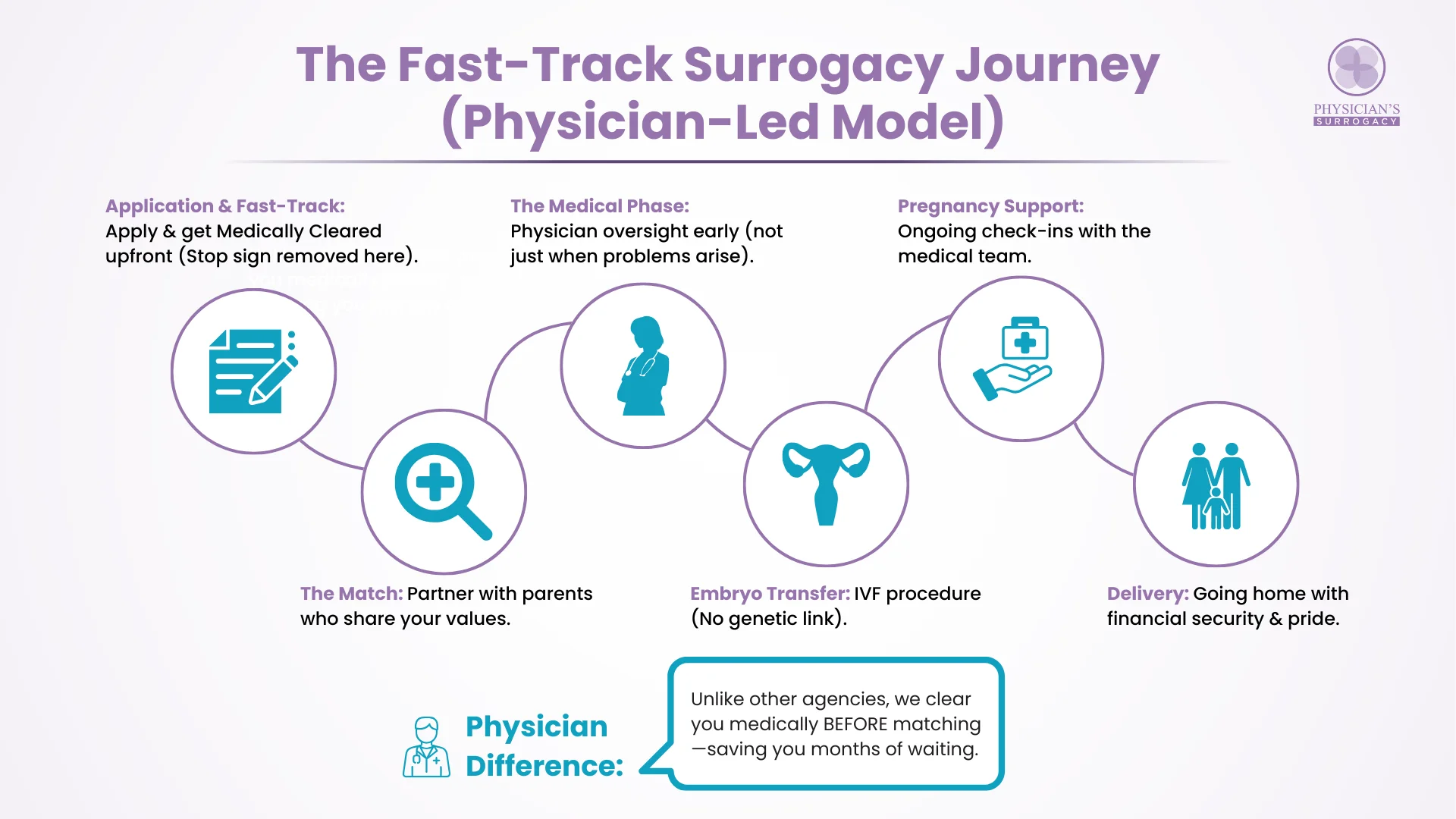
With our Medically Cleared Surrogates (Fast-Track) Program, you can move forward with fewer unknowns because key medical steps happen upfront, before you’re ever presented for matching.
Instead of matching first and then finding out months later that an IVF clinic won’t approve the journey, fast-track surrogates are fully screened and medically cleared upfront at our affiliate IVF center.
What does this mean in real life? Well, you’re not stuck in the “waiting black hole” that so many surrogates deal with. You get a clearer, more predictable path – with real momentum once you’re accepted.
Physician-led care that stays involved early
Most agencies only loop in medical support when a problem shows up. Our model at Physician’s Surrogacy is different.
We’re physician-managed, which means medical oversight is built into your journey early (during pre-screening and throughout pregnancy planning), so issues can be caught earlier, with fewer surprises.
It’s a calmer experience when you feel like someone’s actually watching the full picture, not just reacting when something goes sideways.
Straightforward compensation for financial security
You shouldn’t have to decode a payment structure or keep track of receipts like it’s a second job.
We moved away from the confusing “itemized reimbursement” approach. With us, your compensation package is clear, fixed, and high-value. You’ll know what you’ll be paid and when, without haggling or wondering what counts.
And with fast-track, there’s another practical upside: the process moves in a more defined way, so you’re not waiting around for months before anything starts.
A screening process that feels ethical and supportive
Surrogacy asks a lot of you, so your support system matters.
We follow ASRM guidelines and go beyond them with our own screening so women in our program are medically and emotionally ready. You’re not doing this in isolation. You’re joining a community of surrogates who understand the decision you’re making: women who want to help families, and also want to feel safe and supported while doing it.
Making a decision between gestational vs traditional surrogacy
Choosing gestational surrogacy vs traditional surrogacy is personal, and it’s smart to think it through before you commit.
- Gestational surrogacy tends to offer clearer legal boundaries and emotional clarity, but it comes with more medical coordination.
- Traditional surrogacy can sound simpler, but it often comes with bigger legal and emotional complications, which is why most professionals steer families away from it today.
A fertility clinic and an experienced reproductive law attorney in your state can also help you understand what applies to you, since laws vary so much.
If you want the more medically structured route – with a clearer timeline and fewer late-stage surprises – gestational surrogacy paired with our fast-track, medically cleared model gives you a layer of predictability that’s rare in this space.
Ready to Start Your Journey?
If you’re ready to explore gestational surrogacy with a physician-led team—and you want to ask about our Fast-Track (Medically Cleared) Program—we’d love to meet you!
Apply to Become a Surrogate Today and see if you qualify.
FAQs
What’s the real difference between gestational and traditional surrogacy?
Gestational surrogacy means the surrogate is not genetically related to the baby. An embryo is created through IVF and transferred to the surrogate’s uterus. Traditional surrogacy means the surrogate is genetically related to the baby, because her egg is used (often through IUI).
That genetic link is the main reason traditional surrogacy can feel legally and emotionally more complicated.
Why do most people choose gestational surrogacy today?
Because it creates clearer boundaries for everyone. The surrogate isn’t using her own egg, so parentage is usually more straightforward (depending on the state). It’s also the route most fertility clinics, attorneys, and agencies support today because it reduces the risk of legal disputes compared to traditional surrogacy.
How much does surrogacy usually cost?
Surrogacy costs can vary a lot based on medical needs, insurance, legal requirements, and the surrogate’s compensation package. For gestational surrogacy, many intended parents budget roughly $90,000 to $150,000+ all-in.
Traditional surrogacy can cost less in some cases, but it’s much less common today because of the added legal and emotional risk.
What is a pre-birth order?
A pre-birth order is a court document that can establish the intended parents as the baby’s legal parents before birth (in states where it’s allowed).
It’s one reason gestational surrogacy can feel more secure: it can help intended parents be recognized legally right away, without adoption steps after delivery.
Who can become a surrogate?
At Physician’s Surrogacy, screening for who can become a surrogate is a big deal because it protects you. We also offer a fast-track (Medically Cleared) program for qualified candidates, where key medical clearance happens upfront, so you don’t get stuck waiting later.
How do I start the surrogacy process with Physician’s Surrogacy?
Start simple: apply, and we’ll take it from there.
If you qualify, our team will walk you through each step—screening, education, matching, and medical coordination—so you’re never guessing what happens next. And if you’re a fit for our Medically Cleared program, we’ll explain what that looks like and how it can speed up the timeline in a more predictable way.

Julianna Nikolic
Chief Strategy Officer Julianna Nikolic leads strategic initiatives, focusing on growth, innovation, and patient-centered solutions in the reproductive sciences sector. With 26+ years of management experience and a strong entrepreneurial background, she brings deep expertise to advancing reproductive healthcare.