
Insurance is one of the first things women ask about when they start looking into surrogacy — and one of the least clearly answered. Most of what you’ll find online is written for intended parents, not for you. That gap matters. You’re the one carrying the pregnancy, and you deserve a straight answer about what covers your body.
Here’s the short version: surrogate insurance coverage depends entirely on the specific policy you carry. Some policies cover a surrogacy pregnancy without issue. Others exclude it by name.
A meaningful number falls somewhere in the middle — coverage is possible, but only after a professional review of the full policy document. What never changes: you will never pay a medical bill out of your own pocket. Intended parents are contractually and financially responsible for 100% of pregnancy-related costs.
This guide covers how surrogate health insurance actually works, what happens if your current plan doesn’t qualify, and what it means that Physician’s Surrogacy is the only OB-managed surrogacy agency in the U.S. — because physician oversight has a direct effect on your medical risk during the journey.
The honest answer is: it might. Approximately 60% of employer-sponsored health plans in the U.S. do not explicitly exclude surrogacy — meaning those policies can, in theory, cover a gestational carrier pregnancy the same way they’d cover any other pregnancy.
But “in theory” requires verification. The other 40% of employer plans, most individual plans, and certain government programs like Tricare explicitly exclude surrogacy. And some plans land in gray territory — the policy doesn’t mention surrogacy at all, which means a professional needs to read every section carefully before anyone assumes coverage applies.
Only about 1 in 10 surrogates enters the process with insurance that fully qualifies without any additional action. That’s not a reason to worry. It’s a reason to verify early — which is exactly what the insurance review process is designed to do.
Before 2015, most insurance billing used a coding system (ICD-9) that didn’t distinguish a surrogate pregnancy from a standard one. That changed when the medical industry switched to ICD-10, which introduced a specific code for gestational carriers: Z33.3.
That code tells a claims processor — and an insurer — that the pregnancy is a surrogacy. Policies that once processed surrogate pregnancies without issue now flag them. This is one reason more surrogates today need either a backup plan or a separate policy than they did a decade ago.
Two categories almost always disqualify:
Quick Answer
A surrogate-friendly plan treats a gestational carrier pregnancy exactly like any other pregnancy — covering prenatal care, delivery, and postpartum recovery with no surrogacy-specific exclusions. This determination requires a full review of the actual policy document, not just the summary of benefits.
A lot of people think checking their summary of benefits is enough. It isn’t. Surrogacy exclusions can appear in the main exclusions section — but they can also hide in covered services language, subrogation clauses, or coordination of benefits sections. A professional insurance review reads all of it.
The review looks for specific language patterns:
That last one is called a lien clause. Some plans (certain Kaiser and Sutter Health plans, for example) will cover the pregnancy — but then place a lien on your surrogate compensation to recover what they paid out. A proper policy review catches this before you’re matched, not after.
That letter lands in one of three places: full confirmation that your coverage applies, a clear finding that an exclusion exists and a new policy is needed, or a flag on ambiguous language that requires a follow-up inquiry. At Physician’s Surrogacy, this review happens during the pre-screening phase — before you’re ever matched with intended parents.
Then intended parents purchase a policy that does. This is standard across the industry. You never go uninsured, and you never pay for it yourself.
There are three main paths when a surrogate’s existing coverage doesn’t qualify.
The Affordable Care Act (ACA) mandates that maternity care be covered as an essential health benefit. Every state except Wyoming has ACA marketplace plans available that will cover a surrogate pregnancy — and these plans generally do not contain explicit surrogacy exclusions.
Monthly premiums typically run $400–$800 without subsidies. Deductibles range from $0 to $6,000 depending on the plan tier, and maximum out-of-pocket limits cap at $4,000–$10,000. Intended parents pay all of it through escrow.
The one challenge with ACA plans is timing. Open enrollment runs November 1 through January 15 (extended through January 31 in California). Outside that window, enrollment requires a qualifying life event. Surrogacy attorneys and experienced agencies plan around enrollment periods to avoid coverage gaps.
These are purpose-built policies for gestational carriers — no exclusions, no ambiguity. They’re structured as contractual liability policies backed by Lloyd’s of London, which means they operate differently from traditional health insurance but cover surrogacy pregnancies at any hospital, with any provider, year-round.
Typical costs for a singleton pregnancy run approximately $10,000 in premiums plus a $19,000 self-funded retention (a prepaid amount similar to a deductible) — roughly $29,000 total. If actual medical costs come in under the retention amount, the policy may return unused funds.
For intended parents, the appeal is certainty. No coverage surprises, no mid-pregnancy policy disputes, no claim denials. For you as the surrogate, the appeal is the same: you know from day one that your care is fully covered.
Some surrogates have primary insurance that covers most of the pregnancy but may face gaps in specific situations. Supplemental policies — available from providers like New Life Agency — activate only when the primary insurance denies a claim. A singleton supplemental policy typically includes a small company fee plus a medical fund of around $10,000–$15,000 for covered gaps.
| Coverage Type | Typical Cost (Paid by IPs) | Best For |
|---|---|---|
| Surrogate’s existing insurance | Premiums + deductibles + copays | Plans with no surrogacy exclusion |
| ACA marketplace plan | $400–$800/month + out-of-pocket costs | No qualifying existing coverage |
| Specialty maternity policy (Lloyd’s) | ~$29,000 (singleton); higher for twins | Maximum certainty; no network limits |
| Supplemental/backup policy | ~$10,000–$15,000 medical fund | Primary coverage with gap protection |
| Your out-of-pocket cost | $0 | Always |
* All costs listed are paid by intended parents through a secure escrow account. Surrogates never pay for pregnancy-related medical care.
Intended parents are responsible for every dollar of pregnancy-related medical cost. This isn’t a handshake agreement — it’s a contractual obligation spelled out in the Gestational Carrier Agreement (GCA) before your journey begins.
The money flows through a third-party escrow account. Intended parents fund the account before medical care begins. When bills arrive, they’re paid from escrow — directly to providers, directly to insurers, directly to pharmacies.
You never see a medical bill. You never write a check. For a deeper look at how financial protections are written into your agreement, see what surrogacy contracts cover.
Escrow accounts stay open for several months after delivery to cover any remaining obligations — late-arriving claims, postpartum follow-ups, or other end-of-journey costs. The entire financial system is designed so your compensation stays yours and medical expenses stay theirs.
New York has codified this at the legal level: under New York’s Gestational Surrogates’ Bill of Rights, intended parents must provide health insurance covering the preconception period through 12 months postpartum and pay all copays, deductibles, and out-of-pocket costs. Most states rely on the GCA to achieve the same outcome.
Health insurance covers the pregnancy. But a complete surrogacy insurance package protects you in several other ways that matter just as much.
Every reputable surrogacy arrangement includes life insurance for the gestational carrier. Coverage amounts range from $250,000 to $750,000 depending on the agency and state requirements — New York legally mandates $750,000. This policy is purchased and paid for by intended parents and must be active before embryo transfer.
Life insurance typically remains effective for 12–24 months after delivery to cover any pregnancy-related complications that emerge postpartum. You never pay the premium.
Short-term disability insurance covers lost wages if your doctor orders bed rest during the pregnancy or if your recovery extends beyond the normal postpartum period. This is separate from any disability coverage you carry through your employer. Coverage durations typically range from 3 to 9 months. Your pre-pregnancy income determines the payment amount.
Some surrogacy insurance packages include protection for specific medical events that go beyond a standard pregnancy — hysterectomy, loss of reproductive capacity, or other serious complications. These provisions exist because, while rare, serious outcomes do happen in pregnancy, and you deserve protection if they do.
Specialty surrogacy maternity policies often include coverage for stillbirth or infant demise. This matters both financially and emotionally. Knowing this protection exists before you begin the journey is part of going in with your eyes open.
Quick Weigh-Up
Using your existing insurance vs. getting a new policy — what actually matters for you.
Using your existing plan (if it qualifies)
Getting a new policy
The insurance review is one of the most important steps in your pre-screening process — and it happens before you’re matched, not after. That timing matters.
A specialist reviews your complete policy document. Not just the summary. The entire policy, looking for every section that could affect a surrogacy pregnancy: exclusions, covered services, subrogation, coordination of benefits. The review typically takes a few days and results in a written opinion letter.
That letter does one of three things:
Specialist firms like ART Risk Solutions have placed over 8,500 maternity policies since 2010 and manage hundreds of surrogacy insurance claims each year. This is specialized work — and having it done early protects everyone.
At Physician’s Surrogacy, the insurance review integrates into your pre-screening process. You know your coverage status before you meet intended parents. No surprises mid-journey.
Most surrogacy content treats insurance as a financial topic. It is — but it’s also a medical one. The risk profile of your pregnancy shapes what insurance costs, what complications are possible, and how protected you need to be.
Here’s what the research actually shows. Gestational carrier pregnancies carry a higher baseline risk than unassisted pregnancies. A 2024 Ontario population-based study found that severe maternal morbidity was three times higher in surrogate pregnancies.
Technology-assisted pregnancies also carry roughly twice the risk of preeclampsia compared to unassisted conception, according to a 2023 American College of Cardiology study of over 2.2 million patients.
That’s not said to frighten you. It’s said because it makes the medical quality of your surrogacy agency genuinely important — not just for your health, but for your protection.
Physician’s Surrogacy is led by in-house board-certified OB/GYNs. This is rare. Most surrogacy agencies are run by coordinators and business operators with no medical background. It’s what we call the Physician’s Advantage — and it shapes every aspect of how your journey is managed.
Our physician-designed screening protocol goes beyond the American Society for Reproductive Medicine (ASRM) guidelines — not to make qualification harder, but to match surrogates with proven obstetric histories to journeys they’re medically positioned to handle well.
Selecting the right surrogates from the start is the most effective way to reduce the risk of complications during the pregnancy.
Once you’re pregnant, our in-house physicians monitor your journey. They receive clinical communications after every appointment. If a question arises — about a medication, a lab result, a symptom — a physician is involved, not just a coordinator.
More than that: our physicians can consult peer-to-peer with your managing OB/GYN. If something unexpected comes up, your OB isn’t navigating it alone. That level of medical backup is something virtually no other surrogacy agency can offer.
Research consistently supports the connection between quality prenatal oversight and better outcomes. A 2025 systematic review published in PubMed Central found that high-quality prenatal care is associated with a 41% reduction in neonatal mortality.
A Taiwan population-based study of over 75,000 women found that adequate prenatal care eliminated the elevated risk of preterm birth and low birth weight in women with infertility histories.
Multiple pregnancies are one of the biggest drivers of insurance risk — and one of the most preventable. NICU admission rates run about 43% for multiple pregnancies versus roughly 9% for singletons. The adjusted odds ratio for NICU admission in multiple gestations is nearly 10 times that of singleton surrogate pregnancies, according to a study published in PMC.
Physician’s Surrogacy strongly advocates for single embryo transfer. ASRM guidelines back this position, and our in-house physician team supports it. It protects your health — and keeps your surrogacy pregnancy as close to a standard pregnancy as possible.
Surrogates on Medicaid at the time of application are not eligible to carry a surrogate pregnancy under their Medicaid coverage. Surrogacy compensation substantially exceeds income thresholds for Medicaid eligibility.
Using government insurance for a compensated pregnancy also creates legal complications. If you’re currently on Medicaid, this is something to discuss with your coordinator early in the process.
Tricare explicitly excludes surrogacy. If you’re a military spouse or veteran using Tricare, intended parents will need to secure a separate policy before your journey begins. This is handled routinely — it’s not a barrier to becoming a surrogate — but it does affect timeline planning around insurance enrollment windows.
A multiple pregnancy significantly increases the complexity and cost of surrogacy insurance. Specialty maternity policies cost more for twin pregnancies, and insurance review for multiple gestations requires additional attention. Twin surrogacy carries specific risks worth understanding before you begin.
This is another reason why Physician’s Surrogacy advocates strongly for single embryo transfer — it protects you medically and keeps the insurance picture straightforward.
Your medical coverage doesn’t end at delivery. Standard postpartum coverage continues for at least 90 days. Some arrangements extend coverage for up to 12 months postpartum. Life insurance typically remains active for 12–24 months after delivery to cover any pregnancy-related complications that emerge later.
Physician’s Surrogacy also provides 3–6 months of post-delivery support — coordinator access, medical follow-ups, and a point of contact if you have questions after the birth. You’re not on your own the moment the baby arrives.
While the baby is in utero, it’s covered as part of your pregnancy under your insurance. The moment the baby is born, that changes — coverage transfers immediately to the intended parents’ plan. Domestic intended parents have 30–60 days to add the newborn, and coverage backdates to the birth date. You are never financially responsible for the baby’s medical care at any point.
Surrogate insurance is a topic that feels complicated until someone walks you through it clearly. The actual experience for most surrogates is simpler than it looks from the outside: you get screened, your insurance gets reviewed by a professional, and coverage is confirmed or arranged before you’re matched with anyone. You start your journey knowing exactly what your protections are.
Physician’s Surrogacy is the only surrogacy agency in the U.S. where practicing OB/GYNs manage your medical journey from the start. That means the insurance review happens during pre-screening, physician oversight continues throughout pregnancy, and — because our screening produces a preterm rate 50% below the national average — your risk profile going in is as strong as possible.
If you’re curious about how this works for your specific situation, our team can answer your questions directly. Apply to become a surrogate — there’s no obligation, and finding out if you qualify costs nothing.
Apply to Become a Surrogate
When your friend decides to become a surrogate, it’s an incredible moment of generosity. Knowing how to support a surrogate friend is one of the best gifts you can give her. But let’s be honest – sometimes it’s hard to know exactly what to say to a surrogate or how to help during this unique journey.
You want to be there for your friend, but the usual pregnancy comments don’t always apply. You might worry about saying the wrong thing or unintentionally making her uncomfortable. That’s completely normal when supporting a friend through surrogacy!
This guide shares surrogate friend advice to help you handle those conversations with confidence. It’s a resource your surrogate friend can share with her inner circle so everyone can show up for her in a way that actually feels good.
Before jumping into what to say to a surrogate (and what not to say), it helps to quickly understand what makes surrogacy different from a traditional pregnancy.
As a gestational carrier (GC), your friend isn’t genetically related to the baby she’s carrying. Her role is to provide a safe, healthy environment for the baby to grow before they go home with their intended parents. This difference shapes how she might experience the pregnancy emotionally.
Research from the National Center for Biotechnology Information shows that surrogates often develop their own ways of managing their feelings throughout the process. One surrogate in the study explained it perfectly: “That baby would never belong to me. I only provided an appropriate environment for the baby to be born.”
This mindset doesn’t mean the journey isn’t emotional – it absolutely is. But those emotions might look different than what you’d expect in a traditional pregnancy.
You want to show you care, but even with the best intentions, it’s easy to say something that misses the mark. Here is some surrogate friend advice on common phrases that might make your surrogate friend uncomfortable, and why:
Why it misses the mark. This is probably the most common question surrogates hear, and it often comes from a misunderstanding of gestational surrogacy. Most surrogates have already thought deeply about this aspect and have a clear understanding of their role in the process.
Why it misses the mark. This reduces an incredibly personal and meaningful journey to just a transaction. While compensation is an important part of surrogacy, it’s a private matter between the surrogate and the intended parents.
Why it misses the mark. This questions the personal and often difficult family-building choices of the intended parents. Each family’s path to parenthood is deeply personal, and this comment can feel judgmental.
Why it misses the mark. In gestational surrogacy, the answer is clear – it’s the intended parents’ baby. This question creates confusion and an awkward dynamic that your friend likely wants to avoid.
Why it misses the mark. While said out of concern, this can undermine your friend’s confidence. Surrogates go through extensive medical screenings and have made an informed decision after careful consideration.
Why it misses the mark. Constantly focusing on the baby can make your friend feel like she’s just a vessel, rather than a whole person going through a significant experience. Remember that she’s still the same friend you’ve always known.
Now that you know what to avoid, let’s focus on the positive. Knowing what to say to a surrogate can make all the difference. Here are supportive alternatives that focus on your friend’s well-being and acknowledge her choice:
Why it works. This acknowledges the altruism and kindness of her decision, reinforcing positive feelings about the journey.
Why it works. This validates her contribution and highlights the impact she’s having on another family’s life.
Why it works. This open-ended question centres the conversation on her personal pregnancy journey. It allows her to share as much or as little as she wants without making assumptions.
Why it works. It shows you care about her health and well-being beyond her role as a surrogate.
Why it works. This direct offer of support lets her define what she needs, whether it’s a ride to an appointment, a listening ear, or just a fun distraction.
Sometimes the best support isn’t about what you say, but what you do. This is where learning how to support a surrogate friend becomes truly meaningful, especially during the pregnancy and after the birth.
Your friend’s daily life continues during the pregnancy, and your consistent friendship is a real gift.
The postpartum period is a critical time for recovery, both physically and emotionally.
Knowing how to support a surrogate friend through her journey is simpler than you might think. Focus on her experience, offer specific help (like a ride to an appointment), and remember to just be a friend. The next time you talk, try asking a simple question like, “How are you feeling?” to open the door for a real conversation.
Building a great support system matters when supporting a friend through surrogacy. If your friend is looking for an agency that provides comprehensive, compassionate support, Physician’s Surrogacy is here to help.
We guide surrogates and intended parents every step of the way, making the journey a positive and successful one. Learn more about our supportive surrogacy program and see how we help build families with confidence and care.
The most important thing to remember is that her experience is unique and different from a traditional pregnancy. To best support a surrogate friend, focus your support on her well-being and decision, not just the baby.
You shouldn’t ask about payment because it reduces her personal journey to a financial transaction. Compensation is a private matter, and focusing on it can feel dismissive of her generous act.
A simple, supportive question to ask is, “How are you feeling, physically and emotionally?” This centres the conversation on her personal experience and shows you care about her overall well-being.
You can offer practical help by being specific and direct. Instead of a vague offer, try saying, “I’m heading to the store, can I grab anything for you?” This makes it easier for her to accept.
Yes, it is best to avoid asking if she’ll get attached. Surrogates understand their role clearly, and this common question can undermine the emotional and mental preparation they’ve already done.
The support most needed after birth is practical help during her recovery. Offering to bring meals, help with housekeeping, or drive her to appointments can make a huge difference.
Deciding to carry for another family is one of the most meaningful commitments a woman can make — and one of the most physically demanding. Over the next year to 18 months, you’ll go through hormone injections, frequent medical appointments, and the profound changes of pregnancy. The stakes for your health and your family’s financial security are real.
That’s why how you choose a surrogacy agency as a surrogate matters just as much as the decision to become one. At Physician’s Surrogacy — the nation’s only OB-managed surrogacy agency — we work with women every day who came to us after frustrating experiences with agencies that overpromised and underdelivered. This guide walks you through what to look for, what to avoid, and the questions that reveal whether an agency truly has your back.
Dozens of programs promise to make your journey seamless, but the difference between a well-run agency and a poorly run one shows up in very specific, verifiable ways. Here’s how to tell them apart.
Before evaluating specific programs, it helps to understand what an agency actually does and why most first-time gestational carriers prefer working with one over going independent.
Going independent means acting as your own project manager — coordinating lawyers, escrow accounts, and clinical appointments without institutional support.
For most women, that administrative load on top of the physical demands of pregnancy is not realistic. An agency’s job is to serve as a buffer and a guide, so you are never placed in the awkward position of asking intended parents directly for money or navigating a medical complication without a team behind you.
When you choose a surrogacy agency as a surrogate, you are picking the team that will schedule your medical appointments, manage your legal paperwork, and provide support when the process feels overwhelming.
Research published in Human Reproduction shows that professional, third-party support measurably improves the emotional wellbeing of gestational carriers — and that difference is felt most during the harder stretches of the journey.
Surrogacy is not just a matching process. It is a coordinated medical procedure, and your agency needs to understand the clinical reality of what you are committing your body to.
According to guidelines published by the American Society for Reproductive Medicine (ASRM), comprehensive medical and psychological screening is a required standard.
You’ll undergo a pelvic exam, ultrasound, and extensive blood work, along with cultures for sexually transmitted infections and toxic substances. If applicable, your partner will also be asked to complete blood work screening.
Research in the Journal of Psychosomatic Obstetrics & Gynecology confirms that thorough medical and psychological evaluations significantly reduce the risk of postpartum complications.
Once you are medically, psychologically, and legally cleared, the physical demands of the process increase. You will begin cycle suppression and self-injectable medications to prepare your uterus for the embryo.
Research in Fertility and Sterility confirms that proper hormonal preparation is required for endometrial receptivity — these injections are not optional.
In the weeks leading up to embryo transfer, you will visit the clinic for vaginal ultrasounds and blood work one to two times per week. Injections typically continue through the first trimester to support the pregnancy.
The embryo transfer takes place approximately four weeks after injectable medications begin.
The procedure itself takes about ten minutes: the embryo is loaded into a small catheter, which is guided through the cervix and into the uterus. After the transfer, you will be placed on bed rest for 24 to 72 hours depending on the physician’s protocol.
The American Journal of Obstetrics and Gynecology notes that adherence to post-transfer protocols supports implantation and reduces early pregnancy loss.
A blood test is performed 12 to 14 days after the transfer to measure hormone levels. Two blood tests and a heartbeat ultrasound are used to officially confirm a positive pregnancy. Once the pregnancy is stable — typically around 10 to 12 weeks — you will stop fertility medications and transition to your personal OB/GYN for the remainder of the pregnancy and delivery.
The clearest green flags center on two things: financial transparency and medical safety. As you interview programs, these are the indicators that show an agency respects your time and protects your wellbeing.
A reputable program tells you exactly what you will be paid — upfront, in full, with no conditions.
At Physician’s Surrogacy, we use a Flat-Rate Surrogacy model: your total compensation of $55,000–$75,000+ is disclosed at the start of your agreement. There’s no base amount with vague add-ons. There’s also no waiting to find out whether you qualified for a line item. Your number is your number, stated clearly in your contract from day one.
This structure also reduces paperwork significantly. You won’t be submitting receipts for childcare, mileage, and miscellaneous expenses throughout your journeys since the fixed package covers it. Payments are distributed in regular monthly installments, making it straightforward to plan your finances throughout the process.
In a traditional agency model, the timeline can become emotionally draining fast. You match with intended parents, then wait to find out whether their IVF clinic will approve your records.
If the clinic finds an anomaly — or simply does not have capacity to screen you that month — you can be dropped and sent back to the matching pool. Studies in the Journal of Assisted Reproduction and Genetics identify canceled cycles and delays as a major source of psychological distress for people going through fertility-related processes.
A strong green flag is any program that offers medical clearance before matching. At Physician’s Surrogacy, our Medically Cleared Program lets you complete your full screening before you are matched with intended parents. You start the process already cleared — so there is no back-and-forth with a clinic, no waiting to be approved, and no risk of losing a match over a records issue.
Your legal contract is the blueprint for the entire journey. A trustworthy agency insists on two separate attorneys: one representing the intended parents, and one representing you.
This separation is not optional — it prevents any conflict of interest and protects your rights, your bodily autonomy, and your financial agreements throughout the process. Legal fees are paid by the intended parents.
Look for an agency with case managers available around the clock and a medical team that follows ASRM guidelines on surrogate health standards. Agencies that hold surrogates to clinical health requirements — including Body Mass Index (BMI) guidelines — are protecting your safety during pregnancy, not just filling a roster.
Post-delivery support for three to six months is another sign that an agency treats the surrogate relationship as lasting beyond the birth.
Knowing the red flags before you apply protects you from the situations most likely to cause real harm — financial, medical, or legal.
Some agencies advertise high compensation numbers to attract applicants, then reveal after the application process that the advertised amount includes line-item allowances for things you may never use or qualify for.
If an agency cannot give you a clear, guaranteed total from the start — the number that will appear in your contract — that is a red flag. Vague “up to” figures and multi-column compensation charts are designed to obscure what you will actually receive.
If an agency offers to have one lawyer represent both you and the intended parents to save time, walk away. That arrangement creates a conflict of interest that puts your rights at risk.
The same applies to agencies that manage your compensation funds directly instead of routing them through a licensed, independent escrow company. If the agency faces financial difficulty, your money is at risk without that separation.
Many agencies are run by former surrogates who bring valuable personal experience — but personal experience is not the same as clinical authority.
If an agency expects you to manage your own medication calendar, interpret your own side effects, and self-triage complications without a medical team behind you, they are not equipped for the job. A dedicated medical coordinator and physician oversight are not extras, but the standard.
Treat your initial consultation as a two-way interview. You are evaluating them just as much as they are evaluating you. These questions cut through marketing language and get to what actually matters.
Physician’s Surrogacy is the nation’s only OB-managed surrogacy agency. That distinction is not a marketing line — it changes every aspect of how your journey is run.
Our in-house board-certified OB/GYNs and an Advisory Board of specialists in maternal-fetal medicine, neonatal care, and obstetrics manage the agency and oversee your medical care directly. No other surrogacy agency in the U.S. is structured this way.
That physician-led model produces measurable results. Our preterm delivery rate is 50% below the national average, driven by our proprietary 47-point physician-designed screening process that exceeds ASRM guidelines. We also arrange medical pre-screening as close to your home as possible so the process fits your life — not the other way around.
Our Medically Cleared Program lets you complete full medical screening before matching, so you skip the uncertainty of waiting on a clinic’s approval after you are already emotionally invested.
Combined with our Flat-Rate Surrogacy model — where your total compensation of $55,000–$75,000+ is disclosed in your agreement from day one — you start your journey knowing exactly where you stand medically and financially.
Ready to see if you qualify? Review the surrogate requirements and take the first step with a team built to protect you at every stage.
!
Thinking about becoming a surrogate is a huge step. It’s an exciting idea: helping a family in a profound way, with generous compensation to match. But before you begin this journey, it helps to ask yourself a simple question: are you emotionally ready for surrogacy? Alongside the excitement, a storm of questions and doubts is likely swirling in your mind.
Will I get too attached to the baby? Will it feel transactional, like I’m just “renting out my womb?” What if something goes wrong?
These feelings are completely normal. Surrogacy is an emotionally complex journey, and many women run into the emotional challenges of surrogacy at some point—even when they feel confident at the start. It’s a blend of altruism and a major financial decision, and it takes honest self-reflection before you jump in.
To help you find clarity, this guide walks through five key questions to ask yourself. Answering them honestly will help you decide if you’re emotionally ready for surrogacy and prepared for the reality of the journey.
Here are the five questions you should ask yourself before becoming a surrogate.
Getting clear on your “why” is the foundation for a positive surrogacy experience. When things get challenging (and yes, there will be challenging moments), your motivation is what you’ll come back to.
Most women who become surrogates have two primary motivations:
Here’s the thing: it’s completely okay for your motivation to be a blend of both. In fact, that’s healthy. Being transparent with yourself about the financial side helps you set realistic expectations.
Once you’re clear on your motivations, the next step is to face some of the most common fears about the process.
One of the most common fears we hear is from a Reddit user who posted, “I’m scared of signing up for it and being too attached to the kid, and suffering since I would probably have zero contact with the child after is born.”
This is a valid concern, and addressing it is part of becoming emotionally ready for surrogacy. There are several factors that help most surrogates manage this well.
It helps to know that today, almost all surrogacy is gestational surrogacy. This means you, the gestational carrier, have no biological or genetic link to the baby you’re carrying. The embryo is created using an egg from an intended mother or a donor.
As one surrogate wisely put it, “It’s not ‘your’ baby.” This distinction can make the emotional challenges of surrogacy feel much more manageable for many women.
The science backs this up. A systematic review of studies found that surrogates generally show a lower maternal-fetal bond compared to mothers carrying their own biological children. Researchers believe this can function as a healthy psychological mechanism that supports the handover after birth.
This doesn’t mean the experience is emotionless. Many surrogates report feeling “a little empty” or “kind of sad not to be pregnant anymore” after delivery. That can be a normal response to the end of a major life event and the postpartum hormone shift, not automatically a sign of unhealthy attachment to the baby.
Beyond your personal feelings, the relationship you build with the intended parents plays a big role in how supported you feel.
The relationship you build with the Intended Parents (IPs) sits at the heart of the journey. It’s a partnership, not just a transaction.
Some people think of surrogacy as just “renting my womb,” but that mindset can leave you with unmet emotional needs. A healthy journey is usually built on trust, respect, and clear communication with the IPs.
Research on surrogacy relationships has identified a few different types. Think about which one feels like the right fit for you:
Knowing your preference is a big part of the matching process. A strong agency will help you match with IPs who want the same level of connection you do.
While your relationship with the IPs matters, you also need your own support system outside of that partnership.
A solid support system is essential. You can’t – and shouldn’t – do this alone.
Your journey impacts your whole family. It helps if your partner, children, and closest people are on board and ready to support you through the highs and lows.
You’ll also want practical help during pregnancy and consistent surrogate emotional support throughout the process. Friends who understand surrogacy will also help immensely.
Beyond your personal circle, a good surrogacy agency should provide layers of professional support:
Support becomes even more important when the process throws unexpected “what if” moments your way.
Surrogacy is a medical journey, and medical journeys come with uncertainty. Being mentally prepared for challenges is part of being emotionally ready for surrogacy.
The process involves medications, injections, and procedures. There’s always a chance of a failed embryo transfer, pregnancy complications, or other unexpected outcomes.
Being prepared doesn’t mean you expect the worst. It means you trust your ability to handle uncertainty without it derailing you—and you know you have support if complications happen.
This is one reason an OB-managed agency like Physician’s Surrogacy can make a real difference. With a physician-led team overseeing the journey, you have a stronger layer of clinical support. In fact, our preterm delivery rate is less than 50% of the national average, which gives many surrogates and IPs real peace of mind.
Deciding to become a surrogate is a journey of the head and the heart. By exploring your motivations, preparing for the emotional complexities, and confirming you have a strong support system, you set the foundation for a positive experience. It’s also healthy to be motivated by both the desire to help and the life-changing compensation.
If you’ve reflected on these questions and feel that you are emotionally ready for surrogacy, our team at Physician’s Surrogacy is here to support you. As the nation’s only OB-managed agency, we provide strong medical guidance and emotional support throughout your journey.
We invite you to reach out to our team for a confidential conversation about your questions and to learn more about becoming a surrogate with us.
The compensation a surrogate can expect typically ranges from $48,000 up to $95,000. Your final compensation package depends on factors like your location, experience, and the specifics of your agreement with the intended parents.
No, you will not be biologically related to the baby in a gestational surrogacy. The embryo is created using an egg from the intended mother or a donor, so there is no genetic link between you and the child.
If you are worried about getting too attached, it helps to remember it is not your biological child. The required psychological screening and ongoing counseling are also designed to help you process these emotions in a healthy way.
The intended parents pay for all medical bills related to the surrogacy. As the surrogate, you will not have any out-of-pocket expenses for medical care, from fertility treatments through postpartum recovery.
Support for surrogates can include professional counseling, coordinators, and peer support groups. A reputable agency should provide medical, emotional, and logistical support throughout the entire journey.
The first step to becoming a surrogate is completing an online application with a reputable agency. This initial screening helps confirm you meet the basic medical and lifestyle requirements before moving on to the next steps.
If you’ve been researching surrogacy, you’ve likely run into the terms “gestational surrogate,” “surrogate mother,” and “gestational carrier” used interchangeably — but without anyone clearly explaining what the role actually involves. That confusion is common, and it matters.
A gestational surrogate is a woman who carries a pregnancy on behalf of intended parents. She has no genetic connection to the baby. The embryo is created using the intended parents’ (or donors’) egg and sperm through In Vitro Fertilization (IVF) and then transferred to the surrogate’s uterus. The surrogate carries the pregnancy, gives birth, and returns the child to the intended parents.
At Physician’s Surrogacy — the only obstetrician-managed surrogacy agency in the U.S. — this is the only type of surrogacy we facilitate. Here’s exactly what the role entails, who qualifies, and how the process works from start to finish.
Quick Answer
A gestational surrogate (also called a gestational carrier) is a woman who carries a pregnancy created from someone else’s genetic material. She is not biologically related to the baby — the embryo is formed through IVF using the intended parents’ or donors’ egg and sperm.
The word “gestational” is the key distinction. It refers to gestation — the period of carrying a pregnancy. The surrogate’s only biological contribution is her uterus. She does not provide eggs, which means she has no parental rights to the child.
This differs from traditional surrogacy, where the surrogate provides her own egg and is genetically related to the baby. Traditional surrogacy raises serious legal and emotional complications and is no longer practiced at responsible surrogacy agencies. When agencies or articles refer to “surrogacy” today, they almost always mean gestational surrogacy.
The surrogate’s role goes well beyond carrying a pregnancy. She is an active participant in a medically supervised, legally structured process. Here’s what that looks like in practice.
Gestational surrogacy is one of the most medically sophisticated ways a family can be built — and one of the most human. The surrogate takes on real responsibility, and the best agencies treat that with the seriousness it deserves.
Not everyone who wants to become a surrogate will qualify. The screening process exists to protect the surrogate’s health and to give the intended parents the best possible chance of a successful pregnancy.
General eligibility requirements for gestational surrogates here at Physician’s Surrogacy include:
If you have questions about your specific situation — a prior C-section, a managed health condition, or anything in your medical history — our physician team can give you a real answer. You can explore becoming a surrogate or read about common disqualifications before you apply.
In everyday conversation, “surrogate mother” and “gestational surrogate” are often used to describe the same thing. Technically, there is a distinction.
“Surrogate mother” historically referred to a woman who was both the carrier and the genetic mother — meaning she provided her own egg. That’s traditional surrogacy. “Gestational surrogate” or “gestational carrier” is the accurate term for what happens today: the surrogate carries the pregnancy but contributes no genetic material.
In practical terms, most people searching online use “surrogate,” “surrogate mother,” or “gestational surrogate” interchangeably, and most agencies — including ours — understand the intent. For legal and medical documentation, the correct term is “gestational carrier” or “gestational surrogate.”
Matching is one of the most personal parts of the surrogacy journey — for both the surrogate and the intended parents. The goal is to find a pairing where values, expectations, and medical profiles align.
At Physician’s Surrogacy, our average match time is one week. That’s not a typo. We maintain the largest active pre-screened surrogate pool in the country, which means intended parents aren’t waiting months to meet a match — and surrogates move forward with families who are genuinely ready.
Surrogates share preferences during the application process — things like desired relationship level with the intended parents, comfort with multiples, and geographic considerations. Intended parents review surrogate profiles that meet their clinical criteria. Both sides must agree before the match is confirmed.
Once matched, the legal process begins. Both parties work with independent reproductive law attorneys to finalize a surrogacy agreement before any medical procedures take place.
If you’re considering becoming a surrogate, here’s how the process typically unfolds from application through delivery.
You complete an online surrogate application covering your health history, prior pregnancies, and personal circumstances. Our physician team reviews your submission and determines eligibility.
Our physician-designed screening goes beyond ASRM (American Society for Reproductive Medicine) guidelines. You’ll complete a physical exam, lab work, a uterine cavity evaluation, and a psychological evaluation with a licensed counselor.
Once medically cleared, you review potential matches. Both you and the intended parents must agree to move forward. You share preferences — including your desired level of contact and comfort with specific journey details — before any match is finalized.
You and the intended parents each work with independent reproductive law attorneys. The contract protects your rights, confirms compensation terms, and outlines responsibilities before any medical procedures begin.
A fertility clinic performs the embryo transfer — a short outpatient procedure. If the transfer results in a confirmed pregnancy, ongoing monitoring begins. Our in-house physicians communicate directly with your OB throughout the pregnancy.
You deliver at your chosen hospital with your own OB. The intended parents receive their child. Compensation continues through recovery, and our coordinators remain available for 3–6 months after delivery to support your transition.
Want a closer look at each stage? Read our full guide on the surrogate application process.
Compensation is one of the first questions women ask — and it should be. You’re committing real time, energy, and your body for 12–18 months. That deserves real, transparent numbers.
At Physician’s Surrogacy, total surrogate compensation ranges from $55,000 to $75,000+, depending on your experience level and location. Your package includes:
All funds are held in a secure escrow account managed by a third party — so payments are protected regardless of what happens with the intended parents’ finances.
For the full breakdown, see our surrogate compensation page or read our post on how much surrogates get paid in 2026.
The gestational surrogate definition is consistent across agencies. The experience of being a surrogate is not.
Most surrogacy agencies are run by non-medical staff. That means your pregnancy is coordinated by case managers and administrators — people who genuinely care, but who aren’t physicians. When a medical question comes up, they pass messages. At Physician’s Surrogacy, our in-house OB/GYNs and Advisory Board — which includes specialists in maternal-fetal medicine and neonatal care — oversee your screening and stay involved throughout your pregnancy.
That direct physician oversight is why our preterm delivery rate sits 50% below the national average. It’s also why we can give you real answers about eligibility, not vague disclaimers.
Learn more about what makes our model different on our Physician’s Advantage page.
Surrogacy sits at the intersection of modern medicine and profound human generosity. It’s also a 12–18 month commitment that affects your body, your schedule, and your family. The decision deserves careful thought — not a sales pitch.
If you meet the eligibility requirements and you’re drawn to the idea of helping a family that can’t build one on their own, the surrogacy journey can be one of the most meaningful experiences of your life. Many surrogates describe the experience as one that changed how they see themselves.
If you’re not sure you qualify — or you want to understand what a gestational surrogate actually goes through before committing — our team can walk you through it. No pressure, no obligation.
Most surrogacy agencies match you in months. We do it in a week — with physician-screened surrogates. See if you qualify and take the first real step.
!
Surrogacy can be an emotional decision, even for people who usually feel confident making big plans. You might feel hopeful one moment, then overwhelmed the next—especially when you’re trying to sort out gestational vs traditional surrogacy and every site seems to explain it differently.
The difference can sound small on paper, but it shapes the whole experience: how conception happens (IVF vs IUI), what the legal process may involve, and how clear the boundaries feel for everyone involved.
In this guide, we’ll walk you through the main differences between gestational and traditional surrogacy. At Physician’s Surrogacy, we’re a medical-led team, and we care a lot about clarity, especially at the start, when everything can feel like a blur of terms and timelines. As the nation’s only OB-managed surrogacy agency, we build physician oversight into the journey early so you’re not piecing things together on your own.
People often ask about gestational carrier vs surrogate—here’s the simplest way to think about it.
This distinction in terminology reflects the fundamental difference between the two types of surrogacy arrangements.
When people compare gestational vs traditional surrogacy, they’re usually trying to understand three things: genetics, the medical process, and legal parentage.
In a nutshell, the main differences between gestational vs traditional surrogacy come down to genetics (no link vs biological link), the medical process (IVF vs IUI), and legal steps (often clearer with gestational surrogacy, depending on the state).
Let’s talk about it in more detail below.
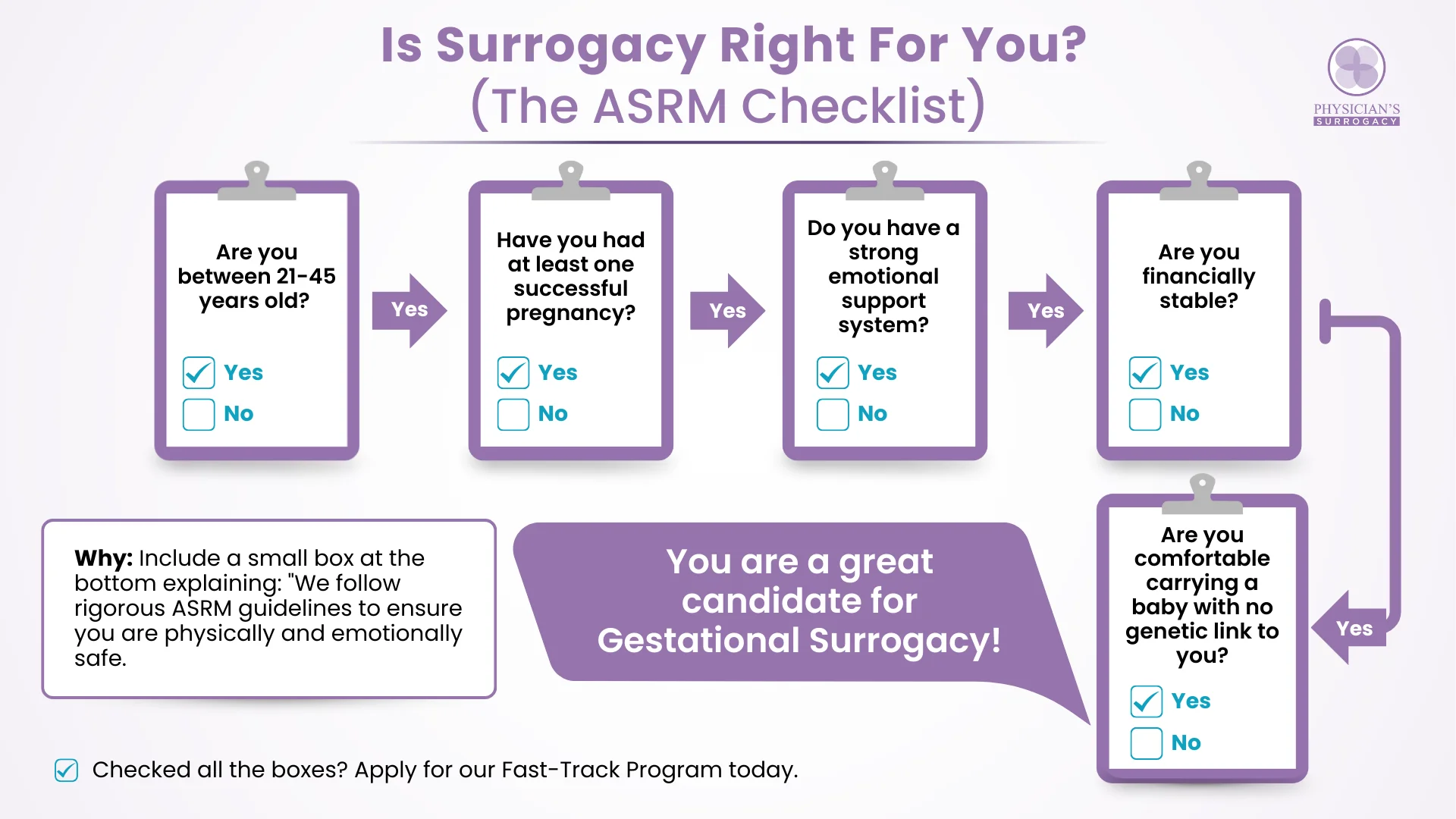
A gestational carrier is a type of surrogate who carries a pregnancy but has no genetic link to the baby. In everyday conversation, people say “surrogate” for both types, but medically and legally, “gestational carrier” is the more precise term.
Gestational surrogacy has become the predominant form of surrogacy in the United States and many other countries, accounting for approximately 95% of all surrogacy arrangements today.
In fact, here at Physician’s Surrogacy, this is the only type of surrogacy we facilitate, as it offers the highest level of safety and legal security for both our surrogates and intended parents.
In gestational surrogacy, the embryo is created using:
This lack of genetic connection is the cornerstone difference that shapes the entire gestational surrogacy process.
Gestational surrogacy requires In Vitro Fertilization (IVF), a more complex medical procedure that involves:
According to the American Society for Reproductive Medicine, this process requires careful synchronization of the carrier’s and egg provider’s cycles and typically takes 2-3 months of preparation before the embryo transfer.
There’s a big difference between gestational vs traditional surrogacy when it comes to the legal process.
Because the gestational carrier has no genetic link to the child, intended parents can often secure a pre-birth order. This legal document establishes them as the legal parents before the child is born, significantly simplifying the process.
A study published in the Journal of Human Reproductive Sciences notes that this clearer legal framework is a primary reason gestational surrogacy has become the preferred method.
However, it’s also important to understand that surrogacy laws vary significantly by state. Independent legal representation for both the intended parents and the gestational carrier is still essential.
Traditional surrogacy is the historical form of surrogacy that was more common before advances in reproductive technology made gestational surrogacy possible.
In traditional surrogacy, the surrogate is the biological mother of the child. Her egg is used in conception, creating a genetic link between her and the baby.
Traditional surrogacy typically involves Intrauterine Insemination (IUI), a significantly simpler and less costly medical procedure than IVF. The process includes:
This process more closely resembles natural conception and doesn’t require the extensive medical interventions associated with IVF.
Due to the higher legal and emotional risks, very few surrogacy agencies and fertility clinics facilitate traditional surrogacy today. This limited availability can lead to longer wait times and difficulties finding professional support for this path.
Termination of parental rights is one of the most important topics in surrogacy.
That said, it’s also where traditional surrogacy becomes significantly more complex. With gestational surrogacy, there is no biological link to the child, so the surrogate is legally not the parent of the child.
But because the surrogate is the biological mother in traditional surrogacy, she also has parental rights at birth that must be legally addressed:
This process carries a higher risk of legal complications if the surrogate changes her mind about relinquishing the child. These legal complexities and emotional risks have led to a significant decline in traditional surrogacy arrangements.
Here’s the quick comparison of gestational vs traditional surrogacy. If you only read one section, make it this one.
| Feature | Gestational Surrogacy (Our Standard) | Traditional Surrogacy |
| Genetic Link | No (Embryo transfer) | Yes (Biological mother) |
| Medical Procedure | IVF (Physician-Managed) | IUI (Artificial Insemination) |
| Legal Security | High (Pre-birth orders) | Low (Requires adoption) |
| Emotional Clarity | High | Low |
| Availability | The standard for top agencies | Rare / Independent only |
Beyond the medical and legal aspects, surrogacy – whether that’s gestational vs traditional surrogacy – involves profound emotional and ethical dimensions that deserve careful consideration.
Many people express discomfort with the concept of “renting another person’s body.” This is a valid concern that reflects deeper questions about bodily autonomy and potential power imbalances in surrogacy arrangements.
To address these concerns, the surrogacy field has developed rigorous screening processes. According to the American Society for Reproductive Medicine, ideal surrogacy candidates are:
All parties undergo extensive medical and psychological evaluations to ensure they are prepared for the surrogacy journey – and are entering the agreement with full agency and understanding.
The concern about “Maternal/Infant Separation Trauma” is grounded in the understanding that pregnancy creates powerful bonds.
As one person in our research expressed, “My desire for my child to be in existence is not a reason to separate them from their birth parent they had been bonding with for the last 9 months.”
This concern is particularly relevant in traditional surrogacy, where the genetic connection strengthens the biological bond. This is one reason why gestational surrogacy has become the preferred approach.
Research from the Journal of Human Reproductive Sciences suggests that a positive relationship between the carrier and intended parents is often a key factor in positive outcomes for all parties, including the child. Many modern surrogacy arrangements include some form of ongoing contact that honors the special role the gestational carrier played in bringing the child into the world.
The cost of surrogacy represents a significant barrier for many hopeful parents.
Gestational surrogacy is typically more expensive due to the costs associated with IVF, fertility medications, legal fees, and carrier compensation.
Costs can range from $90,000 to over $150,000 for gestational surrogacy, while traditional surrogacy might range from $60,000 to $100,000.
These costs vary based on:
Some families pursue altruistic surrogacy (where the surrogate receives reimbursement for expenses only) with a friend or family member to reduce costs, though this approach comes with its own emotional complexities.
Perhaps the most critical aspect of any surrogacy arrangement is establishing comprehensive legal protections for everyone involved.
A thorough surrogacy contract should address:
Luckily, good surrogacy agencies like Physician’s Surrogacy will make sure that everyone’s rights are protected.
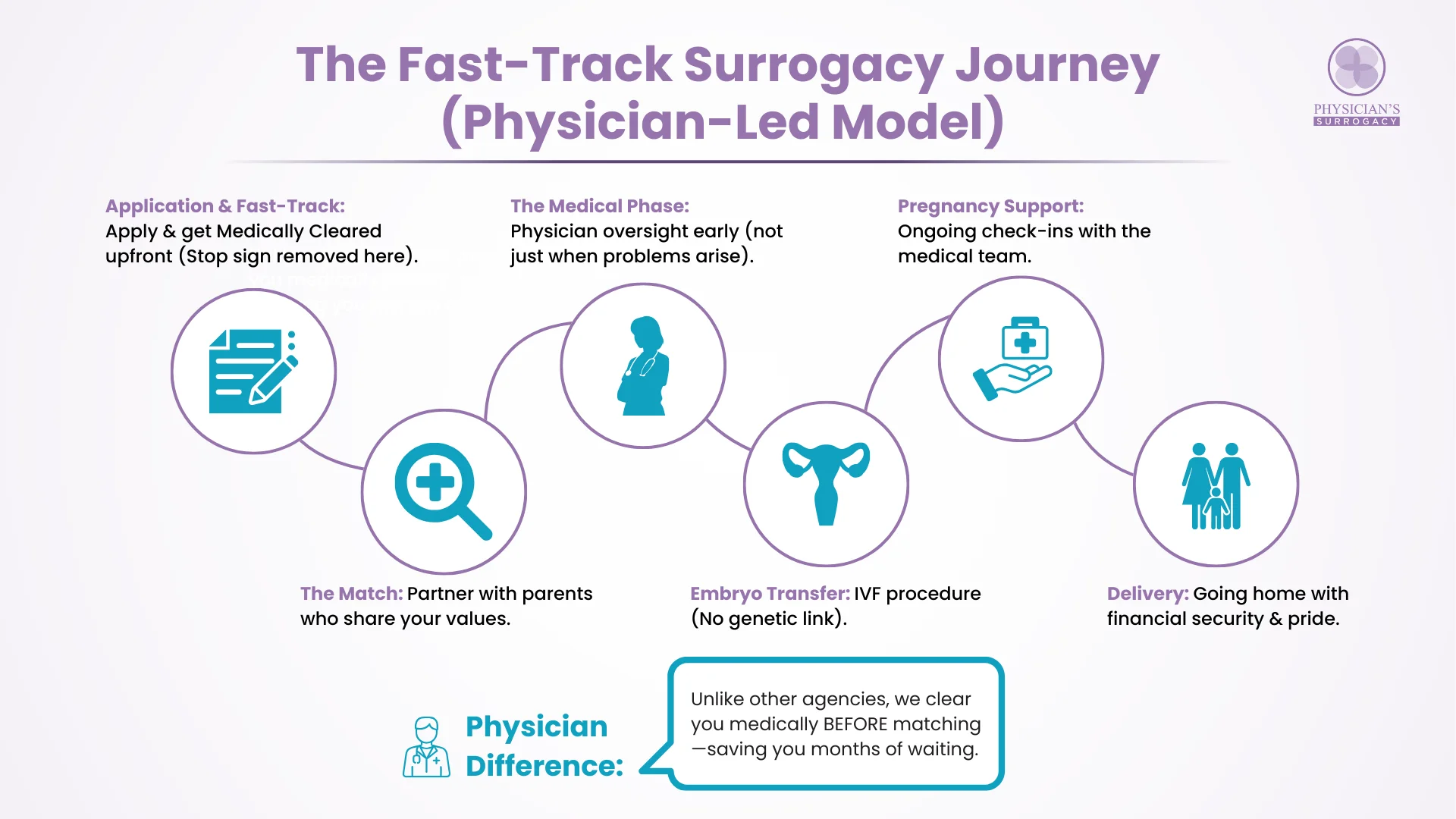
Becoming a surrogate is a big decision. It’s exciting, but it can also feel heavy. You’re not just signing up for appointments – you’re committing your time, your body, and your energy to help someone build a family.
So, you deserve a team that answers your questions like a human, treats your time with respect, and stays close to the medical side of the process from day one.
Here’s what makes our program at Physician’s Surrogacy different and why so many women feel confident doing this with us.
This is the biggest change in our program right now.
With our Medically Cleared Surrogates (Fast-Track) Program, you can move forward with fewer unknowns because key medical steps happen upfront, before you’re ever presented for matching.
Instead of matching first and then finding out months later that an IVF clinic won’t approve the journey, fast-track surrogates are fully screened and medically cleared upfront at our affiliate IVF center.
What does this mean in real life? Well, you’re not stuck in the “waiting black hole” that so many surrogates deal with. You get a clearer, more predictable path – with real momentum once you’re accepted.
Most agencies only loop in medical support when a problem shows up. Our model at Physician’s Surrogacy is different.
We’re physician-managed, which means medical oversight is built into your journey early (during pre-screening and throughout pregnancy planning), so issues can be caught earlier, with fewer surprises.
It’s a calmer experience when you feel like someone’s actually watching the full picture, not just reacting when something goes sideways.
You shouldn’t have to decode a payment structure or keep track of receipts like it’s a second job.
We moved away from the confusing “itemized reimbursement” approach. With us, your compensation package is clear, fixed, and high-value. You’ll know what you’ll be paid and when, without haggling or wondering what counts.
And with fast-track, there’s another practical upside: the process moves in a more defined way, so you’re not waiting around for months before anything starts.
Surrogacy asks a lot of you, so your support system matters.
We follow ASRM guidelines and go beyond them with our own screening so women in our program are medically and emotionally ready. You’re not doing this in isolation. You’re joining a community of surrogates who understand the decision you’re making: women who want to help families, and also want to feel safe and supported while doing it.
Choosing gestational surrogacy vs traditional surrogacy is personal, and it’s smart to think it through before you commit.
A fertility clinic and an experienced reproductive law attorney in your state can also help you understand what applies to you, since laws vary so much.
If you want the more medically structured route – with a clearer timeline and fewer late-stage surprises – gestational surrogacy paired with our fast-track, medically cleared model gives you a layer of predictability that’s rare in this space.
If you’re ready to explore gestational surrogacy with a physician-led team—and you want to ask about our Fast-Track (Medically Cleared) Program—we’d love to meet you!
Apply to Become a Surrogate Today and see if you qualify.
Gestational surrogacy means the surrogate is not genetically related to the baby. An embryo is created through IVF and transferred to the surrogate’s uterus. Traditional surrogacy means the surrogate is genetically related to the baby, because her egg is used (often through IUI).
That genetic link is the main reason traditional surrogacy can feel legally and emotionally more complicated.
Because it creates clearer boundaries for everyone. The surrogate isn’t using her own egg, so parentage is usually more straightforward (depending on the state). It’s also the route most fertility clinics, attorneys, and agencies support today because it reduces the risk of legal disputes compared to traditional surrogacy.
Surrogacy costs can vary a lot based on medical needs, insurance, legal requirements, and the surrogate’s compensation package. For gestational surrogacy, many intended parents budget roughly $90,000 to $150,000+ all-in.
Traditional surrogacy can cost less in some cases, but it’s much less common today because of the added legal and emotional risk.
A pre-birth order is a court document that can establish the intended parents as the baby’s legal parents before birth (in states where it’s allowed).
It’s one reason gestational surrogacy can feel more secure: it can help intended parents be recognized legally right away, without adoption steps after delivery.
At Physician’s Surrogacy, screening for who can become a surrogate is a big deal because it protects you. We also offer a fast-track (Medically Cleared) program for qualified candidates, where key medical clearance happens upfront, so you don’t get stuck waiting later.
Start simple: apply, and we’ll take it from there.
If you qualify, our team will walk you through each step—screening, education, matching, and medical coordination—so you’re never guessing what happens next. And if you’re a fit for our Medically Cleared program, we’ll explain what that looks like and how it can speed up the timeline in a more predictable way.
You’ve spent years trying to grow your family. IVF cycles, pregnancy losses, medical dead ends — and now surrogacy feels like the real path forward. But a fear sits right underneath the excitement: what if the surrogate changes her mind and wants to keep the baby?
It’s one of the most common questions intended parents ask, and the worry makes sense. Decades-old headlines about custody battles still echo in popular culture. But the legal landscape has changed dramatically since those early cases. If your surrogacy arrangement is structured correctly, a surrogate cannot back out and keep your child.
Here’s how we know that, why it’s true, and what Physician’s Surrogacy does to make sure it never becomes an issue for our families.
In a properly structured gestational surrogacy arrangement in a surrogacy-friendly state like California, a surrogate cannot back out and keep the baby. She has no genetic relationship to the child, the surrogacy contract is legally enforceable, and pre-birth parentage orders establish you as the legal parents before the child is born.
Quick Answer
In gestational surrogacy, the surrogate has no genetic link to your child and no legal claim to parentage. Under California Family Code §§ 7960–7962, your surrogacy agreement is presumptively valid and enforceable. A pre-birth parentage order names you — not the surrogate — as the legal parents from the moment of birth.
But the question deserves more than a one-line answer. If you’re about to entrust someone with carrying your child, you should understand exactly why the law protects you — and what went wrong in the rare cases where it didn’t.
Most of the anxiety around surrogates backing out traces back to a single case. In 1986, Mary Beth Whitehead agreed to carry a child for William and Elizabeth Stern using her own egg and William’s sperm. This was traditional surrogacy — Whitehead was the biological mother of the child.
After giving birth, Whitehead refused to hand over the baby. She fled to Florida with the child. The Sterns sued, and the case went all the way to the New Jersey Supreme Court. The court invalidated the contract but awarded custody to the Sterns based on the child’s best interests. Whitehead received visitation rights.
Baby M was a legal earthquake — and it’s the case that still fuels most of the fear around surrogacy today. But the detail most people miss is that Whitehead was the genetic mother of the child. She used her own egg. That’s traditional surrogacy, and reputable agencies haven’t used it in decades.
Seven years after Baby M, the California Supreme Court heard a very different kind of case — and the ruling reshaped surrogacy law for the next three decades.
Mark and Crispina Calvert hired gestational carrier Anna Johnson to carry a child conceived from their own egg and sperm. Johnson had no genetic relationship to the baby. Late in the pregnancy, she demanded full payment or refused to relinquish the child.
The Calverts sued. The California Supreme Court ruled unanimously in their favor, defining the legal mother as the woman who intended to create and raise the child — not the woman who carried and delivered the child.
Johnson v. Calvert is the foundation of gestational surrogacy law in California and has influenced courts across the country. The principle it established has held firm for over 30 years: intent determines parentage. If you contracted for a child to be created and raised by you, the child is legally yours.
Johnson v. Calvert wasn’t a one-off. The pattern has repeated consistently in every major gestational surrogacy dispute since — and the rulings keep getting clearer.
An Iowa couple hired a gestational surrogate who became pregnant with twins. One twin tragically died. After delivery, the surrogate refused to honor the agreement and claimed parental rights to the surviving child.
The Iowa Supreme Court enforced the contract, terminated the surrogate’s presumptive parental rights, and awarded full custody to the biological father. Iowa had no specific surrogacy statute at the time — yet the court still ruled decisively for the intended parents, writing that a contrary ruling would “deprive infertile couples of perhaps the only way to raise their own biological children.”
Gestational surrogate Melissa Cook carried triplets for a single intended father using donor eggs and his sperm. When the intended father asked Cook to reduce the pregnancy from three to two fetuses, she refused — and later sought parental rights herself, arguing that California’s surrogacy law was unconstitutional.
The courts upheld the contract and awarded sole custody to the intended father. Cook appealed all the way to the U.S. Supreme Court, which declined to hear the case. The message from the legal system was unambiguous: in gestational surrogacy, the intended parent’s rights hold.
Modern surrogacy doesn’t rely on a single safeguard. Your protection comes from multiple independent layers working together — each one strong enough on its own, and reinforced by the others.
A legally binding surrogacy contract signed before any medical procedures begin. It spells out parental rights, financial obligations, medical decision-making, and what happens in every conceivable scenario. Both parties have independent legal counsel.
Filed during the second trimester in surrogacy-friendly states. Under California Family Code §§ 7960–7962, this court order names you as the legal parents before birth. The surrogate and her spouse are formally declared not parents of the child.
The surrogate has no genetic relationship to your child. This biological fact is the foundation of every court ruling since 1993. Without a genetic claim, a surrogate has no standing to assert parental rights under any state’s parentage laws.
Before matching, surrogates undergo psychological evaluations to confirm they understand the process, feel emotionally prepared, and can relinquish the child after delivery. Research shows most surrogates don’t develop attachment the way many people assume — but screening catches the rare red flags that legal documents alone can’t.
We understand how much is on the line. You’ve waited years — sometimes a decade or more — to reach this point. The thought that anything could go wrong at the finish line feels unbearable. It’s a fear we take seriously, and it’s one we’ve built our entire program around preventing.
Physician-designed screening goes deeper than the industry standard. Physician’s Surrogacy is the only surrogacy agency in the U.S. managed by practicing OB/GYNs. Our physicians — not business administrators — design and oversee the screening process. Fewer than 8% of surrogate applicants pass. That selectivity covers medical fitness, psychological readiness, and a demonstrated history of stable, healthy pregnancies.
We only work with gestational surrogacy. Traditional surrogacy — where the surrogate provides her own egg — is the only arrangement where a surrogate has ever successfully claimed parental rights. We don’t do it. Your child is genetically yours (or your donor’s), carried by a surrogate with zero biological connection to the baby. You can read more about how the full process works on our site.
We match in an average of one week. Longer wait times create uncertainty on both sides. Our matching speed — compared to the industry standard of 6–12 months — means you move from consultation to signed contract faster, with less time for circumstances to shift on either side.
Pre-birth parentage orders are standard in our program. Because Physician’s Surrogacy is headquartered in California — one of the most surrogacy-friendly states in the country — your parental rights are established before delivery. Your names go on the birth certificate from day one. For families pursuing surrogacy from other states, our legal coordination team handles interstate legal requirements so nothing falls through the cracks.
Continuous medical oversight throughout pregnancy. Our OB/GYN team monitors clinical communications, coordinates with the surrogate’s managing obstetrician, and provides direct physician-to-physician consultations during complications. This medical-first model produces a preterm delivery rate 50% below the national average — and it means potential concerns are caught early, on both the medical and relationship side.
Not every state enforces gestational surrogacy agreements the same way. Some — like Michigan and Louisiana — restrict or prohibit compensated surrogacy. Others have no specific surrogacy statute and rely on court precedent, which can vary by county.
This is why agency choice matters so much. Physician’s Surrogacy operates from California, where surrogacy law is among the strongest and most protective in the nation. We coordinate surrogacy across states, but we structure every agreement to leverage the legal protections of surrogacy-friendly jurisdictions.
If you’re coming from a state with weaker surrogacy protections — or from outside the U.S. — our legal team maps out a parentage strategy specific to your situation before you sign anything. You’ll know where you stand legally before any medical procedures begin.
Baby M happened nearly four decades ago, in a form of surrogacy that reputable agencies no longer practice. Since then, the law has moved decisively — and consistently — in favor of intended parents in gestational surrogacy disputes.
Johnson v. Calvert, P.M. v. T.B., Cook v. Harding — every one of these cases ended the same way. Courts ruled for the intended parents, and the legal principle gets clearer with each decision: when the surrogate has no genetic connection to the child and the agreement was properly executed, the intended parents are the legal parents. Full stop.
We understand why this question keeps you up at night. After everything you’ve been through to get here, the idea of losing your child at the last stage feels like more than you could bear. That fear is real, and it deserves a real answer — not a pat reassurance.
Surrogacy sits at the intersection of modern medicine and profound human generosity. At Physician’s Surrogacy, we add OB-managed oversight on top of the legal protections, the contractual framework, and the screening process — because families like yours deserve nothing less than a physician-led team watching over every step. Hear from families who’ve been through it on our testimonials page.
Your family is worth that extra layer of care. We treat it that way.
!
You’ve thought about becoming a surrogate. You’ve researched compensation, screening, time commitment. But one question keeps coming back: what if the intended parents change their mind?
It’s a fair worry. You’d be carrying a child for someone else — and the idea that they might walk away mid-journey feels like a risk most agencies gloss over with vague reassurance.
We’re not going to do that here. Instead, we’ll look at what actually happens when intended parents back out, examine real cases where it went wrong, and explain the legal and financial protections that keep surrogates safe when the system works correctly.
Book your complimentary consultation →
Before we look at worst-case scenarios, some context. Most intended parents arrive at surrogacy after years of fertility treatments, pregnancy losses, or medical barriers. Surrogacy is rarely someone’s first choice — it’s usually the path they land on after everything else didn’t work.
That emotional commitment comes with a financial one. By the time embryo transfer happens, intended parents have already spent tens of thousands of dollars on agency fees, legal contracts, IVF procedures, psychological evaluations, and insurance arrangements.
Surrogacy attorney Andrew Vorzimer tracked 81 cases where intended parents changed their mind over the lifetime of the industry. That’s a tiny fraction of the thousands of surrogacy journeys completed in the U.S. each year.
So the short answer: it almost never happens. But “almost never” isn’t “never.” And that’s exactly why legal protections exist.
Headlines about intended parents backing out are rare — but when they happen, they’re dramatic enough to make national news. These cases shaped surrogacy law and give us a clear picture of what courts do when things fall apart.
TV host Sherri Shepherd and her husband Lamar Sally used a donor egg and a gestational surrogate to start a family. Midway through the pregnancy, their marriage collapsed. Shepherd tried to void the surrogacy agreement entirely.
She refused to sign the pre-birth order, skipped the delivery, and fought to keep her name off the birth certificate. She’d spent over $100,000 on the surrogacy process — and still attempted to walk away.
Courts didn’t let her. A Pennsylvania judge ruled the surrogacy contract was legally binding and declared Shepherd the child’s legal mother. She was ordered to pay $4,100 per month in child support. Her appeals — all the way to the Pennsylvania Supreme Court — failed.
The lesson for surrogates: this case proved that a well-drafted gestational surrogacy agreement (GSA) holds up even under extreme personal conflict between intended parents. Shepherd’s divorce didn’t release her from her obligations to the child — or to the surrogate who carried him.
Chinese actress Zheng Shuang and her partner hired two U.S.-based surrogates. When the couple’s relationship ended before the babies were born, Zheng tried to abandon both children. Leaked recordings captured her expressing frustration that it was too late for the surrogates to terminate the pregnancies.
Zheng’s ex-partner raised both children alone in the U.S. for over a year. The fallout destroyed Zheng’s career — Prada dropped her sponsorship, state media condemned her, and multiple TV shows were canceled. The Weibo hashtag about the scandal generated over 3 billion views.
This case shows what happens when surrogacy crosses international borders without strong legal frameworks. The U.S. surrogates in Zheng’s case had their contracts to fall back on, but the situation would have been far simpler if robust escrow and pre-birth parentage orders had been in place from the start.
An Australian couple hired a Thai surrogate who became pregnant with twins. When prenatal testing showed one twin had Down syndrome, the surrogate claimed the couple asked her to abort that child. She refused. The couple took the healthy twin sister back to Australia and left the boy behind.
The surrogate — a 21-year-old food vendor with two children of her own — was left to raise a child with complex medical needs on a salary that couldn’t cover his treatment. An online fundraiser raised over $240,000 for Baby Gammy’s care.
Thailand banned commercial surrogacy for foreigners the following year. This case is exactly why surrogacy-friendly U.S. states with strong contract enforcement and pre-birth orders exist — and why working in an unregulated jurisdiction puts surrogates at enormous risk.
A gestational surrogacy agreement (GSA) is more than paperwork. It’s a legally binding contract — signed before any medical procedures begin — that spells out exactly what happens in every scenario, including the unlikely one where intended parents back out.
Every properly drafted GSA includes provisions for financial obligations regardless of relationship status changes, the intended parents’ responsibility for all medical and pregnancy-related expenses, what happens if intended parents become incapacitated or pass away, and liquidated damages clauses for breach of contract.
Both the surrogate and the intended parents must have separate, independent legal counsel. Your attorney works only for you — their job is to make sure the agreement protects your rights, your compensation, and your health. If you want to understand more about what a typical surrogate contract covers, we’ve written a full breakdown.
Quick Answer
If intended parents back out after the surrogacy contract is signed, they are still legally and financially responsible for the child, your compensation, and all pregnancy-related expenses. Escrow funds are secured before embryo transfer, and courts consistently uphold surrogacy agreements in surrogacy-friendly states like California.
One of the most concrete protections in modern surrogacy is the independent escrow account. Before embryo transfer begins, intended parents deposit funds into a third-party escrow account that covers your full compensation, monthly allowances, medical expenses, and reimbursements.
The money isn’t sitting in the intended parents’ bank account where they could decide not to pay. It’s held by an independent escrow company, released to you on a set schedule regardless of what’s happening in the intended parents’ personal lives.
This is why escrow fraud cases — like the SEAM case in Houston, where missing surrogate funds led to over $1 million in court-ordered penalties — get so much attention. When escrow fails, surrogates are exposed. A properly funded and independently managed escrow account removes that risk entirely.
In California and other surrogacy-friendly states, intended parents obtain a pre-birth parentage order during pregnancy — typically around the second trimester. This court order establishes them as the child’s legal parents before the baby is even born.
Under California Family Code §§ 7960–7962, gestational surrogacy agreements are fully enforceable. Once a pre-birth order is issued, the intended parents’ names go directly on the birth certificate at delivery. The surrogate has no parental rights or duties, and the intended parents cannot disclaim theirs.
This is the legal mechanism that prevented Sherri Shepherd from walking away. And it’s the mechanism that makes domestic surrogacy in states like California, Nevada, and Connecticut far safer than international arrangements without equivalent legal infrastructure. For a broader look at how surrogacy laws vary across the country, we’ve compiled a state-by-state guide.
At Physician’s Surrogacy, we’ve built protections into every stage of the journey — not just the legal stage. Here’s what that looks like in practice.
We’re the only agency in the U.S. managed by practicing OB/GYNs. Our physicians screen intended parents for medical readiness before matching — not just surrogates. This filters out uncommitted or unprepared IPs before you ever meet them.
Every surrogate in our program works with her own attorney — paid for by the intended parents. Your lawyer reviews the surrogacy agreement and makes sure every protective clause is in place before anything medical begins.
Intended parents fund an independent escrow account before embryo transfer. Your full compensation — $55,000–$75,000+ — along with allowances and medical expenses, is secured and disbursed on a fixed schedule.
Our multilingual coordinators are available around the clock. If you have questions or concerns at any point — about your IPs, your contract, or your payments — you have direct access to someone who can intervene immediately.
Gestational surrogacy is one of the most medically sophisticated ways a family can be built — and one of the most human. We take the “what ifs” seriously because the women in our program deserve real answers, not vague comfort.
No matter which agency you work with, ask these questions before embryo transfer. They’re the clearest indicators of how well you’ll be protected if anything goes sideways.
Weighing surrogacy pros and cons is an important part of this decision. The more informed you are before signing, the stronger your position throughout the journey.
The cases that make headlines — Shepherd, Zheng Shuang, Baby Gammy — all share a pattern. Weak legal infrastructure, insufficient escrow protections, or unregulated international jurisdictions left surrogates exposed.
That’s not what surrogacy looks like when it works correctly. In a well-structured domestic surrogacy arrangement with enforceable contracts, pre-funded escrow, pre-birth parentage orders, and dedicated legal counsel, the risk of being left unprotected approaches zero.
At Physician’s Surrogacy, our physician-led model adds another layer. OB/GYN oversight means our screening process — which fewer than 8% of applicants pass — catches potential issues with surrogates and intended parents that business-only agencies miss.
You deserve to go into this journey with your eyes open and your protections locked in. The right agency will welcome your hardest questions — because they’ve already built the answers into the program.
!
You’ve made the incredible decision to become a surrogate. You’re excited about helping create a family and the journey ahead. But what happens when the intended parents start texting you multiple times daily about what you’ve eaten, or seem concerned every time you mention taking a walk?
This isn’t uncommon. Many surrogates find themselves dealing with anxious intended parents who become overprotective about diet, activities, and lifestyle choices during pregnancy.
For a smoother experience, learning about managing intended parents and their feelings matters. Their concern often comes from love and longing, but it can still feel overwhelming when you’re dealing with overprotective intended parents.
Before we talk about managing intended parents, it helps to understand where this anxiety comes from. For many intended parents, the path to surrogacy has been paved with disappointment, loss, and emotional trauma.
Many have experienced:
★
Research shows that people who pursue surrogacy after infertility often carry emotional scars that can show up as intended parent anxiety during the pregnancy.
This anxiety commonly shows up in a few ways. Recognizing the pattern helps you respond with empathy, without giving up your boundaries.
Many anxious intended parents become highly focused on your diet, exercise, sleep, and daily activities. It can feel like scrutiny, but it’s often their attempt to reduce fear in a situation they can’t fully control.
Another common behavior is researching every symptom and potential complication, sometimes catastrophizing minor issues. For some intended parents, “if I know everything, nothing bad will happen” becomes a coping strategy.
This can also manifest as excessive monitoring, such as requesting frequent updates, asking for additional ultrasounds, or wanting to attend every appointment. Their involvement can be meaningful, but it still needs to respect your autonomy.
Finally, many live with what one intended parent described on Reddit as “waiting for the other shoe to drop.”
When you remember this behavior usually comes from fear, not distrust, managing intended parents becomes less personal and more practical.
As a surrogate, you have both the right and responsibility to maintain healthy boundaries while still being supportive of the intended parents’ emotional needs. Here’s how to strike that balance.
When overprotective behavior starts to feel uncomfortable, address it directly but with compassion.
“I understand you’re concerned about the baby’s wellbeing. I want you to know I’m taking this responsibility very seriously. Let’s talk about how we can keep you informed while still making this journey comfortable for both of us.”
Clear communication from the start helps prevent resentment from building up. Try to:
Here at Physician’s Surrogacy, we’ve found that surrogates who share proactive updates often experience less hovering from intended parents. You might:
One surrogate shared on Reddit, “I started sending a short weekly email with any updates about how I was feeling and upcoming appointments. It really helped my intended parents feel connected without them feeling the need to check in constantly.”
Work together on a structured communication plan that feels fair for everyone:
★
A plan like this is one of the most effective tools for managing intended parents because it gives them predictable access to information, which can reduce anxiety-driven check-ins.
If boundaries keep getting crossed, involve your coordinator at Physician’s Surrogacy. As an OB-managed agency, we’re equipped to support both the emotional and medical side of these moments.
Our team can:
You’re not meant to manage this alone. Support is part of the process.
Want a Surrogacy Journey With Real Support?
At Physician’s Surrogacy, our OB-managed team helps you build a strong, respectful partnership with your intended parents—without sacrificing your comfort or autonomy.
This article is written for surrogates, but intended parents read these topics too. If you see yourself in the patterns above, these strategies can help you manage anxiety without putting pressure on your surrogate.
Taking care of your mental health isn’t selfish. It’s part of showing up well in the journey:
Many intended parents find relief in talking with others on a similar path. It helps normalize the fear and gives you coping tools that don’t rely on monitoring your surrogate.
Focus on what you can control:
The healthiest journeys happen when surrogates and intended parents work as a team.
A supportive agency also makes a real difference in keeping the relationship steady.
At Physician’s Surrogacy, we take a proactive approach to these dynamics. As the nation’s only OB-managed surrogacy agency, we provide:
★
Surrogates benefit from clear expectations and professional guidance, while intended parents get medical reassurance that can reduce anxiety.
A successful surrogacy journey is built on empathy and clear communication. Intended parent anxiety often comes from past trauma, not a lack of trust.
You can build confidence for everyone by setting boundaries and offering proactive updates. One of the best tools for managing intended parents is a communication plan that feels supportive and respectful.
At Physician’s Surrogacy, we’re here to support you every step of the way. Our OB-managed approach provides medical reassurance and expert guidance that helps create a healthy, positive relationship between you and your intended parents.
The main reason intended parents get anxious is often past trauma from infertility, loss, and the high emotional stakes of the journey. Their worry usually comes from fear, not a lack of trust in you.
You can set boundaries without hurting feelings by communicating with kindness and empathy. Acknowledge their concerns first, use “I” statements to share your needs, and create a plan that works for both of you.
If intended parents text too much, create a communication plan. Suggest a regular check-in time (like a weekly call or an after-appointment update) so they feel reassured without constant texts.
Yes, it’s normal to feel guilty when setting boundaries as a surrogate. Healthy boundaries protect your well-being and help the journey stay positive and sustainable for everyone.
You should involve your agency if you’ve communicated your needs and boundaries are still being crossed. An agency can mediate and help reinforce the communication plan you agreed on.
Providing proactive updates helps anxious intended parents by reassuring them before they feel the need to ask. A short weekly update or a quick post-appointment text can reduce worry and constant check-ins.
The best way to start is collaborative and positive. You can say, “To make sure we’re both comfortable, let’s create a communication plan together. How would you feel about a weekly update call?”
You’ve been thinking about becoming a surrogate. Maybe it’s the generous compensation that caught your attention first, or perhaps it’s the profound desire to help someone build their family.
Now you’re faced with a crucial decision in the independent surrogacy vs agency debate: do you work with an established agency like us at Physician’s Surrogacy, or do you pursue an independent arrangement directly with intended parents?
This choice of independent or agency for surrogacy can feel overwhelming. Let’s break down both paths – exploring the independent surrogacy benefits and risks – so you can make the best decision for your surrogacy journey.
!
When you partner with a surrogacy agency, you’re gaining access to a complete support system designed to handle all aspects of your surrogacy journey.
Agencies are designed to take the administrative and legal weight off your shoulders. Here is a breakdown of the specific services you can expect:
Agencies conduct thorough medical, psychological, and background screenings upfront. At Physician’s Surrogacy, our OB-managed approach means medical professionals guide your screening process from day one.
This not only protects you but also helps match you with compatible intended parents who share your values and expectations. One surrogate shared on Reddit, “An agency provides the necessary care and support throughout the period, as needed.”
Agencies work with experienced reproductive attorneys who draft legally sound contracts protecting your rights, responsibilities, and compensation. Your payments are typically held in escrow accounts, meaning your compensation is secured before the journey even begins.
As one surrogate warned on Reddit, “You don’t have any protection if something goes bad that you would have if you went with a reputable agency.” Operating within a strictly regulated, agency-managed legal framework also ensures you are completely protected ethically, keeping you safe from the risks often raised in the human trafficking vs paid surrogacy debate.
Perhaps the most valuable aspect of agency support is having dedicated professionals to guide you through every step.
From coordinating medical appointments to providing emotional counseling and handling communication with intended parents, agencies serve as your advocate throughout the process.
One surrogate emphasized on Reddit, “It’s important to have a really solid support system during a surrogacy.”
Figuring out if you are emotionally ready for surrogacy is much easier when you have a dedicated team evaluating and supporting your mental health.
★
While agencies provide safety and structure, this path isn’t without its potential downsides, depending on your personality type.
Independent surrogacy involves connecting directly with intended parents without an agency’s mediation. You’ll work together to coordinate with fertility clinics, attorneys, and other professionals throughout the process.
There are several reasons why some women prefer to manage the process themselves.
Conversely, navigating this path alone presents specific challenges and requires a high level of organization.
If you decide to pursue an independent journey, you will need to be proactive in finding a match.
Here are the most common ways independent surrogates connect with families:
If you choose the independent route, do not skip these critical protections:
★
Here at Physician’s Surrogacy, we’ve created a unique model that combines the best of both worlds: the professional support of an agency with the personalized care of a medical practice.
When weighing independent surrogacy vs agency, ask yourself the following questions to clarify your preferences:
Most first-time surrogates find that the structured support, legal protection, and financial security of agencies like Physician’s Surrogacy provide valuable peace of mind. The mental and physical demands of surrogacy are significant, and having experts in your corner can make all the difference.
Deciding on independent or agency for surrogacy is a major decision. The independent surrogacy vs agency choice depends on your need for support versus your desire for control.
An agency provides a structured, secure process, while an independent route offers autonomy but requires you to manage every detail.
At Physician’s Surrogacy, our unique OB-managed approach provides the security of an agency with the dedicated medical oversight you deserve.
If you’re ready to take the next step with a team that prioritizes your health and well-being, we invite you to learn more. Start your application today and begin your journey with confidence.
The main difference is the level of support. Agencies provide comprehensive services, including legal, medical, and emotional support. Going independent means you manage everything yourself but have more direct control.
Surrogacy agencies protect you financially by using a third-party escrow account. This makes sure your compensation and reimbursements are secured before you begin the process, protecting your funds throughout the journey.
The main independent surrogacy cons are the increased personal responsibility and higher risk. You are responsible for coordinating all medical, legal, and financial aspects, and you lack the professional oversight and protection that an agency provides.
When considering independent or agency for surrogacy, most first-time surrogates choose an agency for the comprehensive support and security it provides. The legal protection and structured process help remove the uncertainty and stress of managing a complex journey for the first time.
The biggest independent surrogacy benefits are direct control and a closer relationship with the intended parents. You have more say in decisions and can communicate directly, which many surrogates find very rewarding.
Surrogate compensation varies, but with an agency like Physician’s Surrogacy, base pay starts from $48,000 and can reach $75,000. Experienced surrogates can earn up to $95,000, not including other benefits and reimbursements.
Yes, you can be a surrogate even if you don’t know intended parents. Surrogacy agencies specialize in matching you with compatible parents. If you go independent, you can find parents through online communities and matching platforms.
Copyright 2026 © All rights reserved