
You’ve probably spent months — maybe years — on fertility treatments that didn’t work out. And now you’re Googling “surrogate mother San Diego” at midnight, wondering what comes next.
Good news: San Diego is one of the strongest surrogacy cities in the United States. California’s legal protections, a deep pool of pre-screened surrogates, and access to top-tier reproductive clinics all work in your favor here.
But finding the right surrogate mother in San Diego still depends on knowing how the process works, what to look for in an agency, and where the real risks hide. This guide walks through each step so you can move forward with confidence instead of guesswork.
Not all surrogacy-friendly cities are created equal. San Diego combines three things that matter most: airtight legal protections, a deep medical infrastructure, and a large, active surrogate population.
Quick Answer
San Diego sits inside California — the most surrogacy-friendly state in the U.S. Intended parents here can obtain pre-birth parentage orders that place their names on the birth certificate at delivery, regardless of genetic connection, marital status, or sexual orientation.
California was one of the first states to pass surrogacy-specific statutes. Under California Family Code §§ 7960–7962, gestational surrogacy agreements are legally enforceable when both parties have independent legal counsel and the contract is signed before any medical procedure begins.
Pre-birth parentage orders are standard practice in San Diego County. If you’re working with a surrogate mother in San Diego, courts process these orders during pregnancy — often without a hearing — so there’s no custody ambiguity at the hospital.
This framework treats single parents, LGBTQ+ couples, and international parents equally. It’s one reason families fly in from around the world specifically to work with San Diego agencies.
San Diego is home to multiple nationally ranked In Vitro Fertilization (IVF) clinics. San Diego Fertility Center has been operating since 1989 and manages hundreds of surrogacy cases annually. Reproductive Sciences Medical Center (RSMC) specializes in complex third-party reproduction.
The density of experienced reproductive endocrinologists in one metro area means shorter wait times for embryo transfers and more options if your first clinic isn’t the right fit.
Physician’s Surrogacy, headquartered in San Diego, is the only surrogacy agency in the country managed by practicing OB/GYNs. Their in-house physicians design surrogate screening protocols, monitor clinical communications, and consult directly with a surrogate’s managing OB if complications arise.
The process isn’t complicated, but it does have a specific sequence. Skipping steps — especially the legal ones — creates problems that cost time and money later.
Compare San Diego surrogacy agencies on screening rigor, match timelines, pricing transparency, and medical oversight. Ask each agency directly: who designs your surrogate screening protocol?
Most agencies offer a free first consultation. Use this to understand their pricing model, ask about total surrogacy costs, and evaluate how transparent they are about fees.
Your agency presents surrogate profiles that align with your preferences. You’ll review health histories, motivations, and lifestyle factors before accepting a match.
Both parties hire independent attorneys to draft and review the gestational carrier agreement. California law requires this step before any medical procedure begins.
Your surrogate undergoes medical and psychological screening at the IVF clinic. Once cleared, the embryo transfer is scheduled. Some agencies offer pre-screened surrogates who’ve already completed this step.
Your attorney files a parentage petition during the pregnancy. In San Diego County, this is processed before delivery — your names go on the birth certificate from day one.
The agency you choose affects every part of your journey. It determines how your surrogate is screened, how quickly you match, how disputes get handled, and who’s monitoring the medical side.
Most surrogacy agencies are run by former surrogates, social workers, or business operators. They coordinate the logistics — matching, legal referrals, escrow management — but they don’t have medical professionals on staff.
That means nobody with clinical training reviews screening results, monitors clinical communications, or intervenes during complications. Your surrogate’s managing OB handles the medical side independently.
Physician’s Surrogacy runs on a different model. In-house board-certified OB/GYNs design the screening protocol, review every surrogate’s medical history, and provide peer-to-peer consultations with a surrogate’s local OB when questions come up. That clinical backbone is the reason their preterm delivery rate sits 50% below the national average.
The American Society for Reproductive Medicine (ASRM) publishes screening guidelines for gestational carriers. These cover medical history, infectious disease testing, psychological evaluation, and lifestyle assessment.
ASRM guidelines are a baseline, not a ceiling. Some agencies accept surrogates who meet the minimum. Others — particularly those with physicians on staff — go beyond ASRM recommendations with more thorough medical evaluations and pregnancy history reviews.
At Physician’s Surrogacy, only about 8% of applicants pass the physician-designed screening protocol. Intended parents only ever match with surrogates who’ve already cleared that bar.
Surrogacy pricing should never be a guessing game. Ask each agency for a written breakdown of all costs before you sign anything.
Key items to confirm: when agency fees are due, what’s included in surrogate compensation, how escrow is managed, and if you’ll pay additional charges for travel, maternity clothing, or lost wages.
Physician’s Surrogacy uses a Flat-Rate Surrogacy model starting at $140,000–$170,000+, with no agency fees charged until a match is confirmed. That structure removes the financial risk of paying up front for a match that hasn’t happened yet.
If you’re budgeting for a surrogate mother in San Diego, expect California-level pricing. The premium reflects stronger legal protections, higher-caliber medical care, and compensation levels that attract experienced surrogates.
| Cost Category | Typical Range | Notes |
|---|---|---|
| Agency fees | $20,000–$35,000 | Covers matching, screening, case management |
| Surrogate compensation | $55,000–$75,000+ | Varies by experience and location |
| IVF and medical care | $30,000–$50,000 | Includes embryo creation, transfer, prenatal care |
| Legal fees | $10,000–$15,000 | Contract + pre-birth order for both parties |
| Insurance | $6,000–$25,000+ | Depends on surrogate’s existing coverage |
| ESTIMATED TOTAL | $150,000–$200,000+ | California ranges higher than most states |
* Insurance is the biggest variable. Have your surrogate’s policy reviewed by a specialist before matching — California is a lien state, and the wrong policy can add five figures to your total.
States with strong surrogacy statutes tend to cost more. California sits at the top of that list because its legal framework, fertility clinic density, and surrogate compensation levels all run higher than the national average.
But that premium buys something specific: legal certainty. Pre-birth parentage orders, enforceable contracts, equal treatment for all family structures, and a judiciary that has 30+ years of surrogacy case law behind it.
Families who choose cheaper states sometimes face unpredictable courts, post-birth adoption requirements, or parentage orders that aren’t recognized internationally. Those risks don’t exist in California.
Your agency will set up an introductory meeting once you’ve been matched. This isn’t a job interview — it’s a conversation between two people who’ll share one of the most profound experiences of their lives.
Come prepared with specific questions, but also leave room for genuine connection. Surrogacy sits at the intersection of modern medicine and profound human generosity. The relationship you build with your surrogate affects the entire journey.
This works both ways. Your surrogate wants to know who she’s carrying a baby for. Share your family story. Talk about why surrogacy is your path and what this child means to you.
Surrogates who feel connected to the intended parents report a more positive experience overall. When you find a surrogate mother in San Diego who shares your values and communication style, that connection starts in this first meeting — and it sets the tone for the months ahead.
California makes the legal side of surrogacy more straightforward than most states. But “straightforward” doesn’t mean “optional.” Skipping or rushing legal steps creates complications that can delay delivery room decisions.
Every surrogacy journey in California starts with a written contract signed before any medical procedure. Under California Family Code § 7962, this agreement must spell out compensation terms, medical care expectations, parental rights, insurance responsibilities, and contingency plans.
Both you and your surrogate must have separate attorneys — California surrogacy law requires independent legal counsel for each party. That adds cost but protects everyone involved.
In San Diego, your attorney files a parentage petition during the second trimester. The court issues an order — usually without a hearing — that recognizes you as the legal parents before birth.
That order goes to the hospital. When your baby arrives, your names appear on the birth certificate immediately — with no adoption required, no second hearing, and zero ambiguity about who the parents are.
International parents benefit here too — California’s pre-birth orders are recognized by many countries, which simplifies citizenship and travel documentation.
Think of the first meeting as the beginning of a partnership. Your agency has already confirmed this surrogate mother in San Diego meets medical and psychological standards. Now you’re both deciding if the human fit is right.
Write down your top three priorities before the meeting. Maybe it’s communication frequency, comfort with medical appointment attendance, or her views on delivery room preferences. Having a short list keeps the conversation focused without making it feel scripted.
Share your own story too. Tell her why you chose surrogacy, what your family looks like right now, and what this child means to you. Gestational surrogacy is one of the most medically sophisticated ways a family can be built — and one of the most human. That shared understanding starts here.
Most intended parents focus on costs and timelines. Those matter. But the question that separates a good surrogacy experience from a great one is this: who’s actually managing the medical side of your journey?
At most agencies, the answer is nobody with a medical degree. Coordinators handle logistics, and the surrogate’s local OB manages care independently. There’s no clinical review, no monitored reporting, and no physician intervention if something falls between the cracks.
Physician’s Surrogacy exists because that gap matters. In-house OB/GYNs review every surrogate’s screening results, monitor clinical communications after every appointment, and provide peer-to-peer consultations with the surrogate’s managing OB when complications arise. That oversight produces measurable results: a preterm delivery rate 50% below the national average.
If you’re comparing agencies for your surrogate mother search in San Diego, schedule a consultation and ask who’s on the medical team. The answer should be a physician — not a coordinator reading from a checklist.
Schedule A ConsultationTaking a GLP-1 medication and feeling called to become a surrogate can put you in a frustrating position. Many women worry they’ll be turned away immediately, or they get stuck trying to decode conflicting advice online about timing, washout rules, and side effects.
Those concerns are understandable. Surrogacy has a real medical timeline, and glucagon-like peptide-1 (GLP-1) receptor agonists come with real clinical considerations. At Physician’s Surrogacy — the nation’s only OB-managed surrogacy agency — our in-house physicians review each candidate’s full health profile, including any current or recent medications, so nothing falls through the cracks.
The good news: GLP-1 medication and surrogacy can absolutely be discussed and planned safely, as long as you are upfront and guided by your care team. This guide walks through how these medications affect your application, the mandatory timelines for safety, and what to expect at every stage.
Quick Answer
Yes — you can apply and be screened. Current or past GLP-1 use is not an automatic disqualifier. Most clinics will require you to stop the medication before embryo transfer, and timing will depend on the specific drug and your clinic’s protocol. Full disclosure during your initial screening is required.
Many potential surrogates are surprised to learn that past or current GLP-1 use is not an immediate “no.” These medications are common, and many women interested in surrogacy are currently using them or have recently stopped.
Programs ask about GLP-1s because surrogacy involves structured pregnancy planning, medical clearance, and careful clinical monitoring. Some surrogates have used GLP-1s to work toward a qualifying Body Mass Index (BMI) before applying — that kind of proactive health management is exactly what our physician-led team looks for.
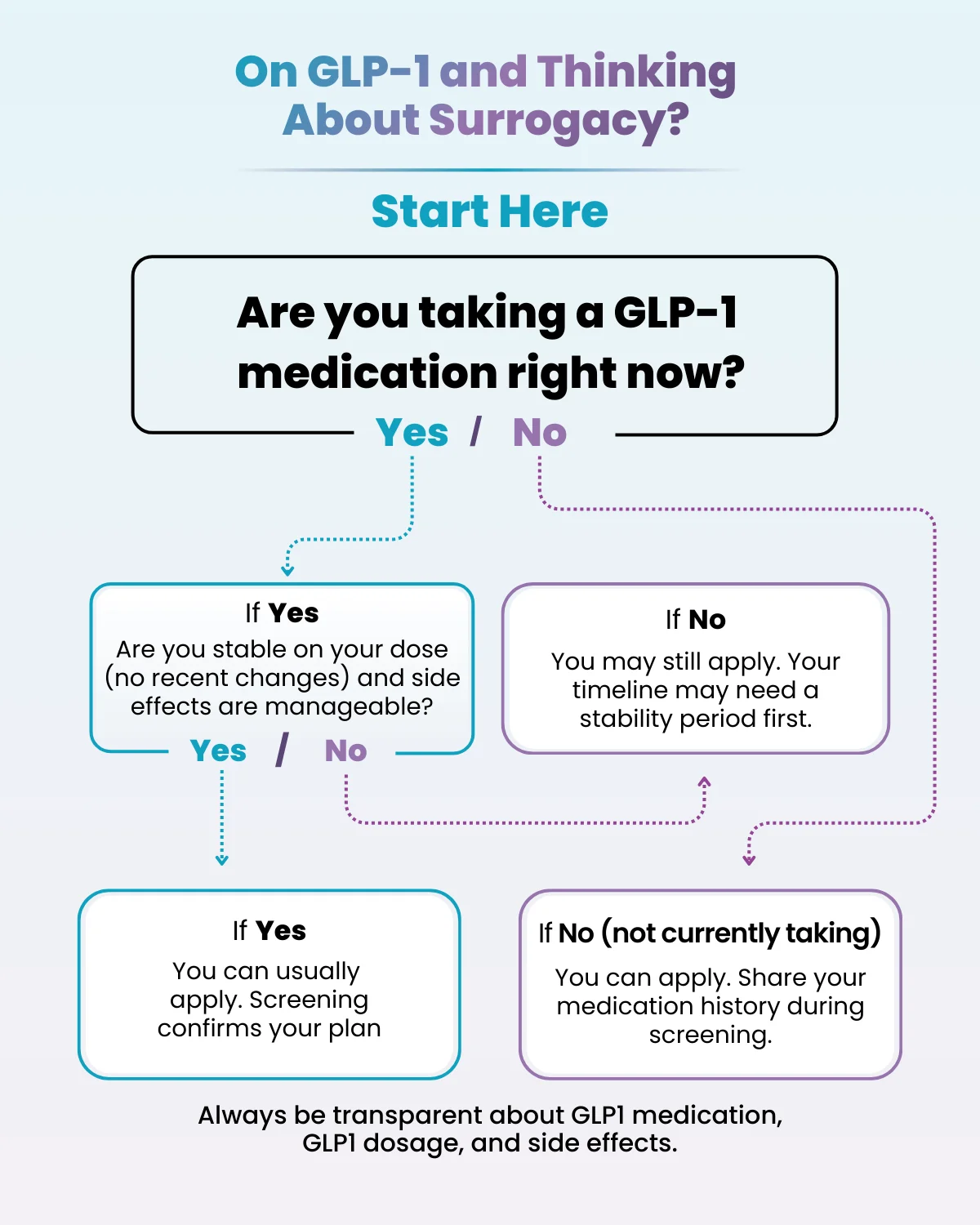
GLP-1 medications (glucagon-like peptide-1 receptor agonists) are a class of drugs used to treat type 2 diabetes and, increasingly, for weight management. Common brand names include Ozempic, Mounjaro, Wegovy, and Zepbound. They have changed how clinicians approach metabolic health — and that shift has brought them into the surrogacy conversation too.
A few terms you may encounter during screening:
When you apply to Physician’s Surrogacy, our medical team reviews your complete health profile to confirm you are a safe candidate for pregnancy. For candidates on GLP-1s, a few specific factors come into focus.
Surrogacy and everyday weight management are different goals. In everyday life, you might stay on a GLP-1 long-term. In surrogacy, the goal is pregnancy readiness. Because you are carrying for another family, fertility clinics use a more cautious approach — especially around medications where pregnancy safety data is still developing.
This section matters most for your timeline. Pregnancy planning drives every decision in surrogacy preparation, and your GLP-1 use will affect that calendar in a specific way.

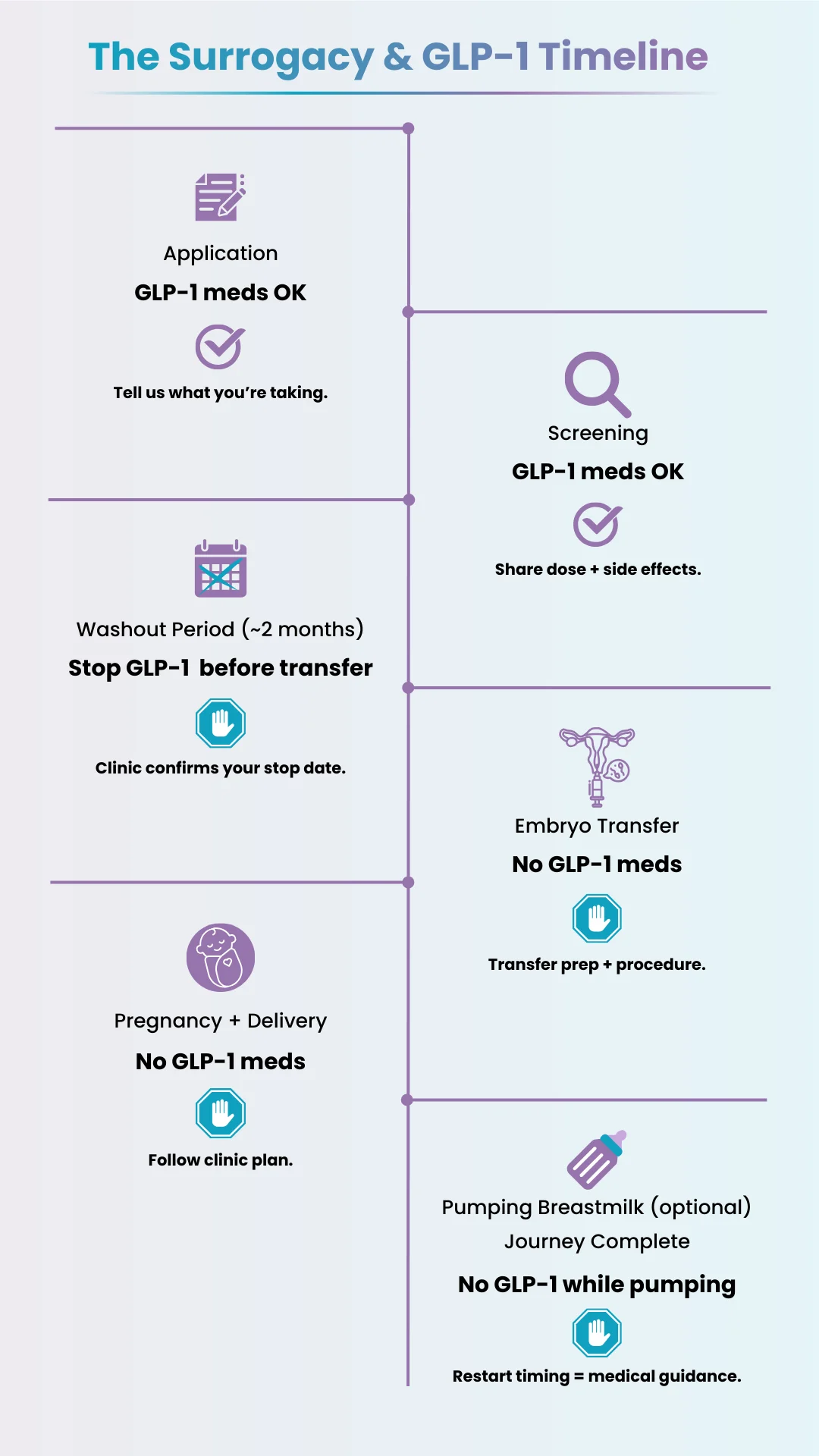
Unlike a personal pregnancy — where you might stop medication the day you get a positive test — surrogacy requires stopping weeks in advance. The plan is made ahead of time, with your prescribing physician and fertility clinic in agreement.
Many fertility clinics require surrogates to stop GLP-1 receptor agonists before embryo transfer. In practice, this washout period is often around two months, but the exact timing depends on the specific medication and your clinic’s protocol. The drug stays in your system for weeks after the last dose, so stopping earlier helps reduce fetal exposure during early development.
A large cohort study published in JAMA Internal Medicine (2024) analyzed pregnancies with GLP-1 exposure. While researchers did not find a dramatic increase in malformations compared to insulin use, they urged caution due to uncertainty and limited safety data on newer drugs. That caution is reflected in how most fertility clinics approach this medication class.
During surrogacy preparation, surrogates typically take birth control pills to synchronize their cycle with the intended mother or egg donor. GLP-1 medications can interact with this step in a specific way.
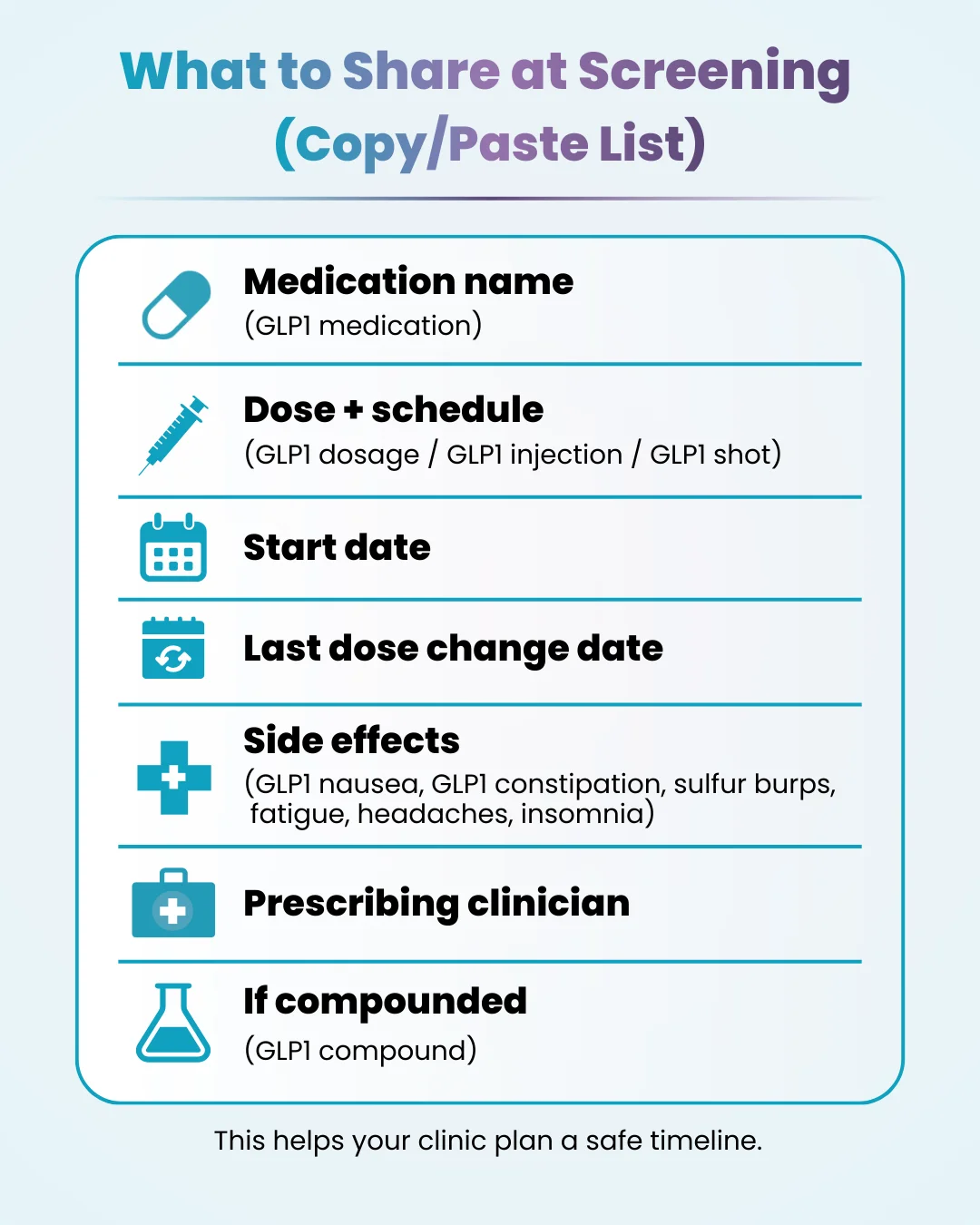
Some reports suggest that the slowed digestion caused by GLP-1s may affect the absorption of oral birth control pills, potentially leading to breakthrough ovulation. Your team will want your exact medication plan documented so cycle timing stays accurate. In some cases, a non-oral birth control method may be recommended during preparation.
Moving through clearance smoothly starts with documentation. Having this information ready before your first appointment keeps the process moving.
Surrogacy doesn’t always end at delivery. Some surrogates choose to provide breast milk for the intended parents for a period after birth. If pumping is part of your plan, GLP-1 restart timing is an important postpartum consideration.
Right now, data on GLP-1 transfer into breast milk and possible effects on an infant is limited. A 2024 study in The BMJ examined infant outcomes related to GLP-1 exposure in early pregnancy. While that study did not focus on lactation transfer specifically, the overall lack of lactation-specific evidence is one reason many clinicians recommend postponing restart until breastfeeding or pumping ends.
If pumping is part of your plan, raise it early so your medical team can factor it into your postpartum timeline.
Your physical comfort is a priority. Some GLP-1 side effects can overlap with — or worsen — early pregnancy symptoms, and your team will want a stable baseline before moving forward with clearance.
Psychological screening is a required part of surrogacy. Being open about your mental health allows the team to support you properly.
If you have a history of pancreatitis or notice sudden vision changes, disclose it right away. These issues are uncommon with GLP-1 use, but your medical team needs the full picture before pregnancy clearance can proceed.
Cost questions come up often, especially for candidates who pay out of pocket or have switched pharmacies. For surrogacy screening purposes, what matters most is stability and clear documentation.
Walking into your consultation prepared makes your path clearer — and it demonstrates to your team that you take the process seriously.
Being on a GLP-1 medication often means you have been investing seriously in your health — and that commitment matters in surrogacy. It does not cancel your ability to help another family build theirs. It simply means your timeline needs careful planning so you feel stable and supported before pregnancy begins.
At Physician’s Surrogacy, our OB/GYN-led team is specifically equipped to guide you through these medical decisions. We review GLP-1 use as part of our physician-designed screening process, coordinate directly with your prescribing doctor, and build a plan around your health — not around a generic checklist. That level of clinical oversight is only possible because our physicians run the agency itself.
You do not have to figure out the timing on your own. If you are ready to find out whether you qualify, reach out to us today and take the first step.
!
The surrogacy contract is the document that protects you. It spells out your total compensation, your rights, your medical decision-making authority, and what happens in every scenario — from a smooth delivery to complications, bed rest, or early termination.
A lot of surrogates sign this contract without fully understanding it. That’s a mistake. Your contract is 30–40 pages long and governs every financial and medical decision for the next 12–18 months of your life.
Here’s what the surrogacy agreement actually covers, what good legal representation looks like, and the red flags that should make you pause before you sign anything.
Your surrogacy contract is negotiated between two independent attorneys: one representing you and one representing the intended parents.
This isn’t optional. One attorney cannot represent both parties — that’s a conflict of interest, and in most states it’s a legal requirement that each side has separate counsel.
Here’s the part that surprises some surrogates: your attorney is paid by the intended parents. But that doesn’t mean they work for the intended parents. Your attorney’s job — the only job they have — is to protect your interests.
They review every financial term. They flag clauses that don’t favor you. They negotiate on your behalf before you sign a single page.
At Physician’s Surrogacy, we connect you with experienced reproductive law attorneys and cover your legal fees as part of the journey. You don’t pay out of pocket. And no one will pressure you to sign quickly — you have time to read, ask questions, and push back on any term you’re not comfortable with.
A surrogacy agreement covers two broad categories: finances and medical decisions. Here’s what falls under each.
Your total compensation amount and the full payment schedule — when each payment is released from escrow, milestone by milestone.
This section also covers monthly allowances, lost wages coverage for you and your partner, and maternity-related expenses like clothing and travel reimbursement.
The contract specifies that all journey funds are held by a neutral, licensed escrow company — not the agency, not the intended parents.
Payments are released on a fixed schedule per the contract terms. Your compensation is secured before the journey begins.
This is one of the most important sections. Your contract will state clearly that medical decisions during the pregnancy are yours. It’s your body.
The contract defines the narrow circumstances, if any, where the intended parents have input — and your attorney’s job is to make sure that language reflects your values, not theirs.
This is the most sensitive section of any surrogacy agreement. Both parties must reach written agreement on these topics before the journey starts.
You should be clear on where you stand — and your attorney should make sure the contract reflects that — before you sign.
Travel restrictions during the pregnancy (typically no international travel, no flying after a certain gestational week), dietary guidelines, abstinence requirements around the embryo transfer cycle, restrictions on alcohol and tobacco, and social media confidentiality expectations.
Miscarriage compensation and procedures, bed rest compensation, what happens if the intended parents divorce or relocate during the pregnancy, what happens if they cancel the journey after contracts are signed, and — in the rare event of surrogate death — life insurance requirements.
When your compensation concludes, how long post-delivery support lasts, pump or breastmilk compensation if applicable, and when your contractual obligations officially end.
Escrow is the payment protection system built into your surrogacy contract. It means your compensation isn’t stored in the agency’s bank account or paid from the intended parents’ personal funds — it’s held by a licensed, neutral third-party escrow company.
At Physician’s Surrogacy, the intended parents deposit the full journey cost into escrow before the journey begins. Not in installments. The full amount, upfront.
What that means in practice:
Your contract will specify exactly when each payment is released — at contract signing, at medical clearance, at embryo transfer, at pregnancy confirmation, and monthly through delivery. You can see your escrow account balance at any time.
Some surrogates have had payments delayed, sent to collections, or withheld entirely when escrow wasn’t part of the arrangement. Don’t work with any agency or intended parent who won’t commit to a properly structured escrow account from the start.
Most surrogacy contracts are drafted properly. But not all of them are. These are the signs that something is wrong — and that you should ask your attorney to address them before signing.
Your attorney will walk through every clause with you. These are the questions to make sure you get answers to — in plain language, not legal language — before you sign anything.
That last question is the most important one. A good reproductive law attorney won’t just explain what the contract says — they’ll tell you what concerns them about it and what they’d negotiate on your behalf.
Once both parties have signed, the contract is the legal document that governs the entire journey. No verbal agreements, no informal understandings — what the contract says is what applies.
The intended parents’ escrow deposit is made before the journey begins. Your coordinator stays in contact with both legal teams throughout the journey to make sure each milestone is documented correctly and each payment is released on schedule.
Around month seven of the pregnancy, your attorney will begin working on the pre-birth order — the court filing that establishes the intended parents’ legal parentage before the baby is born. This is a separate legal phase, but it’s part of the same coordinated process your agency manages.
At Physician’s Surrogacy, our coordinators are available 24/7. Any question about your contract — a payment, a medical decision, a scenario the intended parents raise — has someone to answer it.
The surrogacy contract is the first of three legal phases. Here’s how they sequence from start to finish.
Drafted and negotiated before the embryo transfer. Both parties have independent attorneys. Covers compensation, health obligations, contingency scenarios, and sensitive decisions. Nothing medical happens until this document is signed by both parties.
Filed around month seven of the pregnancy. Establishes the intended parents as legal parents before the birth. In most surrogacy-friendly states, this allows the hospital to discharge the baby directly to them — no post-birth court proceedings required.
Required when a pre-birth order was not granted, or when one or both intended parents have no genetic connection to the child. May involve a second-parent adoption or full adoption — depends on the laws of the state where birth occurs.
Your agency coordinates legal referrals, stays in contact with both legal teams, and makes sure each phase is completed before the next one begins. At Physician’s Surrogacy, coordinators stay involved from contract through post-birth confirmation.
For a full overview of the legal process from both parties’ perspectives, see our guide to the surrogacy legal process.
Gestational surrogacy is one of the most medically sophisticated ways a family can be built — and one of the most human. The contract is how that human commitment gets protected legally.
Don’t sign anything you haven’t fully read, and don’t work with any agency that discourages you from having independent legal representation or pressures you to sign before you’re ready.
At Physician’s Surrogacy, we coordinate legal representation for every surrogate — covered as part of the journey — and our team is available at every stage if questions come up.
If you’re ready to learn more about the full surrogacy process, including what screening, matching, and compensation look like, start there. If you’re ready to apply, start your application here — it takes about 10 minutes.
Apply to Become a Surrogate!
p>Starting a surrogacy journey is exciting, emotional, and often filled with unknowns. It’s normal for intended parents to wonder how the process works, what to expect medically and legally, and how to choose the right surrogate and agency.
At Physician’s Surrogacy, the only OB-managed surrogacy agency in the U.S., our mission is to give you clarity and confidence from the very beginning. Below, we answer the top questions intended parents ask about surrogacy, combining medical expertise with clear, compassionate guidance.
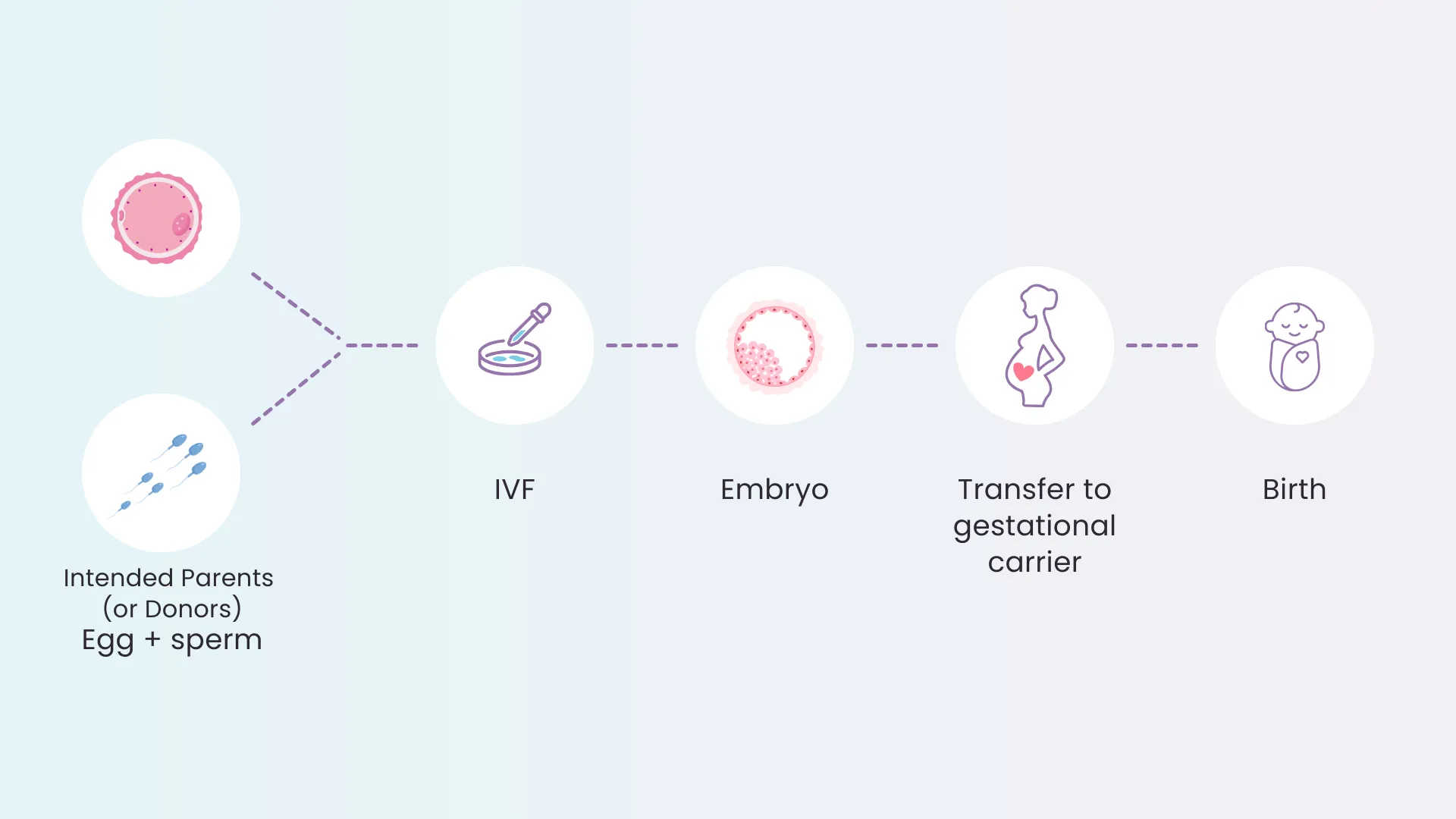
Surrogacy is a family-building method where a gestational carrier carries a baby for intended parents through IVF. In gestational surrogacy, the surrogate has no genetic connection to the baby. The embryo is created using the intended mother’s or donor’s egg and the intended father’s or donor’s sperm. They assume full parental responsibility from birth.
To understand the full process in detail, see our guide on how surrogacy works. For a broader comparison of surrogacy types, the gestational vs. traditional surrogacy guide covers the key distinctions.
National IVF data published by the Centers for Disease Control and Prevention (CDC) offers insight into treatment outcomes and success rates. You can explore the latest figures from all reporting clinics at the CDC ART database.
Finding the right surrogate is one of the most important decisions intended parents make. Many choose to work with a surrogacy agency to coordinate screening, matching, and communication.
Before a surrogate is introduced to intended parents, she undergoes comprehensive medical, psychological, and social evaluations. At Physician’s Surrogacy, that screening is physician-designed and exceeds ASRM guidelines. Only about 8% of candidates pass. You can read more about how PS screens surrogates and what makes the protocol different.
These evaluations confirm that a candidate is medically ready for pregnancy and fully understands the commitment involved. Once cleared, her profile may be presented for matching. As you move toward matching, it helps to review the questions to ask your surrogate to ensure alignment and compatibility.
Surrogacy costs are shaped by surrogate compensation, medical care, legal requirements, insurance, and your IVF plan. Physician’s Surrogacy operates on a fixed and flat model. The price quoted at the start is the price you pay, with no surprise invoices at any stage.
Four program tiers are available:
| Program | Price | Match to Baby |
|---|---|---|
| Physician Plus | $193,000 | 12 to 14 months |
| Surrogacy Flat Rate | $145,000 | 18 to 22 months |
| Surrogacy Livebirth Guarantee | $208,000 | 18 to 22 months |
| All Inclusive Bundle | $255,000 | 18 to 22 months |
No fees are charged until a surrogate match is confirmed. For a full breakdown of what each program includes, see the surrogacy cost guide. Financing guidance is also available at PS’s financing page.
Surrogacy laws vary by state and country, making legal guidance essential. Your journey typically includes:
Ethical and legal best practices for gestational surrogacy are guided by nationally recognized frameworks, including the ASRM guidelines on gestational surrogacy, which outline protections for intended parents and surrogates.
Physician’s Surrogacy partners with reproductive law experts to protect your rights at every step. For a state-by-state legal overview, the surrogacy laws by state guide is a useful starting point. Our physician-led structure keeps the legal, medical, and psychological sides of the journey aligned.
Intended parents remain actively informed and involved throughout the pregnancy. Clinical teams provide updates after appointments, including ultrasound findings and milestone reports. Many choose to attend key visits virtually or in person.
Some agencies also offer additional prenatal testing options, such as Non-Invasive Prenatal Testing (NIPT), which can provide early insights into fetal health and development.
How often you communicate with the surrogate is typically discussed during matching and outlined in the legal agreement, allowing both sides to set expectations in advance. For more on how the relationship between intended parents and surrogates develops, see the surrogate relationship guide.

Surrogacy can bring a blend of optimism, relief, and understandable uncertainty, especially for families who have previously faced infertility or loss.
Many find that having structured communication, consistent updates, and clear expectations helps the experience feel steadier and more predictable.
Emotional clarity can also come from understanding why surrogacy aligns with your family-building goals. Our guide on why intended parents choose surrogacy addresses this directly. For those who have been through failed IVF, the article on surrogacy after failed IVF may also be helpful.
Over time, most families describe the journey as meaningful and deeply rewarding, particularly once they feel supported at each step.
Immediately after birth, the baby is placed with you. Hospitals and agencies prepare for this in advance so the transition is smooth and emotionally supportive for everyone involved.
A Pre-Birth or Post-Birth Order establishes legal parentage, allowing your names to appear directly on the birth certificate.
For international families, agencies often assist with the documentation and coordination needed for newborn travel. The guide on international surrogacy for intended parents covers what to expect in more detail.

Surrogacy becomes easier to navigate when the process is supported by clinical insight rather than guesswork.
At Physician’s Surrogacy, OB/GYNs help shape the key medical steps, from early surrogate screening to ongoing pregnancy monitoring, so you receive guidance rooted in real clinical practice. This structure brings clarity to a journey that can otherwise feel complex or uncertain.
To review how this structured approach applies to your circumstances, schedule a consultation with our team. There are no fees until a surrogate match is confirmed.
Average matching time: one week. Programs start at $145,000, fixed and flat. Preterm delivery rate 50% below the national average.
Common questions from families who are new to the surrogacy process.
In June 2024, hundreds of intended parents received an email no one wants to read: their escrow company was suspending operations. The money they’d deposited — in some cases $60,000 or more — had quietly vanished. The FBI opened an investigation. Families already mid-pregnancy were scrambling to pay their surrogates out of pocket. One couple drained their retirement account just to keep their surrogate’s prenatal care going.
This wasn’t a fringe story. The collapse of Surrogacy Escrow Account Management (SEAM) affected more than 800 families. ABC News and CNN covered it. The FBI sought additional victims. And more than $16 million in escrow funds is still unaccounted for.
Surrogacy agency red flags are not hypothetical. They’re patterns that real families have paid dearly to learn. This guide covers what those patterns look like — and how to spot them before you’re in one.
Most surrogacy fraud doesn’t announce itself. SEAM had operated since 2015. It was considered the “top escrow management service in the industry” by at least one agency that referred clients to it for years without incident.
Then, in 2024, payments to surrogates started missing. The company sent a form email blaming bank delays. Within weeks, accounts were frozen. The owner, Dominique Side, stopped responding to calls and emails — while an automated reply mentioned a federal investigation.
The lawsuit that followed alleged that escrow funds had been used to finance a clothing line showcased at Fashion Week, a rap music career, real estate purchases, and luxury vehicles. A Harris County judge ordered more than $1 million in damages to be paid to affected families — but many are still waiting.
The 23 families named in the original lawsuit each lost between $12,400 and $90,400. One couple was days away from a gender reveal party when they found out their surrogate’s payment had vanished.
“It’s not just about the money. It’s about their family’s future. It’s about their hope. It’s about their ability to have children.”
— Marianne Robak, attorney representing approximately 30 affected families (ABC News, 2024)
SEAM is not an isolated case. In Florida, a court ordered The Surrogacy Group and its owner to pay nearly $3 million after finding them liable for fraud — misappropriating funds meant for surrogates’ medical care for personal expenses including cruise purchases and concert tickets. That case was brought by the Florida Attorney General.
The pattern is consistent: these are not agencies that fail. They’re agencies that take advantage — and they often do so while appearing professional.
Surrogacy escrow accounts exist to protect everyone. The intended parents deposit funds, the escrow company holds and distributes them according to contract, and no single party can touch the money unilaterally. That’s how it’s supposed to work.
The warning signs appear when an agency recommends a single escrow provider with no alternatives, discourages you from doing independent research on that provider, or makes it difficult to see account statements on demand.
At Physician’s Surrogacy, we manage escrow through a secure, structured process with full transparency for intended parents. Every dollar is tracked, and you’re never left guessing where your funds are.
One of the clearest warning signs in surrogacy: an agency that controls what you and your surrogate can say to each other.
This comes up in intended parent communities more often than most people realize. Parents describe agencies that filter or monitor every message exchanged with their surrogate — not to support the relationship, but to control what each side hears. It surfaces repeatedly, and it’s not a quirk. It’s a strategy.
Agencies that monitor or police the IP-surrogate relationship often do so because they’re hiding something. Poor treatment. Compensation disputes. A surrogate who’s been told things that don’t match what you’ve been told. Open communication threatens that gap.
Ethical agencies have no reason to restrict your relationship with your surrogate. They build in counseling and clear communication protocols because healthy relationships produce better outcomes — for everyone.
Surrogacy is one of the most financially complex arrangements most people will ever enter. The contracts reflect that — or they should.
A vague contract is more than a paperwork problem. It’s an open door for fees to appear mid-journey that no one mentioned at the start. It leaves your surrogate’s rights and your parental rights less protected than they need to be. And it gives an unethical agency room to maneuver.
Ask for a full written cost breakdown before you commit to anything. Reputable agencies provide this without hesitation. If a cost breakdown takes weeks to arrive, arrives full of vague line items, or gets revised significantly after you’ve started — those are serious signals.
Quick Weigh-Up
Questions to ask about contracts and costs before you sign anything.
Green flags
Red flags
Physician’s Surrogacy operates on a Flat-Rate Surrogacy model. You know the program price before you commit — no fees until your match is confirmed, and no surprise additions mid-journey.
Screening isn’t bureaucratic overhead. It’s how agencies protect you, your surrogate, and the baby she’ll carry.
The American Society for Reproductive Medicine (ASRM) publishes guidelines that define a minimum standard for surrogate screening — including age requirements, pregnancy history, psychological evaluation, and medical history review. Agencies that skip these steps aren’t cutting costs. They’re creating risk.
A faster timeline doesn’t automatically signal a problem. What matters is how the speed is achieved. Some programs compress timelines by rushing evaluations or skipping steps. Others — like our Medically Cleared Program — move faster because medical and psychological clearance happen before matching, not after. The screening is front-loaded, not skipped.
If an agency promises speed but can’t walk you through the specific medical steps they follow, that’s worth pressing on.
Our screening program is physician-designed and exceeds ASRM standards — not because it’s a selling point, but because our in-house OB/GYNs built it that way. They review every surrogate candidate’s medical history personally.
Some agencies push for scheduled C-sections regardless of medical need. ASRM is explicit that this is inappropriate. C-sections carry real surgical risks — longer recovery, complications, and ongoing health implications for the surrogate.
When an agency schedules routine C-sections to keep timelines predictable, it’s not a clinical decision. It’s a business decision made at a surrogate’s expense.
The same applies to agencies that use the same surrogates repeatedly, beyond recommended limits. ASRM advises no more than five total deliveries or three C-sections per surrogate. Agencies that exceed these thresholds are prioritizing throughput over the health of the women they work with.
Ask any agency you’re considering: What is your C-section rate? What is your policy on medical decisions during labor? If they can’t answer clearly — or deflect — that’s informative.
Surrogacy law in the U.S. is state-by-state. There’s no federal framework. That makes legal structure in your surrogacy agreement more important, not less — because the contract is often what stands between you and a custody dispute.
One attorney should never represent both the intended parents and the surrogate. That’s a conflict of interest that disadvantages the party with less power — usually the surrogate. Every reputable agency in this space provides for independent legal representation of all parties.
Pre-birth parentage orders are another signal. If an agency is vague about how legal parentage gets established before birth — or in which state — that’s a problem. These orders are how you become your child’s legal parent before they arrive. Missing or delayed orders create exactly the kind of legal limbo that causes nightmares.
For a deeper look at how state law shapes your rights, see our guide to gestational surrogacy and how the process works from consultation to delivery.
There’s no single verification database for surrogacy agencies in the U.S. That means due diligence falls on you — but it’s not as opaque as it sounds if you know where to look.
Search for the agency name in Reddit communities like r/surrogacy and r/IVF, and in Facebook groups for intended parents. These spaces surface stories that agencies can’t curate.
ASRM (American Society for Reproductive Medicine) and SEEDS (Society for Ethics in Egg Donation and Surrogacy) don’t guarantee ethics — but agencies that belong to neither have opted out of accountability structures that exist specifically to protect you.
Most surrogacy agencies are staffed by coordinators — not physicians. Ask directly: who oversees medical decisions? Who designs the surrogate screening process? Who consults with your surrogate’s OB if something goes wrong?
Compare answers side by side — on screening, on communication norms, on legal representation, and on escrow management. The differences become obvious fast.
Before depositing funds, ask who holds the escrow, how funds are segregated, how disbursements are documented, and whether you’ll receive statements. If any agency resists these questions, walk away.
A reputable agency will connect you with former intended parents who’ve completed a journey. If an agency can’t or won’t provide references — or if the only references come pre-screened through the agency itself — take note.
Most surrogacy agencies are coordinated by non-medical staff. That’s not a criticism — it’s just how the industry operates. But it does mean that clinical decisions, screening design, and medical communications pass through people who aren’t clinicians.
Physician’s Surrogacy was built differently. Our agency is managed by in-house board-certified OB/GYNs — not business operators who contracted physicians. That distinction matters because it changes the accountability structure. When the medical team runs the agency, medical decisions don’t get overridden by business pressure.
Our physician-designed screening protocol exceeds ASRM guidelines and produces a preterm delivery rate 50% below the national average. Clinical updates after every surrogate appointment go directly to intended parents. And when complications arise, our physicians can consult peer-to-peer with your surrogate’s managing OB — not pass a message through a coordinator.
That model makes it structurally harder for the kind of corner-cutting that produces fraud and exploitation. It’s not a guarantee — nothing is. But it’s a meaningful difference in how medical accountability gets built into the process.
Learn more about how surrogacy costs break down and what to look for in a program that protects your investment at every stage.
Every agency that has defrauded intended parents looked legitimate before the money disappeared. SEAM had eight years of operation behind it. The Surrogacy Group had a professional website and client testimonials. The pattern isn’t “obvious scam.” It’s polished presentation followed by quiet mismanagement.
The signals that matter are operational: Do they welcome your questions or deflect them? Can they explain their screening process in clinical terms? Will they connect you with the escrow provider independently? Do they encourage independent legal counsel or steer you toward theirs?
Gestational surrogacy is one of the most medically sophisticated ways a family can be built — and one of the most human. It deserves an agency that treats it that way.
We’d welcome the opportunity to answer your hardest questions directly. Read about who we are and what families say about working with us — then add Physician’s Surrogacy to your shortlist and compare our answers with everyone else’s.
Schedule A Consultation!
If you’ve completed a surrogacy journey and found it meaningful, you’re not alone in wondering if you can be a surrogate again. Many women carry more than once: some twice, some three times, a rare few even more. What determines if you can do it again isn’t arbitrary agency policy. It comes down to medical guidelines, your personal health history, and who’s reviewing your file.
There’s no fixed cap on how many times you can be a surrogate. What there are, though, are medical standards that exist to protect your health at every stage, and a real difference in who’s applying those standards depending on the agency you choose.
At most agencies, the answer stops at five prior pregnancies. At Physician’s Surrogacy, it doesn’t have to — because our board-certified OB/GYNs review every file individually, the way a clinical decision should be made.
What Research Actually Shows
The direct answer: at most other agencies, you can be a surrogate up to five times.
The requirement that surrogates have at least one prior child of their own means you enter a surrogacy program with at least one pregnancy already behind you — so five surrogacy journeys brings your total pregnancy count to six, which is the ceiling most agencies apply.
At Physician’s Surrogacy, you can be a surrogate up to six times. That means up to seven pregnancies total (your own child plus six surrogacy journeys), provided your clinical picture supports it at each application.
Because our OB/GYNs review every file individually, we can accept candidates that most agencies can’t — not by lowering the bar, but by actually clearing it medically rather than by checklist.
The C-section limit is the same everywhere and it doesn’t flex: a maximum of two prior C-sections before a surrogacy journey, regardless of how many vaginal deliveries you’ve had.
At a Glance
Most Agencies
Surrogate journeys: Up to 5. Surrogates must have at least one biological child, so five journeys brings the total to 6 pregnancies — the ASRM ceiling most agencies apply as a hard cutoff.
Prior C-sections: Maximum 2 prior C-sections for any surrogate candidate.
Physician’s Surrogacy
Surrogate journeys: Up to 6. Our OB/GYNs review each file clinically rather than applying a cutoff, so candidates with 6 prior pregnancies (7 total) may qualify when the evidence supports it.
Prior C-sections: Maximum 2 prior. This limit is firm and applies everywhere.
The numbers aren’t round figures chosen arbitrarily. They reflect decades of obstetric research on what cumulative pregnancies do to the uterus over time.
Every delivery places physical demands on uterine tissue. Vaginal births require the uterus to contract and recover repeatedly. C-sections do something more lasting: each incision replaces a layer of uterine muscle with fibrous scar tissue. That scar tissue doesn’t flex or function the way healthy muscle does.
With each additional C-section, the risks compound in specific and documented ways:
ASRM’s five-prior-pregnancy recommendation reflects the point where cumulative risk starts to outweigh the benefit of another pregnancy for most women. But ASRM uses the word “ideally” for a reason: it’s a clinical guideline, not a legal limit.
A 2024 multicenter cohort study published in American Journal of Perinatology (DeBolt et al.) found that among grand multiparous women, increasing parity itself was not the primary risk driver — prior adverse pregnancy outcomes and advanced maternal age were. That nuance is exactly what a physician can evaluate and a coordinator cannot.
For women with a clean obstetric history, six prior pregnancies may still be compatible with a safe surrogacy journey, provided a physician is actually reviewing the file.
The C-section limit is handled separately, and it is stricter. ASRM’s guideline is a maximum of three total cesarean deliveries over a lifetime. A surrogate candidate’s C-section history is capped at two prior surgeries — a cesarean at delivery would bring that to three, which is ASRM’s lifetime maximum. This limit applies regardless of total pregnancy count and doesn’t move.
Grand multiparity — defined as five or more deliveries — is associated with increased obstetric risks including uterine atony, placenta previa, and operative delivery complications. Careful counseling and individualized assessment is recommended for each subsequent pregnancy.
ASRM’s five-prior-pregnancy recommendation is a clinical baseline — an evidence-backed starting point, not a fixed ceiling. ASRM itself uses the word “ideally” and calls for individualized clinical review for candidates at or beyond that threshold.
Most surrogacy agencies apply the five-pregnancy figure as a hard cutoff because they have no clinical basis to go further. When your application is reviewed by a coordinator, there’s no physician making the call. A checklist can only do what a checklist can do.
Physician’s Surrogacy is the only surrogacy agency in the U.S. managed by practicing OB/GYNs. That means your pregnancy history goes to a physician who can actually read it.
Our doctors review your full obstetric record: every pregnancy, delivery type, complication, and recovery outcome. Then they make a clinical determination. That’s how we can clear a candidate with six prior pregnancies — where the surrogacy becomes the seventh — when the evidence supports it.
The C-section limit remains firm and separate: a maximum of two prior C-sections for any surrogate candidate. That boundary is grounded in documented uterine tissue risk and doesn’t flex. But for women with predominantly vaginal delivery histories, a sixth prior pregnancy may well be safe, and our physicians are qualified to make that determination.
Physician’s Surrogacy is the only U.S. surrogacy agency run by practicing OB/GYNs. Our physicians review your full pregnancy history the way a clinical decision deserves. That’s what allows us to say yes when other agencies can’t.
Candidates with 6 prior pregnancies may qualify for a surrogacy journey. Each file is reviewed individually by our OB/GYN team.
The 2-prior-C-section limit applies to all surrogate candidates regardless. This is firm.
The research tells you the limits. These stories show you what repeat surrogacy actually looks like for the women who live it and for the families they help build.
When Elton John and his husband David Furnish welcomed their first son, Zachary, on Christmas Day 2010, they did so through a gestational carrier whose identity they chose to keep private, both to protect her and, as Furnish later explained to People, so their sons would understand “the spirit and love that was at the heart of the process.”
Three years later, in January 2013, the same surrogate carried and delivered their second son, Elijah. The same woman. The same family. A relationship built on trust during the first journey, repeated because it worked.
After Elijah’s birth, the couple released a statement: “Both of us have longed to have children, but the reality that we now have two sons is almost unbelievable. The birth of our second son completes our family in a most precious and perfect way.”
Their surrogate had proven herself — medically, emotionally, personally. Elton and David knew exactly who they were working with. That certainty was worth more to them than starting over with someone new.
This is the pattern repeat surrogates describe again and again: the second journey with a family you already know often feels less like a medical arrangement and more like completing something meaningful together.
Tonight Show host Jimmy Fallon and his wife Nancy Juvonen welcomed daughter Winnie Rose via surrogate in 2013, followed by Frances Cole the following year, both via the same surrogate.
Fallon has spoken openly about the experience: “My wife and I had been trying a while to have a baby. We tried a bunch of things — so we had a surrogate.”
What these stories share isn’t celebrity status. It’s a pattern: a surrogate who is healthy, trusted, and willing, and intended parents who found that starting over with someone new simply wasn’t necessary when the person who helped them the first time was ready and able to go again.
Behind the celebrity stories are thousands of women who carry for families outside the spotlight. One surrogate, writing for Motherly, described carrying for three different families and what she learned across each one.
Her third journey arrived already shaped by experience. She described the dual nature of surrogacy: being a helper and a fixer by nature, while learning to advocate for herself without guilt.
“A want to help someone is valid, but so is asking for the things you want. You can do both,” she wrote.
That shift from first-time uncertainty to third-time confidence is one of the most consistent things repeat surrogates describe. The process gets easier to manage. The emotional rhythms become familiar. The sense of purpose, far from diminishing, often grows.
The reasons repeat surrogates give are rarely just financial, even when compensation is part of the decision.
Ellen Glazer, a clinical social worker whose practice focuses on third-party reproduction, observed through Harvard Health that women who carry for others are often drawn by the ripple effect: the knowledge that their act changes not just one life, but an entire family’s. For generations.
Many surrogates describe the first journey as something that changes their sense of what they’re capable of. The second becomes a choice made with full knowledge — not naïve altruism, but informed generosity.
That combination is consistent with what we hear from surrogates at Physician’s Surrogacy: the experience of helping others is deeply fulfilling, and many choose to do it more than once. If you’re still weighing whether surrogacy is right for you at all, our guide on why women become surrogates is a good place to start.
Clearing screening once doesn’t mean you’re automatically cleared for a second or third journey. Every new surrogacy requires a fresh evaluation. At Physician’s Surrogacy, our board-certified OB/GYNs review your current health status against the same standards applied to first-time applicants.
The surrogate screening process is worth reviewing before you apply — and what our physicians are actually looking for in your records.
Most reproductive specialists recommend waiting at least six months to a year after delivery before starting another surrogacy journey. This recovery window gives your body time to return to its baseline: hormonally, physically, and emotionally.
C-section deliveries typically warrant the full twelve months. The uterine incision needs time to fully heal before it can safely carry another pregnancy.
A large retrospective cohort study by Metz et al. in American Journal of Obstetrics and Gynecology found that an interpregnancy interval under 12 months is independently associated with uterine rupture in women with a prior cesarean. A separate analysis by Stamilio et al. in Obstetrics & Gynecology found that intervals shorter than six months increase the risk of uterine rupture and major morbidity two- to threefold. Vaginal deliveries generally allow a shorter recovery window, though this varies by individual.
At Physician’s Surrogacy, our OB/GYNs determine your readiness based on your actual recovery, not the calendar. Some women are ready closer to the six-month mark. Others benefit from waiting longer. Both paths are valid, and our clinical team gives you an honest assessment either way.
Repeat surrogates bring something first-timers don’t: direct experience. You know what embryo transfer preparation feels like, how your body responds to medications, and what the emotional rhythms of the journey are like. That familiarity reduces anxiety and sharpens communication with everyone involved.
The surrogate health benefits don’t diminish with a second journey. For many women, the confidence that comes from having done it before makes the physical and emotional experience more manageable the second time.
From a practical standpoint, repeat surrogates at Physician’s Surrogacy also benefit from:
Experienced surrogates earn more at Physician’s Surrogacy. Your proven track record reduces uncertainty for intended parents and the agency, and compensation reflects that directly.
For first-time surrogates, compensation starts at $60,000–$75,000+ based on state. Experienced surrogates can earn more. There’s no receipt to submit and no approved provider to use — what you sign is what you receive. For a full breakdown of what’s included, see our surrogate compensation page.
Repeat surrogates sometimes ask how compensation works across multiple journeys from a tax standpoint. Our guide on surrogate income and taxes covers the key considerations, including why most surrogate compensation is not treated as taxable income by the IRS.
If you completed your first journey with a different agency, you qualify for experienced surrogate compensation at Physician’s Surrogacy from the start. Your history comes with you.
This is where the difference between agencies becomes real. Many surrogacy agencies are run by coordinators or former surrogates: people who care, but who apply a checklist rather than clinical judgment.
When a coordinator reviews your file and sees five prior pregnancies, they stop. That’s the published guideline, and they have no clinical basis to go further. They can’t evaluate nuance in your delivery history. They can’t make the call a physician can.
Physician’s Surrogacy is the only surrogacy agency in the U.S. managed by practicing OB/GYNs. Our physicians review your complete history: total pregnancies, delivery types, C-section count, complications, and recovery. Then they give you a medically grounded answer about your candidacy, not a form rejection based on a single number.
That review is what makes accepting a sixth prior pregnancy possible when the evidence supports it. It’s not a looser standard. It’s a higher one.
That physician-led model drives our outcomes: a preterm delivery rate 50% below the national average, 3–6 months of post-delivery support for every surrogate, and 24/7 coordinator access throughout your journey.
For repeat surrogates who know what it means to carry a child for someone else, the decision about which agency to trust with a second journey isn’t small. Working with a program where physicians are reviewing your file — not just approving a form — is what makes that decision feel like the right one.
Yes, and it’s more common than people expect. The trust built during a first journey can make a second one feel more collaborative from the start. Both sides already know how the other communicates, what they value, and what the experience is like together.
Elton John’s surrogate carried both of his sons. Jimmy Fallon’s surrogate delivered both of his daughters. These aren’t anomalies. They’re what happens when a surrogacy journey goes genuinely well and everyone involved is ready to do it again.
If you’d like to work with the same family again, that preference gets noted during matching. A new legal agreement is drafted regardless. Both sides deserve fresh documentation even when the relationship is established.
Physician’s Surrogacy handles that conversation and makes sure everything is documented properly before the journey begins. Read real surrogate stories from women who’ve been through the journey, including those who’ve carried more than once.
Physical readiness and emotional readiness don’t always arrive at the same time.
Surrogacy involves real emotional investment: building a relationship with intended parents, carrying a pregnancy with intention, and returning home after delivery. That transition deserves time and real processing. Our guide on emotional readiness for surrogacy walks through the signs that you’re genuinely ready: not just logistically, but personally.
Repeat surrogates consistently report feeling more prepared the second time. They know what to expect at each stage. That confidence tends to translate into better communication, calmer transfer days, and stronger relationships with the families they’re matched with.
That said, every journey brings new variables: a new family, a different pregnancy, possibly different circumstances at home. A psychological evaluation is part of screening for every journey — not as a formality but as a genuine check-in before you commit.
It also helps to have your partner on board from the start. Our surrogate partner guide covers how to have that conversation and what support tends to make the biggest difference during the journey.
At Physician’s Surrogacy, post-delivery support runs 3–6 months after birth. That support doesn’t change, first journey or third.
If you’ve completed a journey and want to explore another, the first step is submitting an application. Our team will review your history and give you a clear picture of where you stand, medically and practically.
Our application is quick. A coordinator will follow up to review your full history, walk through your specific situation, and give you a clear answer about where you stand.
Physician’s Surrogacy is the only agency in the U.S. run by practicing OB/GYNs. Your file goes to a physician, not a checklist.
The best states for surrogacy share one thing: they make the legal outcome predictable before you ever match with a surrogate. Where your surrogate gives birth matters more than most intended parents realize — and most agencies don’t tell you that upfront.
Surrogacy law in the United States is entirely state-governed. There is no federal framework. That means the birth state’s statutes and court practices determine whether your surrogacy agreement is enforceable, how parentage is established, and whether your name goes on the birth certificate before or after delivery.
For same-sex couples, single parents, and families using donor gametes, the differences between a surrogacy-friendly state and a conditional one aren’t just procedural — they can define whether the journey goes smoothly or stalls entirely.
This guide lays out the best states for surrogacy in 2026, explains what “surrogacy-friendly” actually means in practice, and covers what to do if you live in a state with more complicated rules. At Physician’s Surrogacy, we coordinate journeys nationwide — and the state-by-state legal landscape is one of the first things we review with every intended parent.
The absence of federal surrogacy law is the root of every state-by-state complication you’ll encounter. Each state has developed its own legal posture through a combination of enacted statutes, appellate court decisions, and administrative practices — and those postures range from fully permissive to functionally prohibitive.
Most legal frameworks in the U.S. address gestational surrogacy specifically, where the gestational carrier (GC) has no genetic link to the child. Traditional surrogacy — where the surrogate is also the biological mother — faces steeper restrictions in most states and is rarely used in modern agency-coordinated journeys.
States generally fall into three categories:
Laws as written can differ significantly from how they’re actually applied in a given county or courthouse — which is why experienced legal counsel in the birth state is non-negotiable.
One more factor worth understanding early: the state where you or your surrogate lives is less determinative than the state where the birth occurs. For cross-state journeys, the birth state’s parentage laws and court processes govern the outcome.
Surrogacy-friendly states share three core characteristics: enforceable gestational surrogacy agreements, a clear and predictable parentage process (typically including pre-birth orders), and established court and vital-records workflows that reduce last-minute surprises. The states below consistently meet that standard across a wide range of family structures.
Click any teal state to read the Physician’s Surrogacy guide for that state.
| State | Friendly? | Pre-Birth Orders | Who It Works For | Notes |
|---|---|---|---|---|
| California | ✅ | ✅ | All family structures | Gold standard. Deepest legal and clinical infrastructure. |
| Colorado | ✅ | ✅ | All family structures | Intent-based statute. Strong for donor-gamete families. |
| Illinois | ✅ | ✅ | Most family structures | Sequencing matters — get contracts and filings in order early. |
| Nevada | ✅ | ✅ | All family structures | No residency requirement. Popular for Western states. |
| Connecticut | ✅ | ✅ | Most family structures | Best option in the Northeast. Modern parentage statute. |
| Michigan | ✅ (2025) | ✅ | Broader than before | New law as of April 2025. Confirm pathway with local attorney. |
| Massachusetts | ✅ (2025) | ✅ | Most family structures | Statutory clarity as of Jan 2025. Infrastructure still maturing. |
| New York | ✅ | ✅ | Most family structures | Strengthened in 2025. Surrogates’ Bill of Rights in place. |
| Texas | ⚠️ | ⚠️ | Married couples only | Validated pathway excludes single parents and unmarried couples. |
| Oregon | ⚠️ | ⚠️ | Many family structures | Case law-based. County-level variation applies. |
| Virginia | ⚠️ | ⚠️ | Many family structures | Permitted but procedurally structured. Plan legal steps early. |
| Louisiana | ❌ | ❌ | Married heterosexual couples (own gametes only) | No donor gametes, no compensation. Court approval required pre-transfer. |
| Nebraska | ❌ | ❌ | Very limited | Contracts void by statute. Post-birth adoption typically required. |
California is the benchmark for gestational surrogacy law in the United States — and the most inclusive legal pathway of any state for LGBTQ+ families, single parents, and international intended parents.
We’re headquartered in San Diego and coordinate a high volume of journeys here. For a deeper look at how surrogacy works in this state, see our guide to surrogacy in California and our comparison of the best surrogacy agencies in California.
Colorado is one of the strongest alternatives to California, with one of the few state frameworks that addresses gestational surrogacy directly and thoroughly in statute rather than relying on case law.
See our comparison of the best surrogacy agencies in Colorado.
Illinois offers a clearly defined legal route for enforceable gestational surrogacy agreements, with well-established parentage procedures for families who follow the document sequence correctly.
See our comparison of the best surrogacy agencies in Illinois.
Nevada is a popular choice specifically because it imposes no residency requirement — families can pursue a Nevada birth journey without living there.
See our comparison of the best surrogacy agencies in Nevada.
Connecticut’s Parentage Act clarified and strengthened surrogacy-related parentage procedures, making it one of the most predictably friendly states in the Northeast.
See our comparison of the best surrogacy agencies in Connecticut.
Michigan underwent a significant legal shift effective April 2, 2025 — moving from one of the more restrictive states to a legitimately surrogacy-friendly one.
See our comparison of the best surrogacy agencies in Michigan.
Both states have made significant legal updates and are increasingly viable options, particularly for families in the Northeast.
See our comparisons of the best surrogacy agencies in New York.
These states can be viable for gestational surrogacy — but they rely more heavily on case law, impose procedural requirements that vary by county, or limit pathways for certain family structures.
Two states stand out as genuinely limiting for most intended parents.
Understanding the legal categories is useful, but what matters is how the law translates to your timeline and hospital paperwork. Here’s what distinguishes a smooth journey from a complicated one:
The state-by-state legal landscape is one of the first things we review with every intended parent. We’ve coordinated cross-state journeys for families from restrictive states — and we match within a week on average.
Onsite OB/GYNs. One-week average match. Preterm rate 50% below national average.
Confirm your legal pathway and get a clear timeline — no obligation.
Your home state being restrictive doesn’t prevent you from pursuing surrogacy. Intended parents from Nebraska, Louisiana, and other challenging states complete journeys every year. The key is building a cross-state strategy with the right team in place before you match.
For a closer look at how surrogate screening works and what it’s designed to catch, see our overview of how surrogacy works.
Choosing the right state is one planning decision. Choosing the right agency is the decision that determines whether the journey actually stays on track.
These are the questions that surface real differences between agencies:
The American College of Obstetricians and Gynecologists (ACOG guidelines) recognize that surrogate pregnancies carry specific medical considerations warranting closer monitoring than typical pregnancies. In an OB-managed program, that monitoring is built into the agency structure itself — not dependent on whether the surrogate’s external provider happens to communicate updates.
For more context on how physician oversight changes the surrogacy experience, see our overview of the physician’s advantage in surrogacy.
The legal environment a state provides also affects the matching timeline. In states where surrogacy agreements are enforceable and parentage is predictable, agencies can move from confirmed match to medical clearance to embryo transfer on a more reliable schedule. In conditional or restrictive states, unexpected legal steps can push that window out by months.
Most intended parents focus on “how long does it take to get matched?” — but the real question is “how long from match to transfer?” That second window is where state law, medical readiness, and agency coordination all converge.
It’s also worth understanding how surrogate compensation is structured across states, since some states have restrictions on what’s permissible beyond medical expense reimbursement. Our guide to how much surrogates make covers what’s included in the flat-rate package, what additional benefits look like, and how the payment structure is managed through escrow.
For a full breakdown of state-by-state legal environments, see our surrogacy laws by state guide. And for families who want to understand what goes into the legal agreement before signing, our surrogacy contracts guide covers the key terms and protections.
For families weighing the total cost of a surrogacy journey — including how state choice affects legal fees and timelines — our breakdown of surrogacy costs provides a full picture of what to budget for.
The best states for surrogacy give you legal predictability. The right agency uses that predictability rather than squandering it.
We coordinate gestational surrogacy journeys nationwide, with intended parents regularly matched within a week of their initial consultation. Our physician-designed screening process — built and reviewed by onsite OB/GYNs — produces a preterm delivery rate 50% below the CDC national average. For families from restrictive states, we have direct experience with cross-state arrangements and legal coordination in California and other surrogacy-friendly jurisdictions.
Every state situation is different. Schedule a consultation and we’ll review your specific pathway, confirm eligibility, and give you a clear timeline — before you commit to anything.
Flat-Rate Surrogacy starting at $140,000–$170,000+. No agency fees until match confirmed.
Average match time: one week from the largest pre-screened surrogate pool in the U.S.
When you start researching surrogacy, you will quickly run into terms like “hormonal stimulation,” “fertility medications,” and “IVF protocol” — and it is not always clear which parts apply to you as a surrogate. The short answer: you do not go through ovarian stimulation or egg retrieval. Those steps belong to the person providing the eggs — the intended mother or an egg donor. Your hormonal protocol is different, and simpler.
The hormones surrogates take serve one purpose: preparing your uterus to receive and support the embryo. At Physician’s Surrogacy, the only surrogacy agency in the United States managed by practicing OB/GYNs (obstetrician-gynecologists), our physicians oversee this process directly — reviewing your medications, monitoring your response, and communicating peer-to-peer with the fertility clinic’s reproductive endocrinologist when questions arise.
This guide covers exactly what the surrogate hormone protocol involves — which medications, what they do, what side effects to expect, and what the full timeline looks like from preparation through pregnancy confirmation.
In a natural pregnancy, your body’s own hormonal cycle prepares the uterine lining every month. Estrogen builds the lining, progesterone stabilizes it, and if a fertilized egg arrives at the right moment, it has a ready environment.
In a frozen embryo transfer (FET) cycle — how most surrogacy transfers work — the fertility clinic must control that timing precisely. The clinic cannot rely on your natural cycle to produce the right conditions on the exact day the embryo is ready. So the clinic removes your natural cycle from the equation and creates the right uterine environment artificially, using estrogen and progesterone on a controlled schedule that syncs with the embryo.
That is the entire purpose of the surrogate hormone protocol. It is not the intense process that ovarian stimulation involves. It is targeted preparation for one specific goal.
Some fertility clinics begin the surrogate hormone protocol with a suppression phase to regulate your cycle before building it back up on their schedule. This is common in certain protocols but not universal — your clinic may or may not include this step.
Birth control pills are the most common suppression method. You take oral contraceptive pills for 2–4 weeks before estrogen begins. The pills quiet your natural hormonal fluctuations so the clinic can start estrogen at a predictable baseline. Side effects during this phase mirror standard birth control: possible mood changes, lig
t spotting, breast tenderness, or mild nausea. Most surrogates tolerate this phase without major disruption.
Some protocols use Lupron (leuprolide acetate) — a GnRH agonist — instead of or alongside birth control. Lupron suppresses your pituitary gland’s hormone production, putting your ovaries in a temporary resting state. Clinics administer it as a daily subcutaneous injection, typically in the abdomen.
Side effects can include hot flashes, headaches, and mood shifts — essentially mild, temporary menopause-like symptoms that resolve once you stop taking it. Not all clinics use Lupron for FET cycles; its use depends on the specific protocol the reproductive endocrinologist (RE) designs for your case.
Once suppression (if used) is complete, estrogen begins. This phase develops your uterine lining — called the endometrium — to the right thickness and texture to receive the embryo.
The endometrium must reach a minimum thickness, typically at least 7–8mm, for the transfer to proceed. Estrogen drives that growth and also affects the lining’s receptivity.
The fertility clinic monitors your lining with transvaginal ultrasound during this phase, usually one or two times, to confirm it is developing properly before moving forward.
Estrogen comes in several forms, and different clinics prefer different delivery methods. Your clinic will specify which form and dose they prefer. The estrogen phase typically lasts 2–3 weeks.
Most surrogates find estrogen easy to tolerate. Common side effects include bloating, breast tenderness or fullness, mild nausea, headaches, and mood changes — some women feel more emotional, others notice no difference at all. Light spotting is more common with vaginal forms.
These effects are temporary and typically ease as your body adjusts. If you experience severe nausea or headaches that do not respond to over-the-counter relief, contact your coordinator or care team.
Once your lining reaches the target thickness, progesterone is added. This is the hormone that most surrogates have the most to say about — it is effective, it is necessary, and it comes with side effects worth knowing about upfront.
In a natural cycle, progesterone rises after ovulation and shifts the lining into a receptive state — ready to support an implanting embryo. In a FET cycle, the clinic adds progesterone 5–7 days before the scheduled embryo transfer, mimicking the natural post-ovulation window. The embryo transfers into a lining that is in exactly the right developmental stage.
If the transfer results in pregnancy, progesterone continues for several weeks — typically through 10–12 weeks, when the placenta takes over its own progesterone production.
Progesterone is most commonly administered as an intramuscular injection — progesterone in oil (PIO) — in the upper outer quadrant of the buttocks. The oil base, usually sesame, olive, or ethyl oleate, makes the injection effective and long-lasting, but it also makes the injection site sore afterward.
PIO injections use a longer needle than most at-home injections — typically 1.5 inches — to reach the muscle. The oil is thick, so the injection goes in slowly. Most protocols require daily injections, at least initially. Having a partner give the injection makes the process considerably easier when you are relaxed.
Some clinics use vaginal progesterone suppositories — such as Endometrin or Crinone gel — instead of or alongside injections.
Suppositories deliver progesterone directly to the uterus, requiring lower systemic doses. They avoid injection site soreness entirely, but require insertion 2–3 times daily and can cause vaginal discharge. Some protocols combine injections plus suppositories for surrogates who need higher progesterone levels.
Progesterone affects a wide range of systems in the body. Common side effects include:
All of these side effects are temporary. Once progesterone tapers after the first trimester, they resolve.
Quick Answer
The embryo transfer itself takes about 15–20 minutes and does not require anesthesia. Most surrogates describe it as mildly uncomfortable — similar to a pap smear — rather than painful. You will rest briefly at the clinic and then go home.
After 5–7 days of progesterone, the transfer is scheduled. You will arrive at the fertility clinic with a moderately full bladder — this helps with ultrasound visualization during the procedure.
A speculum is inserted, and a thin, flexible catheter is guided through the cervix into the uterus. The embryo is placed through the catheter into the uterine cavity.
Many surrogates go about their normal day afterward; some prefer to rest for 24 hours. Your clinic will give you specific guidance on activity restrictions post-transfer. For a full breakdown of what the procedure feels like, read our post on what embryo transfer is like for surrogates.
The period between the embryo transfer and the pregnancy blood test is commonly called the “two-week wait” — though it is usually closer to 10 days, confirmed by a blood test (called a beta hCG test).
During this time, you continue all medications exactly as prescribed.
The embryo either implants or it does not — your activity level, diet, or how much you rested does not change the outcome. Your role during this window is to keep taking your medications and take care of yourself.
Not every transfer results in pregnancy, even with good embryos and a well-prepared lining. If the beta hCG comes back negative, it is emotionally hard for both you and the intended parents.
Give yourself time to process it. Most clinics wait one to two menstrual cycles before attempting another transfer. You can read more about handling a failed IVF transfer as a surrogate — what to expect emotionally and medically.
A positive beta hCG means the embryo implanted. The medications do not stop there. You continue estrogen and progesterone for several more weeks — typically through 10–12 weeks of pregnancy, when the placenta develops enough to produce its own hormones.
The clinic gradually tapers the doses rather than stopping abruptly. Most surrogates feel relief when the injections finally end, and by that point the pregnancy is well established.
| Phase | Medications | How Long |
|---|---|---|
| Suppression (if used) | Birth control pills or Lupron | 2–4 weeks |
| Estrogen phase | Estradiol (oral, patch, or injection) | 2–3 weeks |
| Lining check | Ultrasound to confirm thickness | 1 appointment |
| Progesterone phase | PIO injections and/or vaginal suppositories | 5–7 days pre-transfer |
| Embryo transfer | The procedure itself | ~15–20 minutes |
| Two-week wait | Estrogen and progesterone continue | ~10 days |
| Early pregnancy support | Estrogen and progesterone tapered off | Through weeks 10–12 |
Every clinic has its own protocol preferences. Your specific timeline and doses come from the fertility clinic working with your intended parents, and your coordinator walks you through everything before it starts.
At most surrogacy agencies, no doctors work on staff. When a surrogate has a question about her medications or notices a side effect that concerns her, coordinators relay messages between her and outside physicians — with no one at the agency able to evaluate her situation directly.
Physician’s Surrogacy operates differently. Our in-house OB/GYNs stay involved throughout your journey, including the medication phase. If something comes up — a side effect that seems more serious than expected, a lab result that needs review, a question about your specific protocol — a physician on our team can look at your actual case, not just pass along a message.
Our physicians can also communicate directly with the fertility clinic’s RE if there is a clinical question about your protocol. That peer-to-peer coordination is something agencies without in-house physicians simply cannot offer. It is one of the reasons our preterm delivery rate sits 50% below the national average — physician oversight at every stage, including the weeks leading up to the transfer.
To learn more about what makes our physician-led approach different, visit our Physician’s Advantage page.
If you are considering becoming a surrogate and the medication process feels daunting, that is a completely normal reaction. Giving yourself daily injections is not something most people have done before. What surrogates consistently say, looking back, is that it is more manageable than it sounds. The protocol is short, the medications are well-studied, and you are supported at every step.
At Physician’s Surrogacy, we walk every surrogate through the full medication process before they commit to anything. You will know exactly what to expect — which medications, which form, what side effects typically look like, and what support is available — before you sign anything.
Check our surrogate requirements to see if you qualify. When you are ready, apply to become a surrogate and our team will be in touch.
Schedule A ConsultationYou’ve done your research, you meet the requirements, and you’re ready to become a surrogate. Then someone mentions that your health insurance might not cover the pregnancy — or worse, that it could come back and bill you for medical costs after the fact. That’s a surrogate insurance lien, and it’s one of the most misunderstood financial risks in the entire surrogacy process.
Most surrogates assume that because their insurance covers pregnancies, it covers surrogacy pregnancies. That assumption is wrong often enough to derail journeys and leave surrogates with unexpected financial liability.
The difference between a policy that works for surrogacy and one that doesn’t comes down to specific policy language — and most people have never read their policy closely enough to know which they have.
At Physician’s Surrogacy, we treat insurance verification as a non-negotiable step — not an afterthought. Our team reviews every surrogate’s policy before matching, and our in-house OB/GYNs understand the medical and financial landscape of surrogacy in a way that coordinator-only agencies simply don’t.
Here’s what you need to know about surrogate insurance liens before you sign anything.
A surrogate insurance lien — sometimes called a clawback — happens when your health insurance company demands repayment for pregnancy-related medical bills after learning you were compensated for the surrogacy.
They paid for your prenatal care, your delivery, your hospital stay. Then they found out you were paid. And now they want that money back.
This isn’t a hypothetical. It happens because some health insurance policies contain language that conditions coverage on the policyholder not receiving payment for the pregnancy.
A typical clawback clause might state that the insurer may seek reimbursement up to a portion of the monetary compensation the surrogate received. The exact trigger varies by policy, but the outcome is the same: a bill arriving after your journey ends, for an amount that can easily reach five figures.
Quick Answer
A surrogate insurance lien is a post-journey repayment demand from your insurer. It’s triggered by clawback clauses in your health policy that activate when the insurer learns you received compensation. The protection is a professional policy review before you match — not after.
The danger is that the clause can be buried in policy documents most people never read. A surrogate who uses her existing insurance without a professional review may have no idea the clause exists until she receives a collection letter months after delivery.
By then, her compensation has already been spent — or she’s expected to return most of it.
There is no official certification that makes a health insurance policy “surrogate-friendly.”
That phrase describes a practical outcome — the policy covers a compensated surrogate’s pregnancy costs without triggering clawback — but it’s determined by reading the actual policy language, not by any badge or designation the insurer provides.
This creates a real problem. When surrogates ask their insurance company, “Does my plan cover surrogacy?” the answer they often receive is a general yes about maternity coverage — not a specific answer about whether compensated surrogacy is covered or whether a clawback clause exists.
Those are two different questions, and most insurance customer service representatives aren’t equipped to answer the second one accurately.
A surrogate-friendly health insurance policy, practically speaking, is one that:
Meeting all three criteria requires a professional policy review. That’s the only way to know.
Before your insurance is formally reviewed, there are signals that put a policy in a higher-risk category. None of these definitively confirm a problem — but each one is a reason to slow down and verify before proceeding.
Silence is not safety. A policy that doesn’t address surrogacy leaves the insurer with flexibility to deny claims or pursue reimbursement if the situation is later disclosed. The absence of surrogacy language means the outcome is undefined — and undefined risks in insurance almost always resolve in the insurer’s favor.
Some policies state clearly that coverage does not apply to pregnancies carried as a gestational carrier. This is the most direct red flag. A policy with an explicit exclusion will not work for your surrogacy journey, and your intended parents will need to secure an alternative before you match.
A reputable agency treats insurance review as a gate — you don’t advance to matching until the review is complete and documented. An agency that skips this step or treats it as a formality is exposing you to a risk it may not fully understand or is simply not willing to spend the time on. Either way, that’s a problem.
You’re entitled to written confirmation of your insurance status. If the agency or an insurance representative can’t provide a clear, written explanation of your coverage and whether any clawback clauses apply, that’s not a complete review — it’s an assumption. Assumptions don’t protect you if a lien arrives later.
Your intended parents cover all costs related to your insurance — premiums, deductibles, and any costs associated with securing a replacement plan if your current policy is not usable. If anyone suggests otherwise, that is not a standard surrogacy arrangement.
If a professional review confirms your policy has a surrogacy exclusion or clawback clause, your journey isn’t over — it just means your intended parents need to secure a replacement plan before your medical cycle begins. Two options are commonly used in surrogacy arrangements.
An Affordable Care Act (ACA) marketplace plan purchased during Open Enrollment — November 1 through January 15 — can serve as surrogate-friendly coverage when selected carefully and reviewed for clawback language. For coverage starting January 1, enrollment must be completed by December 15. The approximate cost for intended parents runs between $12,000 and $18,000, based on current market estimates from surrogacy insurance specialists.
The critical point: not every ACA plan is automatically surrogate-friendly. The plan still needs to be reviewed by someone who specializes in third-party reproduction coverage. Open enrollment timing also matters — if your journey timeline doesn’t align with the enrollment window, an ACA plan may not be available to you without a qualifying life event.
Specialty policies — sometimes called contingent medical policies, maternity-only policies, or referenced by underwriter names like Lloyd’s of London — are designed specifically for situations where primary coverage either doesn’t exist or has known exclusions. These policies act as a safety layer, covering medical costs where a primary plan fails or has been confirmed unsafe for the journey.
The approximate cost for intended parents: $25,000–$35,000 for a singleton pregnancy, and $40,000–$50,000 for a twin pregnancy. These figures are based on current industry estimates from surrogacy insurance specialists and can vary based on policy terms.
| Insurance Option | Typical Cost (to Intended Parents) | Best For |
|---|---|---|
| ACA Marketplace Plan | ~$12,000–$18,000 | Journeys that align with Open Enrollment window; requires specialist review before use |
| Contingent / Maternity-Only Policy (singleton) | ~$25,000–$35,000 | When primary insurance has confirmed exclusions or clawback risk; backup coverage layer |
| Contingent / Maternity-Only Policy (twins) | ~$40,000–$50,000 | Multi-fetal pregnancies where specialty coverage carries higher actuarial risk |
* Cost estimates are based on current industry figures from surrogacy insurance specialists and subject to change. All insurance costs are the intended parents’ responsibility — never the surrogate’s.
A surrogate insurance review isn’t a five-minute phone call. A specialist in third-party reproduction coverage reads the full policy language — not just the summary of benefits — and looks for specific provisions that most policyholders never encounter. Here’s what that review covers:
A general insurance agent — even one who is familiar with health insurance broadly — is not equipped to evaluate these specific provisions in the context of compensated gestational surrogacy. This review requires a specialist.
At Physician’s Surrogacy, insurance verification happens before the match — not after. We do not advance a surrogate to matching while her insurance status is unresolved. That sequencing is intentional: a lien risk discovered after a match is harder to correct and creates financial exposure that should never have reached that stage.
Our in-house OB/GYNs bring a layer of understanding to this process that coordinator-only agencies cannot replicate. Our physicians understand how insurance intersects with the clinical side of gestational surrogacy — including the timing, the triggers, and the financial exposure points. That perspective shapes how we approach verification and how we communicate risk to surrogates.
Our Medically Cleared Program takes this a step further. Surrogates who opt into this fast-track option complete medical, psychological, and insurance clearance before they’re matched with intended parents.
That means when matching happens, everything — including your insurance — has already been confirmed safe. You enter the match knowing your coverage is secure, not hoping it will be.
If you’re evaluating agencies, the insurance conversation should happen early. Here are the questions that separate a thorough process from a shallow one:
The answer should be a specialist in third-party reproduction coverage, and it should happen before matching. If the agency says “we’ll handle that after your match,” that’s a timing problem.
Written documentation of the review outcome is a minimum standard. Verbal reassurances don’t hold up if a lien appears later. You want a written record of what was reviewed and what was found.
The agency should have a clear process for this — coordinating with the intended parents to secure a replacement plan or backup policy. “We’ll figure it out” is not a process.
Your surrogacy contract should explicitly state that all medical expenses, insurance premiums, and costs related to securing appropriate coverage are the intended parents’ responsibility. If that language isn’t in there, ask why.
If your policy requires notification to the insurer within a specific window after entering a compensated arrangement, the agency should tell you — and help you meet that deadline. Missing it can void your coverage retroactively.
A surrogate insurance lien is one of the more preventable financial risks in surrogacy — but prevention only works before the journey begins. Once the embryo transfer has taken place and medical costs are accumulating, your options for addressing an insurance problem narrow considerably. The time to resolve this is at the beginning, during screening and before matching.
The clearest protection is choosing an agency that treats insurance verification as a condition of matching — not an item that gets checked off later. At Physician’s Surrogacy, our in-house OB/GYN team and our Medically Cleared Program are built around exactly this principle. Your compensation runs from $55,000 to $75,000+, and our job is to make sure a policy clawback doesn’t erase it.
If you’re ready to begin with an agency where insurance review is standard — not optional — learn about becoming a surrogate with us, review our surrogate compensation details, or start your application and let our team walk you through your specific coverage situation.
!
You’ve decided to carry a baby for someone else. One of the first hard questions you ask is: what happens to my pay if the pregnancy doesn’t survive?
It’s a fair question, and a smart one. Miscarriage is a real possibility in any pregnancy, including surrogacy, and knowing exactly how surrogate compensation is protected before you sign anything matters. The question of whether surrogates get paid if they miscarry comes up in nearly every early conversation we have with prospective candidates.
The short answer: yes, surrogates are paid for the work they’ve already done, regardless of pregnancy outcome. Here’s how the surrogacy process works in these scenarios.
Surrogate compensation doesn’t arrive in one lump sum at the end of the journey.
At Physician’s Surrogacy, surrogate payments follow a milestone-based schedule embedded in your surrogacy contract. These payments are part of your flat-rate package and are tied to specific points in the journey, not to delivery.
A typical payment timeline looks like this:
You begin earning compensation as you complete the intake and screening steps. A $1,250 pre-screening bonus is paid as you move through the physician-directed screening process . This sits on top of your total compensation package.
Matching with intended parents begins during the screening phase, alongside your psychological evaluation. Both must be complete before the legal phase can begin and the contract is drafted.
Once the surrogacy contract is finalized between you and the intended parents, pre-pregnancy payments begin. These come directly from your total compensation package.
Compensation continues through the In Vitro Fertilization (IVF) cycle and embryo transfer phase. If the first transfer is unsuccessful, payments continue through any subsequent attempts as outlined in your contract.
Up to $10,000 of your total compensation package can be paid out even before pregnancy is confirmed. Once pregnancy is confirmed, escrow releases your remaining compensation in 9 equal monthly payments for the duration of the pregnancy.
After delivery, any remaining balance is released from escrow. Your full compensation package is now complete and all funds have been paid out.
All funds sit in secure escrow managed by a neutral third party, independently of the agency and the intended parents. Your money cannot be withheld or delayed based on anyone’s financial situation mid-journey.
This structure matters most when something goes wrong. Because surrogate compensation runs on milestones, you’ve already earned and received real money before a pregnancy loss ever occurs.
Quick Answer
Yes. Every payment you’ve already received stays with you. Milestones are never clawed back after a miscarriage. Your contract also includes a dedicated miscarriage compensation clause covering additional payment beyond what you’ve already earned, plus defined terms for what happens next.
Every surrogacy contract includes miscarriage provisions. Here’s what that typically means in practice.
All payments already received stay with you. If you received your match milestone, your medical clearance bonus, and two months of monthly compensation before a miscarriage occurs, those payments are yours. They are not clawed back.
Your contract also specifies additional miscarriage compensation, a separate payment beyond what you’ve already received — to acknowledge the physical and emotional weight of that experience. The exact amount is negotiated during the contract phase and documented before your journey begins.
What happens next depends on what the intended parents decide. If they choose to attempt another embryo transfer, your compensation resumes once the next transfer is confirmed. Your contract outlines exactly how a second attempt works, including what you’ll be paid and at what points.
If the intended parents decide not to proceed, your contract includes cancellation terms that specify what you’re owed. You are not left without compensation because a pregnancy ended.

The surrogacy contract is what makes all of this enforceable. Goodwill and verbal assurances don’t hold up when something goes wrong. This document is what protects you.
A well-drafted surrogacy agreement covers:
Miscarriage following embryo transfer is a real possibility, and its likelihood varies based on maternal age, embryo quality, and other clinical factors. That’s why experienced surrogacy attorneys draft contracts that address this scenario from the start, not after the fact.
A weak contract leaves nothing open to interpretation. When something goes wrong, you want language, not promises.
Miscarriage compensation protects you financially if it happens. The more important question is what a physician-led agency does to reduce the risk in the first place.
Physician’s Surrogacy is the only surrogacy agency in the U.S. managed by practicing OB/GYNs. Our proprietary physician-designed screening evaluates candidates for the specific surrogate health markers. It’s a stringent clinical protocol built by board-certified Obstetrician/Gynecologists (OB/GYNs) who understand what a healthy gestational carrier profile actually looks like.
This is not a checklist put together by a business coordinator. The difference shows up in surrogate outcomes. Our OB/GYNs also conduct peer-to-peer consultations with your delivering OB, closing the clinical communication gap that exists at most agencies.
At Physician’s Surrogacy, surrogates undergo strict medical and uterine evaluations before any transfer happens — and those evaluations are physician-directed, not delegated to administrative staff. When the agency managing your journey is run by doctors, the standard of care is different from the ground up.

Physician’s Surrogacy coordinates your journey but does not perform IVF. That’s done by a partner fertility clinic. Embryo quality, genetic testing, and transfer protocol all affect pregnancy outcomes, which is why the clinical partnership matters.
When a surrogate has a proven uterus and the embryo comes from a young egg donor, miscarriage rates can drop to under 10% and success rates can reach 90–95%, according to fertility physicians. Surrogate health and embryo quality each play a role — and when both are strong, outcomes improve substantially.
Our physicians communicate directly with the IVF team throughout the process, something most agencies cannot offer because they don’t have physicians on staff. That peer-to-peer clinical coordination is one of the clearest structural advantages of the physician-led model.
Before entering any surrogacy contract as a surrogate, get clear, written answers to each of these questions. Vague responses, or anything that isn’t in the contract itself, are not good enough for a surrogate entering this kind of commitment.
If any of these questions get a vague answer, or if the terms aren’t in the contract itself, treat that as a red flag before signing.
Physician-led surrogacy is built around a simple premise: a surrogate who takes on real medical risk deserves financial certainty in return. Compensation structured this way isn’t a courtesy — it’s the baseline.
At Physician’s Surrogacy, every surrogate’s payment schedule is locked into a legally binding contract, held in secure escrow, and reviewed by independent legal counsel before the journey begins. You know exactly what a surrogate earns at each milestone, what happens in the event of a miscarriage, and what your options are if the journey ends early.
If you’re ready to learn what your compensation package would look like, review our surrogate compensation details and a coordinator will walk you through every financial term.
Every payment milestone, including miscarriage provisions, is locked into your contract and held in secure escrow before your journey begins. No surprises.
First-time surrogates start at $60,000–$75,000+. Experienced surrogates can earn $95,000+, sometimes more.
Flat-rate package confirmed before you sign, with independent legal counsel reviewing every term.
Copyright 2026 © All rights reserved