
For most women considering surrogacy, the biggest hesitation isn’t the medical process or the time commitment. It’s the conversation with their kids.
You know how to explain big things to your children — you’ve done it before. But this one feels different. There’s a pregnancy that won’t produce a sibling. There’s a baby that will leave.
Most of their friends’ families know nothing about surrogacy at all. It’s natural to wonder how to tell your kids you’re going to be a surrogate in a way that makes sense to them — one that doesn’t leave them feeling confused or worried.
The good news: children handle this far better than most parents expect. The families that do best start the conversation early, keep it honest, and don’t stop at one talk. This guide gives you the framework to do exactly that — age-by-age scripts, the questions your kids are likely to ask, and how to answer the ones that catch you off guard.
The most common mistake surrogates make is waiting too long. Waiting until you’re showing — or until a child notices on their own — puts your kids in a position where someone else’s timeline controlled when they found out.
Children trust you to tell them things that affect your family. When they find out something big after the fact, even unintentionally, it can shake that trust.
The American Academy of Pediatrics advises parents to get ahead of difficult conversations rather than waiting for children to show signs of distress — proactive honesty almost always goes better.
Starting early — ideally before the process begins, or at minimum before the embryo transfer — gives your kids time to ask questions, sit with the idea, and come back to it as many times as they need to.
It also means you set the tone. You’re not announcing a surprise. You’re bringing them into something you’ve thought about and feel genuinely good about. That distinction matters more than most parents realize.
Every child is different, but age is the most reliable guide for how much detail to offer and how to frame it. Start with what they can understand, then add more as they ask for it.
Age shapes how you open the conversation. The questions that follow come from the same place at every age: a child’s need to know their world is still safe.
Answer this directly and often. “Of course. Nothing changes about our family. I love you exactly the same.” Young children need to hear it more than once — repetition is reassurance, not redundancy.
Be clear: the baby belongs to its family and goes home with them. “It’s their baby — we’re just helping them.” Most kids accept this without difficulty when it’s framed simply and early.
Children ages 6–10 often worry a pregnancy will reduce your availability. Reassure them with specifics — not just “everything will be fine,” but: “I’ll still make dinner, still come to your games, still be there.”
Older kids often ask this directly. “It’s a pregnancy, which always has some risk. But I’m working with the only surrogacy agency run by OB/GYNs — actual doctors who oversee everything.” Specificity builds confidence more than blanket reassurance does.
Underneath every question is usually one of two concerns. Naming them before your child asks does more to put them at ease than any explanation of the medical process.
The Two Real Questions
1. Will you still be my mom the same way? Answer this directly and often. Your relationship doesn’t change. Your schedule may have some medical appointments added, but you’re still the same parent doing the same things.
2. Will the baby take your attention from me? Name it before they ask it. “I know you might wonder if I’ll be focused on someone else’s baby — I want you to know you and our family always come first.”
One conversation isn’t enough. Kids process big information in layers, and they’ll return to it with new questions weeks later. Something will happen — a visible change in your body, a comment from a friend, a scene in a show — that makes them think about it again.
Make it easy for them to bring it up anytime. A few practices that help:
Not every child takes this news well the first time. Some — particularly those who’ve recently dealt with other changes, or who are naturally more anxious — may react with sadness, anger, or withdrawal.
Give them time. A first reaction isn’t a final one. Children who resist the idea initially almost always come around as the pregnancy progresses and they see that family life hasn’t changed the way they feared.
Quick Weigh-Up
When your child pushes back, two approaches get very different results.
One of the quieter benefits of working with a well-run agency is that you’re never figuring this out alone. At Physician’s Surrogacy, our coordinators have supported surrogates through hundreds of these family conversations.
If you’re not sure how to approach a particular child or a difficult family situation, your coordinator can help you think through it. Our process also includes a dedicated conversation with your partner or spouse — the adults in your household need to be on the same page before the conversation with the kids can go well.
Physician’s Surrogacy is the only surrogacy agency in the U.S. led by in-house, board-certified OB/GYNs. That matters not just for clinical outcomes — it means every part of your journey, including how your family is prepared and supported, is overseen by specialists who understand what’s at stake.
Our preterm delivery rate is 50% below the national average — a direct result of physician-led oversight at every stage.
When you tell your older kids “I’m working with the only OB/GYN-managed agency,” that’s not a talking point — it’s the truth. Learn more at our Physician’s Advantage page.
One thing that trips up many family conversations: children (especially older ones) may worry you’re giving away your own baby. Knowing the correct term makes it easier to explain.
In gestational surrogacy, the surrogate has no genetic connection to the baby. The embryo is created from the intended parents’ — or donor — genetic material and transferred to the surrogate’s uterus.
The surrogate carries the pregnancy and gives birth, but the child is biologically the intended parents’ from the start. Once older kids grasp that the baby was never genetically yours, many of the more complex emotional concerns simply dissolve.
For a deeper look at how this works medically, our article on what a gestational surrogate is walks through the process in plain language. To compare types, our gestational vs. traditional surrogacy guide covers the key distinctions.
If you’ve read this far, you’re probably further along in your thinking than you realize. The fact that you’re already wondering how to tell your kids you’re going to be a surrogate is a sign you’re approaching this with the care and intentionality that make surrogates successful.
Our become a surrogate page walks through the full process from start to finish. When you’re ready, you can apply to become a surrogate — the application takes about ten minutes, with no commitment required.
You can also explore surrogate compensation and what to expect financially, or read about the emotional and medical side of the journey.
You already know surrogacy is expensive. What you need is an honest number — not a range so wide it tells you nothing, and not a quote that buries the costs that hit hardest six months in.
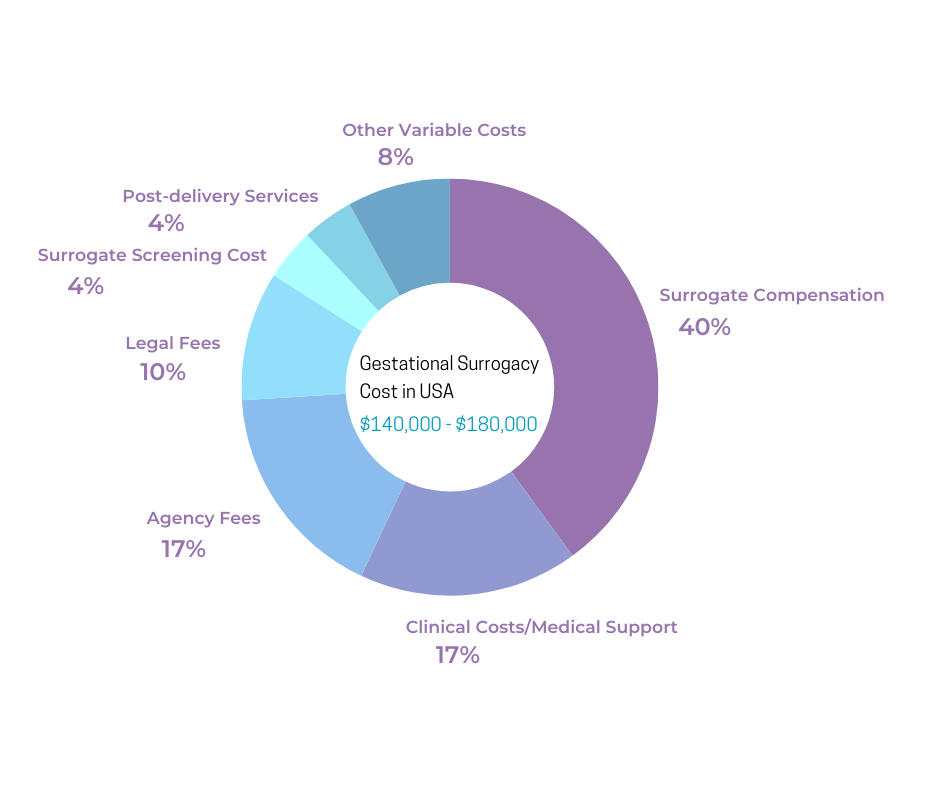
In 2026, a complete gestational surrogacy journey in the United States typically costs between $150,000 and $220,000. In high-demand states like California, totals frequently exceed $200,000. And in complex cases — multiple IVF cycles, donor eggs, or a live birth guarantee — the all-in cost can reach $250,000–$300,000.
That figure covers the full journey from surrogate match to delivery: surrogate compensation, In Vitro Fertilization (IVF), agency coordination, legal services, escrow management, and insurance.
At Physician’s Surrogacy, our surrogacy programs start at $145,000, at or below the industry average. All our quotations are fixed and flat: no hidden costs, no disputes, and no agency fees until your match is confirmed.
This guide breaks down exactly where that money goes, what drives costs up or down by state, and how to read whether a pricing structure actually protects you.
Quick Answer
A full U.S. surrogacy journey in 2026 typically costs $150,000–$220,000, and can reach $250,000–$300,000 in complex cases involving donor eggs or a live birth guarantee. That total includes surrogate compensation, IVF and medical care, agency coordination, legal services, escrow, and insurance.
When families ask how much surrogacy costs, they want the all-in number. Not just the surrogate’s pay. Not just the agency fee. The total includes both fixed and variable expenses — knowing each category helps you spot whether a quoted price is complete or missing entire line items.
Why Physician’s Surrogacy
| Cost Category | Typical U.S. Range | What It Covers |
|---|---|---|
| Surrogate Compensation | $60,000–$75,000+ | Flat-rate package, household allowance, milestone payments |
| IVF & Medical Care | $15,000–$30,000+ | IVF cycles, medications, embryo transfer, medical clearance |
| Agency Coordination | $20,000–$35,000+ | Matching, screening, case management, monitoring |
| Legal & Escrow | $8,000–$15,000 | GCA drafting, parentage orders, escrow management |
| Insurance | $10,000–$25,000+ | Surrogate maternity coverage if plan excludes surrogacy |
| TOTAL (Typical U.S.) | $150,000–$220,000 | Full journey: match to live birth |
* Actual costs depend on program inclusions, embryo readiness, surrogate experience, insurance structure, state law, and number of transfer attempts. Complex cases with donor eggs or live birth guarantees can reach $250,000–$300,000. California journeys frequently exceed $200,000.
Surrogate compensation reflects the physical commitment, medical involvement, and time a gestational carrier dedicates over 12–18 months. It is not a simple fee — and the headline number you see quoted is rarely the final number.
Most agencies quote a starting compensation figure — typically $45,000–$55,000 — then add allowances, reimbursements, and milestone payments on top. By the time the package is fully built out, the total often lands in a similar range to what transparent agencies charge upfront. The difference is that you won’t know the real number until you’re already committed.
At Physician’s Surrogacy, surrogate compensation is structured as a flat-rate package starting at $60,000–$75,000+ for first-time surrogates. Experienced surrogates can earn more on each subsequent journey. The full picture is disclosed on day one — not assembled piece by piece as the journey unfolds.
Three factors drive most of the variation in surrogate compensation across agencies and states.
Agency coordination fees typically run $20,000–$35,000. That range pays for infrastructure — but not all agencies use it the same way, and not all of them wait for a match to start charging.
At many agencies, fees begin accumulating at application or shortly after — before you’ve met a surrogate, before a match is confirmed, before the journey has really started. Some structure fees as a lump sum up front. Others bill at milestones in a way that front-loads the financial risk to the intended parent.
Services covered by agency fees generally include surrogate screening and matching, case management across the IVF clinic, attorneys, and surrogate, and ongoing support when problems arise. The question most families don’t ask early enough: at what point do I start paying, and what do I get for it?
At Physician’s Surrogacy, no agency fees apply until your surrogate match is confirmed. Your financial commitment starts when the match does — not before.
There’s a second question worth asking: who’s actually running the medical side? Most agencies are staffed entirely by coordinators with no clinical training. Our agency is managed by onsite, board-certified OB/GYNs — a structure no other surrogacy agency in the U.S. offers.

Medical care is the most variable part of surrogacy costs — and the one families underestimate most often.
A single IVF cycle in 2026 runs approximately $15,000–$30,000, according to data from FertilityIQ and RESOLVE: The National Infertility Association. The total clinical budget for a surrogacy journey typically reaches $30,000–$50,000 because you’re covering medical care for two patients: the surrogate and yourself (or an egg donor).
Surrogacy-specific IVF requires steps beyond a standard cycle. Food and Drug Administration (FDA) screening for intended parents. Medical clearance protocols for the surrogate. Cycle synchronization between donor and carrier.
Many families add Preimplantation Genetic Testing (PGT-A) to maximize success on the first embryo transfer. PGT-A alone adds $3,000–$10,000, according to the Society for Assisted Reproductive Technology (SART) — but the data supports it. PGT-A tested embryos transferred to a screened gestational carrier achieve live birth rates of 70–80% per transfer, compared to 40–60% without genetic screening, according to published clinical data from SART and the CDC’s Assisted Reproductive Technology reports.
Once a surrogate is confirmed pregnant, the news gets even better. Over 95% of gestational surrogacy pregnancies result in a live birth, according to national outcome data from SART and the CDC. That’s one of the most reassuring statistics in all of reproductive medicine — and it’s largely the result of how rigorously surrogates are screened before the process begins.
What most agencies cannot offer — but Physician’s Surrogacy can — is onsite OB/GYN oversight throughout the medical side of your journey.
Our physicians can order optional antenatal testing: Non-Invasive Prenatal Testing (NIPT), Nuchal Translucency (NT) Sonogram, AFP Quad Screen, and Fetal Echocardiogram. They also conduct peer-to-peer consultations with your surrogate’s managing OB if complications arise.
The result shows up in the data. Our preterm delivery rate runs 50% below the national average. Coordination-only agencies — where medical decisions pass through non-clinical staff — don’t publish equivalent figures.
Legal work protects your parental rights and makes financial responsibilities clear before the journey begins. Costs typically run $8,000–$15,000.
That amount covers a Gestational Carrier Agreement (GCA) — the contract outlining rights and terms — plus pre-birth or post-birth parentage orders depending on state law, and escrow management through a neutral third party.
States with clear surrogacy statutes — California, Nevada, and Texas among them — offer more predictable legal pathways. That reduces both costs and timeline uncertainty. Attorneys with surrogacy-specific experience are still required in every state. General family law attorneys often miss jurisdiction-specific parentage rules that can delay or jeopardize orders.
Insurance is the surrogacy budget line item that surprises families most often. Many standard health plans contain exclusions for surrogate pregnancies. Key variables to review early:
Insurance review should happen before a match is confirmed — not after. For a full checklist, see our guide on surrogacy insurance coverage.
Most agencies start billing before you’ve met a surrogate. At Physician’s Surrogacy, no agency fees apply until your match is confirmed. Our average match time is one week.
Standard program starts at $145,000 — at or below the national average, with OB/GYN oversight included.
See which program fits your situation.
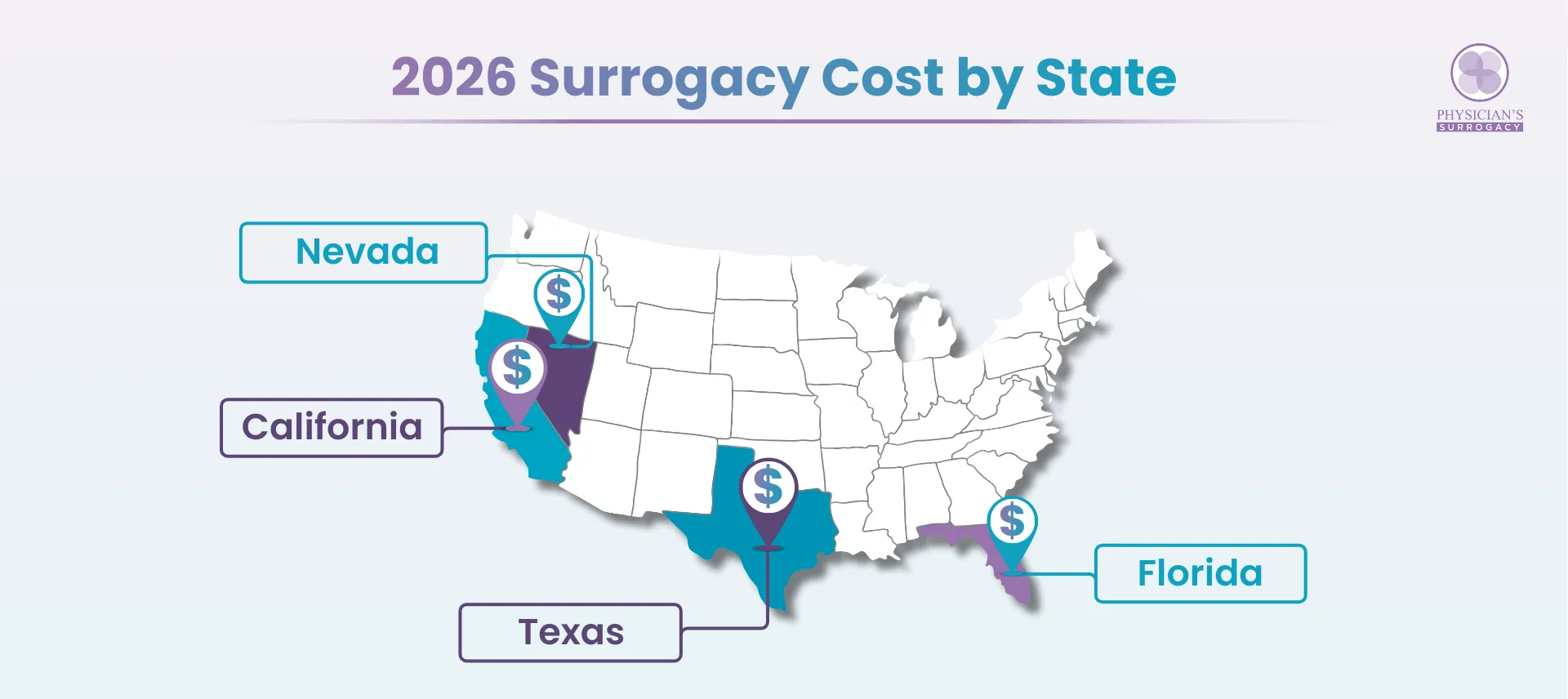
Total surrogacy costs vary by state for three reasons: legal complexity, surrogate compensation expectations, and local cost of living. States with clear surrogacy statutes tend to attract more surrogates, which increases competition and, in some cases, compensation rates.
| State | Typical Total Cost | Surrogate Compensation | Why It Varies |
|---|---|---|---|
| California | $150,000–$200,000+ | Starting at $75,000+ | High demand, strong legal protections, higher cost of living |
| Nevada | $120,000–$180,000+ | Starting at $75,000+ | Clear parentage statutes, competitive pricing |
| Texas | $130,000–$180,000+ | Starting at $60,000+ | Predictable legal environment, lower operational costs |
| Florida | $110,000–$190,000+ | Starting at $67,000+ | Surrogacy-friendly law, moderate medical costs |
| Illinois | $120,000–$170,000+ | Starting at $60,000+ | Gestational Surrogacy Act (2005), insurance mandate state |
| Michigan | $110,000–$160,000+ | Starting at $60,000+ | New ARSPA law (April 2025), growing surrogate pool |
* Ranges are representative 2026 estimates. Actual totals vary based on program tier, agency, surrogate experience, insurance coverage, and number of IVF attempts.
We work with surrogates across 46 states. If your state has restrictive surrogacy laws, a California-based agency creates a cleaner legal pathway and faster timeline. Families working with us benefit from our California headquarters and established clinical partner network.
If you’re exploring whether an agency is necessary at all, our guide on independent surrogacy covers what families give up — and what they’re responsible for — when they proceed without agency screening, escrow, or clinical oversight.
International surrogacy in countries like Colombia, Mexico, or Georgia typically costs $50,000–$80,000. That price gap is real. It also comes with trade-offs most families don’t fully price in at the start.
Most agencies charge premium rates for physician oversight. We include it at comparable pricing — plus a 50% lower preterm delivery rate and one-week matching.
Fixed and flat pricing. Zero agency fees until match.
Get your personalized quote with no obligation.
Most agencies quote a single headline price and leave the rest for later. What you eventually discover — often mid-journey — is that fees began accumulating before you matched, categories were missing from the initial quote, and the total you agreed to bears little resemblance to what you’re actually paying.
Physician’s Surrogacy operates differently. Every program is fixed and flat: the number you see at the start is the number you pay. There are no milestone fees that compound as the journey unfolds or agency fees to pay until your surrogate match is confirmed.
There are four programs, each designed for a different situation. The right one depends on your timeline, whether you’re bringing your own embryos, and how much financial certainty you need if a transfer doesn’t succeed.
| Program | Price | Timeline | Best For |
|---|---|---|---|
| Surrogacy Flat Rate | $145,000 | 18–22 months | Standard fixed-and-flat program. Families with viable embryos ready to proceed. |
| Physician Plus | $193,000 | 12–14 months | Priority access at every stage. 10:1 case manager ratio. Birth concierge. Fastest path to a live birth. |
| Surrogacy Livebirth Guarantee | $208,000 | 18–22 months | All-inclusive GC IVF expenses. Unlimited transfers. 80% refund if live birth not achieved after 3 transfers. |
| All-Inclusive Bundle | $255,000 | 18–22 months | Adds donor eggs to the Livebirth Guarantee. Full end-to-end coverage for families starting from scratch. |
* All programs include OB/GYN-managed surrogate screening, one-week average matching, and Fixed and flat pricing with no agency fees until match confirmed.
A few things worth understanding about how these programs compare to the rest of the industry.
The Surrogacy Flat Rate at $145,000 sits at or below what most families eventually pay at a traditional agency — once all milestone fees, rebilling, and add-ons are counted. The difference is that the PS number is the number. No surprises at transfer or invoices arriving when something unexpected happens.
The Surrogacy Livebirth Guarantee at $208,000 looks higher than the national average, until you price out what happens when things don’t go perfectly. Unbundled surrogacy costs with multiple transfer attempts can easily exceed $280,000–$300,000. The guarantee bundles all GC IVF expenses and provides financial protection that saves families up to $60,000 versus standard unbundled costs.
And the $255,000 All Inclusive Bundle isn’t the upper end of a range; it’s a fully defined package covering donor eggs, a livebirth guarantee, and all clinical expenses. Families pursuing surrogacy without existing embryos frequently hit $250,000+ anyway, usually through a combination of unpredictable agency billing and clinical costs they didn’t budget for. The bundle makes that number certain instead of open-ended.
Every one of these programs includes the same physician-designed surrogate screening that produces our preterm delivery rate 50% below the national average. OB/GYN oversight isn’t a premium add-on here — it’s the foundation of every tier.
Surrogacy is a substantial investment. Many families combine savings, employer benefits, and outside support to make the journey achievable. Planning should start early — well before you commit to an agency.
Several nonprofits offer grants specifically for fertility treatment and surrogacy-related expenses. These awards are competitive, but even partial funding reduces strain on the overall budget.
Many employers now offer fertility benefits through programs like Progyny, Carrot, or Maven. Some plans reimburse IVF, donor gametes, and — in certain cases — surrogacy-related services. Check with HR before assuming coverage isn’t available. Coverage has expanded meaningfully in recent years.
Specialized fertility lenders structure products around the milestone-based nature of surrogacy. They typically offer higher loan limits, deferred or interest-only payment periods, and repayment timelines aligned with IVF and pregnancy milestones.
Other tools families use:
Cost comparisons across agencies mislead when two quotes don’t cover the same categories. A lower headline price may exclude insurance review, escrow setup, or the cost of re-screening if a surrogate withdraws. An agency that charges fees before a match shifts financial risk to the intended parent from day one.
The more useful question isn’t which agency is cheapest. It’s what does this price include, and who is responsible when something unexpected happens?
The families who feel most confident entering this journey aren’t the ones who found the lowest quote. They’re the ones who understood every line item before they signed anything — and chose an agency where medical decisions were made by doctors, not coordinators. That’s a different kind of assurance. And when you’re trusting someone else to carry your child, that difference is exactly the one that matters.
Our preterm delivery rate runs 50% below the national average. That’s a measurable outcome of the physician-led model — not a marketing claim. Families are not paying a premium for physician-led care. They’re getting it at a comparable total cost to coordination-only agencies.
Knowing how much surrogacy costs is only part of the picture. The harder questions are what that price actually includes, whether it will change mid-journey, and who is accountable when something unexpected happens.
At most agencies, those questions don’t have clean answers until you’re already in a contract. At Physician’s Surrogacy, the answers are fixed from the start. Four programs, four prices — each covering a defined scope with no hidden costs and no agency fees until your match is confirmed.
The standard Surrogacy Flat Rate at $145,000 puts physician-managed surrogacy at or below the industry average. The Surrogacy Livebirth Guarantee at $208,000 provides the financial certainty that most families wish they had bought when their journey ran longer than planned. The All Inclusive Bundle at $255,000 covers everything — donor eggs included — for families building from the beginning.
If you want to understand which program fits your situation, talk with our team and get a personalized breakdown.
Our standard program starts at or below the national average — with physician oversight, one-week matching, and Fixed and flat pricing built in. The Livebirth Guarantee and All Inclusive Bundle provide complete financial protection for families who need it.
No agency fees until your match is confirmed. No hidden costs at any tier.
Get your personalized cost estimate with no obligation.
!
If you’re preparing for IVF as an intended parent — using your own eggs or working with an egg donor — follicle stimulating hormone (FSH) is the medication at the center of the process. It’s what drives the ovaries to produce multiple mature eggs at once, which is the biological foundation every IVF cycle depends on.
Understanding how FSH works, what your levels mean before you start, and what to watch for during stimulation helps you go into this process with clear expectations. This guide covers all of it — plus how Physician’s Surrogacy coordinates the medical side of your surrogacy journey with your fertility clinic.
Quick Answer
Follicle stimulating hormone is produced by the pituitary gland and signals the ovaries to develop eggs. In IVF, synthetic FSH medications override the natural one-egg-per-cycle process, stimulating multiple follicles to grow at once — giving fertility clinics more eggs to work with.
FSH is produced by the pituitary gland — a small structure at the base of the brain that governs many of the body’s hormonal systems. The pituitary releases it in response to signals from the hypothalamus, and the hormone travels through the bloodstream to the ovaries.
Its primary function is to stimulate follicle growth. Each follicle contains one immature egg. At the start of a menstrual cycle, rising FSH signals a group of follicles to begin developing. One dominant follicle takes the lead and eventually releases a mature egg at ovulation.
FSH works alongside Luteinizing Hormone (LH), which triggers final egg maturation and release. These two hormones coordinate the monthly cycle that makes natural conception possible. In an IVF context, synthetic versions of the hormone override this natural selection process on purpose — recruiting many follicles at once instead of just one.
FSH & IVF: What the Research Shows
Before starting an IVF cycle, your reproductive endocrinologist (RE) will order a day 3 FSH blood test — drawn on the third day of your menstrual cycle, when FSH levels sit at their baseline. This number is one of the primary markers of ovarian reserve.
A woman is born with a finite number of eggs — roughly one to two million at birth. That count declines throughout her life. By puberty, approximately 400,000 remain. By the late thirties and forties, both egg quantity and quality have dropped.
The pituitary gland detects when the ovaries become less responsive and compensates by producing more FSH — sending a stronger signal to sustain the cycle. This is why FSH levels tend to climb as women approach menopause.
These are general guidelines — your RE interprets your FSH result alongside Anti-Müllerian Hormone (AMH) and antral follicle count (AFC) for a complete ovarian reserve picture.
| Day 3 FSH Level | What It Typically Suggests |
|---|---|
| Under 10 mIU/mL | Normal ovarian reserve — good response expected |
| 10–15 mIU/mL | Borderline — diminished reserve possible; response may vary |
| Above 15 mIU/mL | Reduced reserve — lower egg counts likely |
| Above 25 mIU/mL | Markedly reduced reserve — IVF may need modified protocol |
Higher FSH doesn’t mean IVF is impossible. It means your doctor needs to tailor the stimulation protocol — and that realistic expectations around egg numbers need to be set before the cycle begins.
In a natural cycle, one egg matures and is released. IVF needs more — multiple mature eggs at retrieval increase the number of embryos available and improve the odds of a successful transfer. FSH medications make that possible by recruiting many follicles simultaneously.
This process is called controlled ovarian stimulation (COS). Here’s how each phase works:
Many protocols start with birth control pills or a GnRH agonist (such as Lupron) to regulate your cycle and prevent premature ovulation. This gives your clinic full control over the timing of stimulation.
Once stimulation begins, you’ll self-administer daily subcutaneous injections — typically in the abdomen or thigh. Common medications include follitropin alfa (Gonal-F), follitropin beta (Follistim), and menotropins (Menopur), which combines FSH with LH activity.
Every 2–3 days during stimulation, you’ll come in for a transvaginal ultrasound to measure follicle growth and a blood test to check estradiol. Your RE uses this data to adjust your FSH dose in real time.
When follicles reach 18–20mm, a trigger shot (hCG or a GnRH agonist) prompts final egg maturation. Retrieval is scheduled approximately 36 hours later — timing is precise.
Under light sedation, a thin needle is guided through the vaginal wall using ultrasound to aspirate fluid from each follicle. The procedure typically takes 20–30 minutes. You go home the same day.
Retrieved eggs are fertilized with sperm in the lab and monitored for 5–6 days as embryos develop. The strongest embryos are selected for transfer or frozen for a future cycle.
The number of eggs retrieved depends on how many follicles developed. For someone in their mid-twenties with good ovarian reserve, 10–20 eggs is a reasonable range. For those with diminished reserve, fewer eggs are typical — your RE will set expectations before the cycle begins. You can read more about how this fits into the broader process in our gestational surrogacy guide.
FSH medications have a short half-life, which is why daily injections are necessary — the stimulating effect needs continuous maintenance. Most people tolerate these medications well.
Side effects that do occur are usually linked to the ovaries enlarging as multiple follicles develop. They typically peak in the final days of stimulation and resolve after retrieval.
The most serious potential complication of FSH-based stimulation is Ovarian Hyperstimulation Syndrome (OHSS). This occurs when the ovaries overrespond to the medication — producing too many follicles and causing fluid to leak from blood vessels into the abdominal and chest cavities.
Mild OHSS is fairly common and typically resolves within one to two weeks. Severe OHSS is rare but requires prompt medical attention. According to the American Society for Reproductive Medicine, severe OHSS affects approximately 1–3% of IVF cycles.
Quick Weigh-Up
Mild vs. severe OHSS: knowing the difference helps you act at the right moment.
Some patients are more likely to develop OHSS than others. Your RE will assess your individual risk before the cycle begins and adjust the protocol accordingly.
Higher-risk factors include: young age with high ovarian reserve; high antral follicle count; Polycystic Ovary Syndrome (PCOS); a previous OHSS episode; and rapidly rising estradiol levels during stimulation. For high-risk patients, REs may use lower starting doses, more frequent monitoring, or a GnRH agonist trigger instead of hCG.
You can read more about how medical risk factors affect the surrogacy medical risks in our dedicated guide — including how these factors are evaluated before matching.
Ovarian stimulation isn’t appropriate for every situation. Your RE will review your full health profile before recommending it. Circumstances that require extra caution or protocol modification include:
If you’ve previously experienced a failed IVF cycle, your RE will use that response data to refine your next protocol. It doesn’t necessarily mean surrogacy with a donor egg is the only path — but it does inform the conversation.
Gestational surrogacy is one of the most medically sophisticated ways a family can be built — and one of the most human. The FSH stimulation process sits at the core of the intended mother’s (or egg donor’s) role in that journey.
The intended mother or donor goes through the ovarian stimulation and retrieval process described in this article. The surrogate follows a completely separate hormonal protocol to prepare her uterine lining for the embryo transfer. The two processes happen simultaneously but independently — coordinated between the fertility clinic and the surrogacy agency.
Our Physician’s Advantage means our team understands the clinical side of what you’re going through — not just the logistics. We work with a network of clinical partner fertility centers, and our physicians maintain direct communication throughout your cycle.
If you’re exploring what the full journey looks like — from embryo creation to transfer — our how surrogacy works guide covers every stage. You may also want to review our surrogacy success rates and understand how we screen and match surrogates.
Surrogacy sits at the intersection of modern medicine and profound human generosity. Having a team of physicians who understand the clinical side of your fertility treatment — and stay connected to your fertility clinic — changes the quality of that experience. If you want to understand the full cost of surrogacy or explore financing options, those resources are available on our site.
💡 For Intended Parents Using a Donor
If you’re using an egg donor, your donor — not you — goes through the FSH stimulation and retrieval process. Your role during this phase is to coordinate with the fertility clinic and prepare for the transfer. Many intended mothers also do a parallel hormonal protocol to sync with the cycle timeline.
You’ve done the research. You’ve had the hard conversations. Now the question is which surrogacy agency deserves your trust. That answer matters more than most people realize — because the agency you choose shapes your timeline, your costs, and the safety of everyone involved. This guide breaks down what actually separates a good agency from a great one, and the red flags that should end a conversation immediately.
Surrogacy sits at the intersection of modern medicine and profound human generosity. Every decision along the way has real stakes — clinical, legal, financial, and emotional. The agency you choose manages all of it.
Most agencies are run by business operators: former surrogates, intended parents, or administrators with good instincts but no clinical background. That creates a ceiling on what they can offer. They can coordinate. They can counsel. They can’t review medical records, monitor pregnancies, or maintain physician-to-physician communication with a surrogate’s OB.
That gap is where things go wrong. When no one with clinical authority is watching, surrogate screening becomes a checklist exercise. Medical risks in surrogacy don’t announce themselves in advance — they’re caught by people trained to catch them. Ask any agency you’re evaluating who exactly reviews medical records, and at what point in the process. The answer will tell you everything.
Every agency sounds good in its marketing. The questions below are harder to fake.
Some warning signs are subtle. Others are not. Here’s what should end your consideration of any agency immediately.
Fee structures that front-load risk onto you. Any agency asking for payment before a match is confirmed has the incentive structure backwards. You shouldn’t be paying for the promise of a match — only for the match itself.
Vague answers about screening depth. “We have a rigorous process” means nothing. You want specifics: who reviews medical records, at what stage, and what a failure in screening actually triggers. Read more about surrogacy agency red flags before you start comparing options.
No physician involvement in clinical oversight. This isn’t about prestige. It’s about capability. Pregnancy complications require clinical judgment — not just empathy and coordination. An agency with no physician on its team is asking you to accept a gap at the most consequential point in the process.
Unclear legal framework. Surrogacy laws differ considerably by state. An agency that can’t clearly explain the legal process in your state — or a surrogate’s state — isn’t equipped to protect either of you. See our breakdown of surrogacy contracts for what a solid legal foundation looks like.
A fast match isn’t automatically a good match. Speed matters, but not at the cost of fit. The best agencies balance both — they maintain large enough surrogate pools to move quickly, and they match with enough care that cancellations don’t follow.
The industry average for a match is 6–12 months. The gap between what’s common and what’s possible depends almost entirely on how actively the agency maintains its surrogate pool. Agencies that pre-screen surrogates before any intended parent is in the picture can offer dramatically shorter timelines — because the clinical and psychological work is already done.
When evaluating any agency’s matching process, ask to see a sample surrogate profile. Ask how many profiles you’ll typically receive before a match is made. Ask what happens if you and a surrogate decide it’s not the right fit after initial introductions.
Schedule A ConsultationOnline reviews are a starting point — not a verdict. Social media reviews can tell you about communication style and emotional support. They rarely surface clinical failures, because most clients don’t know enough to identify them until much later.
Better signals: how long has the agency been operating, what professional organizations do they follow (the American Society for Reproductive Medicine sets the baseline), and are their stated practices specific enough to verify? Vague claims — “we care deeply,” “we have a rigorous process” — should always prompt follow-up questions.
Look at their client stories too. Not just for the emotional resonance, but for the specifics: were both surrogates and intended parents represented? Did the stories reference clinical support, coordination, and communication — or only the emotional highlights?
Most agencies are built around coordination. We’re built around medicine — because that’s where the real risk lives.
Physician’s Surrogacy is the only surrogacy agency in the United States managed by practicing OB/GYNs. Our physicians designed the surrogate screening protocol, review medical records personally, and maintain peer-to-peer communication with each surrogate’s managing OB throughout the pregnancy. That’s not an added feature — it’s the foundation everything else is built on.
If you’re researching agencies in a specific state, the legal environment matters as much as the agency’s reputation. Surrogacy laws vary by state — some are highly favorable, others restrictive, and a few are genuinely ambiguous. Choosing an agency that operates across multiple states and understands local law is worth prioritizing.
Click any teal state to read the Physician’s Surrogacy guide for that state.
If you’re also weighing which state fits your surrogacy journey best, it’s worth seeing how the laws compare before you decide.
And if you’re still torn between going independent or working with an agency, that’s worth reading too.
Gestational surrogacy is one of the most medically sophisticated ways a family can be built — and one of the most human. We think that level of complexity deserves physician-level oversight, not just coordination.
Our preterm delivery rate is 50% below the national average.
That outcome doesn’t happen by accident — it’s the result of physician-designed screening and clinical monitoring throughout every pregnancy. Learn how gestational surrogacy works at PS.
There’s no shortage of surrogacy agencies. There is a shortage of agencies that can answer hard clinical questions with specifics, quote you a total cost in writing, and match you in a week rather than a year. Those aren’t small differentials — they’re the difference between a journey that protects everyone involved and one that exposes them to preventable risk.
Take your time with this decision. Ask every question in this article. Push back on vague answers. And pay attention to what an agency prioritizes when it talks about itself — because that reveals what it actually values.
If you’re ready to see what physician-led surrogacy looks like in practice, we’d be glad to walk you through it.
Schedule A Consultation!
You’re not here for a vague overview. You’ve probably already spent time researching, and what you actually need is a clear picture of how surrogacy works — what happens first, what happens next, how long each step takes, and where things typically go wrong.
This guide covers the full process from an intended parent’s perspective: the medical steps, the legal steps, the realistic timeline, and what separates a smooth journey from a frustrating one. It’s written around the process at Physician’s Surrogacy — the only surrogacy agency in the U.S. managed by practicing OB/GYNs — though the foundational framework applies across the industry.
Surrogacy by the Numbers
Surrogacy is an arrangement in which someone else carries a pregnancy on your behalf. In the U.S., almost every intended parent uses gestational surrogacy — meaning the carrier has no genetic link to the baby.
The embryo is created through In Vitro Fertilization (IVF) using eggs and sperm from intended parents and/or donors, then transferred to the carrier’s uterus. The surrogate has no genetic connection to the child she carries.
Two tracks run in parallel from day one: the medical process — IVF, surrogate screening, embryo transfer, prenatal care — and the legal process — contracts, parentage steps, hospital planning. Experienced professionals are needed on both sides, and both tracks move faster when your agency coordinates proactively rather than reactively.
Quick Answer
Surrogacy is rarely a first step. Most intended parents arrive after infertility treatment, a medical diagnosis, recurrent pregnancy loss, or because a genetic connection to their child isn’t possible any other way. It’s a considered, deliberate path — not a shortcut.
People arrive at surrogacy through different paths. Intended parents often pursue it after infertility or repeated IVF failure, medical conditions that make pregnancy unsafe or impossible, recurrent pregnancy loss, prior hysterectomy or cancer treatment, or because they’re same-sex male couples or single parents building a family independently.
According to RESOLVE: The National Infertility Association, roughly 1 in 5 couples in the U.S. experience infertility. Surrogacy serves as a path forward for those for whom other options have been exhausted or ruled out medically.
There are two types of surrogacy, but in practice only one is commonly used today. The distinction matters — legally, medically, and emotionally.
The carrier has zero genetic connection to the baby. An embryo created via IVF is transferred to her uterus. In most cases, at least one intended parent is genetically related to the child. This is what Physician’s Surrogacy — and virtually every reputable agency — uses exclusively. See our full guide on gestational surrogacy for a deeper breakdown.
Traditional surrogacy uses the surrogate’s own egg, creating a genetic link between her and the baby. This raises major legal complexity, is banned or restricted in many U.S. states, and is no longer offered by most reputable agencies. Learn more in our comparison of gestational vs. traditional surrogacy.
For a complete overview of all surrogacy types — including altruistic vs. compensated, domestic vs. international — visit our full types of surrogacy guide.
Here is how surrogacy works end to end — from your first conversation with an agency to bringing your baby home. Each step includes a realistic timeframe based on our program. Gestational surrogacy is one of the most medically sophisticated ways a family can be built — and one of the most human.
A free consultation maps your specific situation: embryo status, preferred timeline, and delivery state. You leave with an actual plan — not a brochure.
Every candidate clears a physician-designed screening protocol — not a coordinator’s checklist. More than 90% of applicants don’t pass. That’s intentional.
Our average match time is one week — versus 6–12 months industry-wide. The Medically Cleared Program pre-clears surrogates before matching, so there’s no post-match screening wait.
Independent attorneys for both parties draft and finalize the surrogacy agreement. The contract covers compensation, medical decisions, insurance, communication, and parentage rights.
Once contracts are signed and the clinic clears your surrogate, the medical cycle begins. Hormonal preparation is followed by the embryo transfer — a brief outpatient procedure at your partner fertility clinic.
Our onsite OB/GYNs review clinical notes after every prenatal appointment and deliver physician-monitored updates to you. When complications arise, our doctors consult peer-to-peer with the surrogate’s managing OB.
Legal preparation for birth runs in parallel with the pregnancy. In most surrogacy-friendly states, a pre-birth order establishes your rights before delivery. Surrogacy laws vary by state — your legal team manages this based on where your surrogate delivers.
Your surrogate delivers at her local hospital. Intended parents are typically present per the match agreement. Post-delivery support for the surrogate continues for 3–6 months — coordinator access, medical referrals, and continued check-ins.
Most agencies are run by business operators. Physician’s Surrogacy is managed by practicing OB/GYNs — a structural difference that shows up at every stage of the journey.
The industry standard for surrogate matching is 6–12 months. Physician’s Surrogacy averages one week — because our onsite OB/GYNs run screening before any match is made, not after.
One week average match time. 50% lower preterm rate. No IP agency fees until match.
Schedule a free consultation — get a plan built around your embryo status and timeline.
The table below shows a realistic timeline using the Medically Cleared Program. Standard program timelines are slightly longer because screening happens after matching rather than before.
| Phase | Timeline | Key Milestone |
|---|---|---|
| Consultation & planning | Week 1 | Embryo status confirmed, program selected |
| Surrogate matching | ~1 week post-consult | Match confirmed — no agency fees until this point |
| Legal contracts | 2–3 weeks post-match | Surrogacy agreement signed |
| Medical cycle & transfer | 4–6 weeks post-legal | Embryo transfer; pregnancy test ~10 days later |
| Pregnancy monitoring | Months 3–9 | Physician-monitored updates every appointment |
| Pre-birth legal steps | Third trimester | Pre-birth order filed (where applicable) |
| Delivery | Month 12–13 | Baby born; intended parents named on birth certificate |
| Post-birth support | 3–6 months post-delivery | Surrogate recovery support; journey complete |
* Total journey time at Physician’s Surrogacy is approximately 14 months from match to live birth. The Medically Cleared Program compresses the pre-transfer phase to 10–16 weeks start-to-transfer.
The single biggest delay in a traditional surrogacy journey is post-match medical clearance. In the standard model, the surrogate goes through fertility clinic screening after matching — which takes 6–16 weeks and sometimes results in rejection after everyone is emotionally invested.
Quick Answer
A complete U.S. surrogacy journey at Physician’s Surrogacy uses a Flat-Rate program — all quotations are fixed and flat, no hidden costs. Programs start at $145,000 for the Surrogacy Flat Rate and reach $255,000 for the All Inclusive Bundle. No agency fees until your match is confirmed.
The major cost categories in any surrogacy journey include surrogate compensation, agency coordination, IVF and embryo transfer, legal fees for both parties, and surrogate medical insurance. PS structures all of these as a flat-rate package — no surprise invoices, no disputes mid-journey.
| Program | Price | Match-to-Baby Timeframe |
|---|---|---|
| Surrogacy Flat Rate | $145,000 | 18–22 months |
| Physician Plus | $193,000 | 12–14 months |
| Surrogacy Livebirth Guarantee (All Inclusive) | $208,000 | 18–22 months |
| All Inclusive Bundle | $255,000 | 18–22 months |
| All programs | Fixed and Flat | No hidden costs, no disputes |
* Surrogate compensation starts at $60,000–$75,000+ based on state for first-time surrogates; experienced surrogates can earn more. All compensation is managed through secure escrow and disbursed on a fixed schedule per the contract. See our complete cost guide.
The biggest structural advantage in our program isn’t just the physician involvement — it’s the sequencing. In a traditional agency model, surrogates go through fertility clinic screening and medical clearance after a match is made.
That sequence introduces a 6–16 week wait at the moment when intended parents are most emotionally invested. It’s also the moment when a medical rejection is most disruptive. The Medically Cleared Program eliminates this by completing all screening before any match is made. When a match happens, both parties move immediately — no waiting, no uncertainty about clearance.
10–16 weeks start-to-transfer, compared to 25–64 weeks at agencies using a traditional post-match model. The legal timeline remains standard — medical clearance accelerates the clinical track, not the legal one.
If you’ve been researching how does surrogacy work because you’re ready to move forward, the most useful next step is a direct conversation — not more reading. A consultation gives you a real answer built around your embryo status, your state, and your timeline.
For prospective surrogates, the process starts with a pre-screening that takes about 20 minutes and qualifies you for the $1,250 completion bonus. You can also browse our surrogate screening overview to see what the process looks like from the inside. Every journey — giving the gift of life or building your own family — starts with one step taken when you’re ready.
For families building through surrogacy and for women giving the gift of life, Physician’s Surrogacy offers physician-level oversight at every stage — and a process built around your timeline, not ours.
Average match time: one week. One week average match time. 50% lower preterm rate. No IP agency fees until match.
You’re excited to become a surrogate, but a question keeps surfacing: “What if the intended parents are difficult?” Midnight texts about your diet. Constant questions about your health. The stress of feeling monitored for nine months straight.
If the thought of managing this relationship gives you anxiety, you’re not alone. The good news is that you have real control over what this looks like. The key isn’t finding a “perfect” set of intended parents — it’s defining a surrogate and intended parent relationship that works for you, one where you feel respected, supported, and comfortable.
At Physician’s Surrogacy, the nation’s only OB/GYN-managed surrogacy agency, we’ve helped surrogates and intended parents build positive working relationships across every communication style. This guide walks you through the most common relationship types, how to set healthy boundaries, and how to protect your emotional well-being when things get complicated.
Surrogate and intended parent (IP) relationships generally fall into three patterns. Knowing which feels right to you before you enter matching is more useful than discovering it six months in.
This type involves a close bond that often continues long after the baby is born. Communication is frequent — sometimes daily — and feels more like a friendship than a professional arrangement.
The intended parents may attend appointments, share in family milestones, and remain a lasting part of each other’s lives. Best for surrogates who naturally form deep connections and want an ongoing relationship after birth.
This dynamic involves warm, supportive communication throughout the pregnancy — but with little expectation of a long-term bond afterward. Regular updates, shared excitement at milestones, and a genuine connection that naturally winds down after delivery.
Works well for surrogates who want warmth during the journey while valuing privacy and independence post-birth.
The most business-like of the three. Communication is formal and often handled through the agency. Updates are limited to key medical milestones, with minimal personal sharing.
Little or no contact after birth. Suits surrogates who prefer clear emotional boundaries, professional distance, and a more private surrogacy experience from start to finish.
One surrogate summed up the family-style connection this way: “I consider my intended parents as part of my family. We bonded immediately once we matched, and from that moment, I just knew my journey was going to be meaningful.”
Another described the professional approach without regret: “I would describe my relationship with the intended parents as one that business partners have. We were both very dedicated to a common goal, but I was not anticipating weekly updates after the baby went home.”
Both are legitimate. Both lead to positive outcomes. The only wrong choice is entering matching without knowing which type of surrogate and intended parent relationship you want.
No matter which relationship type feels right to you, the foundation of a successful surrogate and intended parent relationship is clear communication and healthy boundaries — established early, not after friction has already built up.
The most effective way to avoid relationship stress is to be direct about your preferences from the beginning. At Physician’s Surrogacy, our matching process is designed to connect you with intended parents who share your vision for the relationship. When completing your application, be specific:
The more specific your preferences, the better the match. Vague answers lead to misaligned expectations; clear answers lead to relationships that start on solid ground.
Before the matching conversation happens, it helps to spend some time reading about emotional readiness for surrogacy — understanding your own boundaries makes it much easier to articulate them to a prospective IP.
Even with careful matching, you may find that an IP’s expectations don’t quite align with your comfort level. An intended mother who texts at midnight asking about your vitamins. An intended father forwarding health articles with commentary. These are common situations — and they’re addressable when you have the right tools.
These four approaches handle most day-to-day friction. When they don’t, that’s when your agency becomes the right resource.
Your agency exists precisely for situations where direct communication has reached its limits. If a dynamic becomes genuinely uncomfortable, reaching out to your coordinator is the right move — not a sign of failure.
At Physician’s Surrogacy, our in-house OB/GYNs can communicate directly with intended parents about medical concerns — providing clinical reassurance that takes the pressure off you entirely. When your IPs have questions or anxieties about your care, a physician answers them with authority.
“When my intended mother was anxious about my diet, the agency arranged a call with their OB. Having a doctor explain normal pregnancy nutrition really helped calm her fears, and I felt less monitored.”
This is one of the concrete advantages of working with an OB-managed agency — medical authority exists in-house and gets deployed on your behalf.
Surrogacy is one of the most generous commitments a person can make — and it can be emotionally demanding, particularly when relationship dynamics get complicated. Your emotional health is not secondary to the journey. It is part of the journey.
Having people you can talk to outside the surrogacy arrangement is something to build intentionally, not assume will exist. Consider building each layer deliberately.
When the IP relationship feels draining, these approaches help you reset rather than accumulate resentment:
One difficult text is an incident. Weekly anxiety about a relationship dynamic is a pattern — and patterns are worth addressing with professional support before they compound.
Note when you feel most stressed, and don’t wait until you’re depleted to ask for help. At Physician’s Surrogacy, surrogates receive dedicated coordinator support throughout the journey — and post-delivery support for 3–6 months after birth, because the emotional work doesn’t stop at the delivery room door.
As one surrogate reflected: “I imagined having a close relationship with the intended parents. It was good during pregnancy, but we became more distant after birth. I do wish it had been closer, but I feel it would have gotten too difficult for me.” Relationships evolving differently than expected don’t make the journey a failure — they make it human.
You’ll find more perspective on tips for surrogate mothers navigating the emotional terrain of the process — worth reading before and during your journey.
Understanding relationship types is useful. Knowing how to apply them in the matching process is where it becomes actionable. Here’s how to set yourself up for a surrogate and intended parent relationship that works from the start.
Ask yourself honestly: Do you form deep bonds quickly, or do you prefer boundaried professional relationships? How comfortable would your partner and children be with different levels of IP involvement? Would you be satisfied maintaining contact for years — or do you want a clear endpoint?
Instead of “I’d like a friendly relationship,” give specifics: “I’d like weekly update calls during pregnancy,” “I’m comfortable with IPs at ultrasounds,” or “After birth, I’d appreciate photos twice a year but no ongoing contact.” Specificity directly improves your match quality.
When meeting potential intended parents, ask directly: How often would they like to communicate? What level of involvement do they want during the pregnancy? Have they worked with a surrogate before — and what did that relationship look like?
During matching, pay attention to how you feel in the conversation. Does communication feel natural? Do you sense they respect your comfort level without being asked? The gut feeling that says “these are my people” — or the discomfort that says they’re not — is data worth taking seriously.
It also helps to understand what you’re actually signing up for before you apply. A complete guide to becoming a surrogate covers the full process, from eligibility through delivery — so you go into matching with full context.
Surrogate and intended parent relationships don’t fit a single template. These experiences from surrogates illustrate how different approaches can all lead to meaningful outcomes.
“I loved my intended parents during my surrogacy. When I first met them, it felt like I’d known them my whole life. We’re good friends now — we talk at least once a week over video call, and we’re planning to visit them in Paris next month.”
— Physician’s Surrogacy surrogate
“My relationship with the intended parents couldn’t be better. We hit it off from the beginning, and it grew gradually. They message me with updates and pictures frequently, even now. I will always look at them as part of my family.”
— Physician’s Surrogacy surrogate
And for those who chose a more boundaried path: “I didn’t want a close relationship, and I didn’t think it would matter much to me. But I found that periodic updates mattered more than I expected. They still send pictures once a year, and I love it.”
Every style works — when it’s chosen deliberately.
A successful surrogate and intended parent relationship isn’t about finding perfect intended parents — it’s about defining a relationship structure that works for you and communicating it clearly before you’re inside the journey.
Take ten minutes before your next agency conversation to write down your ideal communication plan: how often, through what channels, and what you want the post-birth relationship to look like. That clarity will serve you through matching, through the pregnancy, and through whatever comes after.
Surrogacy sits at the intersection of modern medicine and profound human generosity. When your relationship with your intended parents is built on honest communication from the start, that generosity has the support structure it deserves.
When you’re ready to take the next step, start your surrogate application — our matching process is built to find intended parents who are looking for exactly the kind of relationship you want.
Every surrogacy agency describes their surrogate screening process with the same three words. “Rigorous.” “Comprehensive.” “Thorough.” None of that tells you what actually happens — or why the outcome at one agency is meaningfully different from another.
The difference isn’t the number of steps. Most agencies run the same basic sequence through their surrogate screening process: application, phone interview, background check, physical, psych eval. The difference is who runs each step, what they’re looking for, and what they do with what they find.
At Physician’s Surrogacy, that difference is structural. Onsite board-certified OB/GYNs design and oversee the medical components of screening — not coordinators with checklists. That single fact changes what the surrogate screening process can catch, what it can clear, and what it means for the women who go through it.
Gestational surrogacy places real physiological and psychological demands on a woman’s body and mind. The surrogate screening process exists to confirm a candidate can meet those demands safely and successfully. Without it, there is no way to know before someone else’s baby is involved.
The ASRM’s 2022 guidelines require all gestational carrier candidates to complete a full medical evaluation and psychosocial consultation before acceptance into any surrogate screening process. That’s the floor.
At Physician’s Surrogacy, our OB/GYNs identified additional risk factors that standard checklist-based screening misses. Blood pressure patterns across multiple pregnancies. Recovery timelines after prior C-sections. Gestational diabetes screening results that a coordinator marks “negative” without knowing what to ask next. These are the things that decide whether a pregnancy goes well.
That’s why our preterm birth rate is 50% below the national average.
Quick Answer
The surrogate screening process covers medical history review, physical screening, psychological evaluation, background checks, and IVF clinic compatibility review. At Physician’s Surrogacy, onsite board-certified OB/GYNs run the medical components. The physician-led model changes what gets caught, what gets cleared, and who gets approved.
Here is what happens inside each step — and what a physician-led process finds that a coordinator-run process typically misses.
A 10-minute form covering personal info, pregnancy history, health status, and lifestyle. It immediately confirms state eligibility, which matters more than most applicants expect.
A 30–45 minute call that goes deeper into your surrogate screening process history than a form can. Health history, motivation, family situation — plus a real opportunity to ask about compensation, timelines, and what happens if something goes wrong.
Criminal and financial screening for the candidate and all adults in the household. Red flags are reviewed in context rather than used as automatic disqualifiers.
Our OB/GYNs read your actual OB/GYN records. Delivery outcomes, labor progression, blood pressure patterns, placental health — the full clinical picture. This is where the surrogate screening process diverges most sharply from how other agencies work.
Arranged near your home. No travel required. The physical surrogate medical screening includes a full bloodwork panel, urinalysis, infectious disease testing, and BMI review. Our physician team goes beyond ASRM minimums on every bloodwork panel.
A licensed mental health professional conducts a structured interview as part of the surrogate screening process. It covers mental health history, motivations, support system, and readiness to hand the baby over. Partners participate. The evaluator is looking for readiness, not reasons to disqualify.
Every fertility clinic has its own gestational carrier requirements. Our physicians handle this review directly with the clinic before matching. You’re never cleared by us, paired with intended parents, and then rejected by the IVF team.
Housing stability, financial independence, household support, personal network. This final stage of the surrogate screening process confirms whether the conditions exist for a safe, successful pregnancy.
Step 4 is where the surrogate screening process separates physician-led agencies from coordinator-run ones. The entire surrogate medical screening lives or dies on what happens in this step.
A coordinator sees “C-section delivery” and checks a box. A physician sees “C-section at 38 weeks due to breech presentation, uncomplicated recovery, well-healed uterine incision, four-year interval since last pregnancy.” Those are not the same data point. One produces a pass/fail. The other produces a clinical judgment.
Our OB/GYNs review delivery outcomes, labor progression, placental health, blood pressure patterns across multiple pregnancies, gestational diabetes screening results, and recovery timelines. They’re reading the same records they’d review in their own obstetric practices. They are the same physicians.
A history of preeclampsia, one or two prior C-sections, or gestational diabetes doesn’t mean automatic rejection. Our OB/GYNs don’t ask “did this happen?” They ask “what does this mean for a future pregnancy, and what does the full clinical picture show?” Those are very different questions. Only a physician can answer them.
The physical component of the surrogate screening process is arranged near your home — no travel required. It includes a physical examination, full bloodwork panel (CBC, metabolic panel, thyroid function, infectious disease), urinalysis, and baseline health metrics including BMI.
BMI is part of the picture, but it isn’t the whole story. Research consistently shows that BMI above 35 at embryo transfer correlates with higher rates of gestational diabetes, preeclampsia, and cesarean delivery. That’s why our threshold is below 35 at application, with case-by-case evaluation for 35–37.
Infectious disease testing follows FDA and ASRM requirements. HIV and hepatitis B or C are absolute disqualifications. There are no exceptions and no retesting pathways for these conditions.
Surrogate medical screening doesn’t stop at bloodwork. Every candidate must also complete a psychological evaluation with a licensed mental health professional. Partners participate too. A surrogacy pregnancy puts real demands on a whole household — sleeping schedules, childcare, finances during bed rest. A partner who isn’t genuinely on board will make that felt long before anyone sees it coming.
GC psychological screening research, published in Fertility and Sterility, confirms that ASRM recommends all candidates complete a psychosocial consultation as part of the surrogate screening process, and that the field continues to refine which protocols work best.
The evaluation covers mental health history, motivations, emotional readiness, support system, and the candidate’s understanding of what it means to relinquish the baby at delivery.
A history of depression or anxiety doesn’t automatically disqualify a candidate. Our physicians and licensed evaluators look at where someone is right now — current stability, current support system, current readiness. For more on how mental health history is handled, see our article on surrogacy with depression.
Research published in Human Fertility found that common tools like the MMPI-2 and Personality Assessment Inventory (PAI) are widely used in surrogate evaluation, though practitioners note they sometimes yield overly positive profiles. Our evaluators use clinical interviews alongside standardized assessments to get a fuller picture.
This step is often missing from explanations of the surrogate screening process, but it’s essential to the gestational surrogacy process. It’s also one of the most practically consequential.
Every IVF clinic has its own requirements for gestational carriers. Some set stricter BMI limits. Some require additional infectious disease panels. Some need specific testing our surrogate screening process hasn’t already covered at that point.
Our physicians handle this compatibility review directly with the fertility clinic before matching. That means a surrogate is never cleared by us, paired with intended parents, and then rejected by the IVF clinic during their own medical review. That sequence causes real harm: to the surrogate, to the intended parents, and to a match that took time and trust to build.
Catching compatibility issues at this stage, before matching, is a structural protection our process provides that coordinator-run agencies can’t replicate. See how it fits into the broader one-week matching process for more context.
The gestational surrogacy process doesn’t end with medical tests. The surrogate screening process also evaluates the broader picture of a candidate’s life. The 2022 ASRM guidelines state that carriers must have a stable family environment with adequate support to cope with the added demands of pregnancy. ASRM doesn’t say this to be invasive. They say it because the data on surrogate outcomes bears it out.
Fewer than 8% of applicants pass Physician’s Surrogacy’s full surrogate screening process. That number surprises people. It shouldn’t.
It doesn’t mean most applicants are unsuitable. Surrogacy has genuine clinical thresholds. The surrogate screening process at Physician’s Surrogacy enforces them consistently rather than letting borderline cases through for the sake of a larger pool.
The acceptance rate is also the reason we can match intended parents in an average of one week. Every surrogate in our pool has already been fully physician-cleared. Intended parents aren’t waiting months for post-match screening. That work is already done. For more on what surrogate qualifications look like in full, see our complete surrogate requirements guide.
Candidates in our Medically Cleared Program complete the full surrogate screening process before being matched with intended parents. That eliminates the 3–5 week post-match screening delay common at other agencies. Your profile goes in front of intended parents the moment you’re cleared.
Same rigorous physician-designed screening. Smarter order.
Learn more about becoming a surrogate and how the Medically Cleared path works.
Clearing Physician’s Surrogacy’s surrogate screening process means an onsite OB/GYN has reviewed your records, evaluated your history, and confirmed you’re medically appropriate for a gestational surrogacy pregnancy.
Once you complete the surrogate screening process and are cleared, your profile becomes visible to intended parents whose needs match your profile. Our coordinators manage the matching process with both parties in active communication, factoring in medical compatibility, personal preferences, geographic considerations, and the kind of relationship both sides want during and after the pregnancy.
For a full breakdown of what surrogates earn once matched, see our surrogate pay guide. For an overview of the full journey from start to finish, see our guide to how surrogacy works.
The surrogate screening process at Physician’s Surrogacy isn’t a bureaucratic obstacle. It’s what produces outcomes 50% better than the national average on preterm delivery. It works because the people running it can read a medical record and act on what they find.
If you’re wondering whether you’d pass the surrogate screening process, the fastest way to find out is to apply. Our application takes about 10 minutes, immediately confirms your state eligibility, and gets your history in front of the only agency in the country where OB/GYNs personally review every candidate.
Apply in 10 minutes. Our physicians evaluate every history individually — with the same clinical judgment they apply in practice.
Over 1,500 babies born. Preterm rate 50% below the national average.
What physician-led screening produces, from application to delivery.
You’re thinking about becoming a surrogate — giving a remarkable gift to another family while receiving compensation for your generosity. But in the quiet moments, a question surfaces: “How will this affect my relationship with my partner?”
It’s one of the most common things we hear. The surrogacy journey for couples doesn’t just change a schedule. It can shift how you communicate, handle stress, and stay connected day to day.
The good news? The impact on your relationship isn’t automatically negative. When you talk early, plan together, and treat it like a shared project, surrogacy can actually bring you closer.
When you first bring up the idea of becoming a surrogate, your partner may feel a mix of pride and worry. Those feelings are completely normal — and addressing them early is the first step toward a positive experience for both of you.
“Will I just be watching from the sidelines?” Many partners worry they’ll be passive observers. The truth is, their involvement isn’t just welcome — it’s required.
Partners participate from the very beginning. They attend medical screenings, meet with mental health professionals, consult with legal teams, and take part in home visits and background checks. The partner’s role in surrogacy is real, not ceremonial.
That involvement turns something abstract into something shared — and that shift matters more than most couples expect going in.
“Will you get too attached to the baby?” It’s one of the most frequently asked questions — and a legitimate one.
Research published in the Journal of Psychosomatics in Obstetrics and Gynaecology found that altruism and empathy drive surrogate motivation — not a desire for another child. That distinction matters.
In gestational surrogacy, the surrogate has no genetic connection to the baby. The embryo is created from the intended parents’ genetic material. This biological reality helps both surrogates and their partners maintain emotional clarity throughout the process.
Surrogates do often feel a mix of relief and sadness after delivery — a normal emotional conclusion to a profound experience, not a sign of unhealthy attachment.
Hormonal medications, physical changes, and emotional ups and downs can affect how couples connect. This is one of the most common relationship impacts reported by surrogates and their partners.
Research from the American Journal of Obstetrics and Gynecology points to open communication as the most effective tool for preventing disconnection during this period.
One surrogate’s husband described it simply: scheduling regular check-ins — sometimes just asking “How are you feeling about all this today?” — kept them grounded when everything else felt unfamiliar.
Partners often want to protect their household. Understanding the financial picture is part of that.
Intended parents cover all medical, legal, and travel expenses — there’s no financial burden on the surrogate’s family. Surrogates at Physician’s Surrogacy receive a flat-rate compensation package of $55,000–$75,000+, with experienced surrogates earning up to $95,000+. Visit our become a surrogate page for full details.
On the medical side, surrogacy pregnancies carry risks similar to standard pregnancies — but with far more clinical oversight built in. Physician’s Surrogacy’s preterm delivery rate runs more than 50% below the national average, a fact that puts many partners at ease.
Quick Weigh-Up
How the surrogacy journey typically affects couples — and what you can do about each side.
Turning potential challenges into growth opportunities takes intentionality. These six steps help couples stay aligned from application to postpartum.
Schedule regular check-ins before anything feels off — not after. Research confirms that clear communication drives long-term satisfaction for surrogates and their partners. Even a 15-minute weekly conversation keeps small concerns from becoming big ones.
Encourage your partner to attend the embryo transfer, key ultrasounds, and any meetings with intended parents. Being present — not just informed — makes the experience feel shared rather than solitary. Partners who attend the transfer often describe it as a turning point.
Decide together how much contact you’ll have with intended parents and what information you’ll share with family. Research shows surrogacy relationships range from fully open to highly structured — knowing which model fits your household prevents friction later and keeps both partners clear on their responsibilities.
Counseling for both of you is preventative care — not a warning sign. Seek a therapist before issues arise. You can find qualified specialists through Psychology Today’s therapist directory. Physician’s Surrogacy provides ongoing emotional support resources for surrogates and their partners throughout the journey.
If you have children, frame it simply: “Mommy is helping a family have a baby because they need her help.” Keeping routines stable matters. Many surrogate families report that their kids become proud little advocates — and that the experience opens meaningful conversations about generosity and family.
The weeks after delivery require continued support as your body recovers and emotions settle. Talk in advance about what that might look like. Partners who understand the hormonal drop after birth — and prepare for it — are far better positioned to provide real support when it matters most.
The entire journey typically runs 12–15 months. Understanding what each phase asks of both of you makes the timeline feel manageable rather than daunting.
Both you and your partner complete medical and psychological evaluations during this phase. Your partner answers questions honestly, provides moral support, and helps set the tone for everything that follows.
Many couples describe the psychological screening as unexpectedly valuable — it opens conversations they might not have had otherwise. This is also when you’ll clarify your motivations and expectations before moving forward.
Learn more about preparing to become a surrogate and what the early steps involve.
This phase involves hormone medications, clinic appointments, and the embryo transfer. It’s often the most physically demanding stretch of the journey.
Your partner’s practical support here can look like helping with daily injections, managing appointment logistics, and being patient with hormone-driven mood changes. One surrogate’s husband described becoming “the shot giver, the appointment reminder, and sometimes just the shoulder to cry on.” That hands-on role makes a real difference.
For more on what to expect medically, see our guide to first trimester tips for surrogates and our overview of hormones surrogates take before transfer.
This is where your partner steps fully into the journey. They can attend key ultrasounds, serve as the family communication point, and help manage the relationship with intended parents.
Many partners worry about the birth. Being included in birth plan discussions — knowing your role ahead of time — resolves most of that anxiety. When the moment comes, preparation replaces uncertainty.
If you’re wondering about the relationship with your intended parents during this time, our article on emotional readiness for surrogacy covers this well.
The weeks after delivery call for continued support. Hormonal fluctuations after birth can affect mood and energy in ways that catch both partners off guard.
Partners who understand this phase in advance provide better support when it matters. Research shows that long-term outcomes for surrogates are generally positive — many maintain meaningful relationships with the families they helped build.
Physician’s Surrogacy provides 3–6 months of postpartum support for surrogates, so neither of you navigates the conclusion of the journey alone.
Physician’s Surrogacy is led by board-certified OB/GYNs who design surrogate screening, monitor clinical communications, and provide peer-to-peer consultation with surrogates’ managing physicians. That level of oversight directly supports safer outcomes for you and your family.
Our preterm delivery rate is more than 50% below the national average.
Learn what sets our physician-led model apart from standard surrogacy agencies.
Gestational surrogacy is one of the most medically sophisticated ways a family can be built — and one of the most human. When both partners go in prepared and connected, the journey becomes something you look back on with pride.
Your next step is simple: take 15 minutes together to talk through what you’ve read here. Name what the partner’s role in surrogacy looks like for your household. Then, when you’re ready, we’re here.
Most women who come to us have two things on their mind. The compensation starts at $60,000–$75,000+ based on state, and it’s real money worth taking seriously. So is the pull of doing something rare: giving another family the gift of life in a way almost no one ever will.
But the question that comes up in nearly every early conversation is more personal. What does this do to you? To your health, your body, your state of mind — not just while you’re carrying, but years later?
The health benefits of being a surrogate aren’t something most agencies talk about honestly. They either ignore the question or paper over it with marketing language. Here’s what the peer-reviewed research actually shows, and why the quality of your medical oversight changes the outcome in ways that matter long after delivery.
What the Research Shows
These health benefits of being a surrogate are not automatic. They depend on the quality of your agency, the standard of medical oversight you receive, and the support structures around you.
The research consistently shows that women who carry with real physician-led support tend to come out of the experience stronger. Our program is built to deliver exactly that. Not just emotionally. Physically too.
Most women never receive this level of medical attention outside of a high-risk pregnancy practice. Every screening, every prenatal appointment, every postpartum follow-up is covered in full. You pay nothing out of pocket.
Screening starts well before any embryo transfer. It includes a full medical history review, a psychological evaluation, IVF center compatibility checks, and our proprietary physician-designed protocol, which exceeds American Society for Reproductive Medicine (ASRM) guidelines.
Published research has documented that the full medical evaluations involved in surrogacy screening can identify previously undetected conditions: thyroid disorders, cardiovascular concerns, and other health factors women may not have known about.
Many candidates enter the process healthy and leave the screening phase with a clearer picture of their health than they’ve ever had. That early detection has real, lasting value for you and your own family, long after the journey ends.
At Physician’s Surrogacy, our onsite OB/GYNs don’t just advise. They manage your care directly. This isn’t a non-medical coordinator forwarding notes to your local OB.
Our physicians oversee clinical communications, can order optional antenatal testing including NIPT, NT Sonogram, AFP Quad Screen, and Fetal Echocardiogram, and provide peer-to-peer consultation with your delivering OB/GYN if complications arise.
This model is why our preterm delivery rate sits 50% below the national average. Many surrogates describe the standard of care they receive here as markedly higher than anything they experienced in their own prior pregnancies. Learn more about what that looks like on our surrogate screening process page.
A detailed legal agreement is established before any medical procedures begin. It defines responsibilities on all sides and protects your rights as a surrogate throughout the process.
Medical care, legal fees, travel costs, and health insurance are all paid separately by the intended parents. None of these come out of your compensation. You are not left to manage billing or paperwork alone.
This is where the evidence is strongest — and where it surprises most people who haven’t looked into it.
The health benefits of being a surrogate include something most people don’t expect: a longitudinal record of positive well-being that spans decades, not just the pregnancy.
Researchers tracked surrogates for 10 years post-birth in one of the most rigorous studies on surrogate well-being. Published in Human Reproduction, it found that surrogate mothers scored within the normal range for self-esteem, showed no signs of depression, and reported continued positive marital quality. Not one surrogate expressed regret.
The same group was followed for 20 more years. Research published in Human Reproduction found that most surrogates continued to report positive psychological well-being two decades later, with the majority showing no long-term psychological problems.
Two decades. That’s not a temporary emotional lift. It’s a durable shift backed by the longest longitudinal data available on this population.
One of the most common concerns from applicants: “Will I feel too attached to the baby?”
Worth addressing directly. There is no genetic relationship between you and the baby. The embryo is created through IVF using genetics from the intended parents or donors. Your own genetics are not involved. For a full explanation of how gestational surrogacy works medically, our overview covers each stage in detail.
The emotional experience is still genuine. That’s exactly why professional counseling support is built into every journey, not as a safeguard against something going wrong, but as a feature of a well-designed program.
Gestational surrogacy is one of the most medically sophisticated ways a family can be built — and one of the most human. The emotional weight is real, and our team is equipped to support you through it.
Our onsite physicians design your screening protocol, monitor clinical communications throughout the pregnancy, and provide peer-to-peer consultation with your delivering OB/GYN. You are not managed by a coordinator. You are managed by a physician team.
Our preterm delivery rate is 50% below the national average. That’s a direct result of physician-led oversight, not a coincidence.
Find out if you qualify. Check our surrogate requirements page.
Surrogacy is not a solo process. For many women, one of the unexpected health benefits of being a surrogate is the density of support that comes with it: medical, psychological, peer-based, and relational.
Many surrogates form lasting, positive relationships with their intended parents (IPs). Being seen, appreciated, and respected by the people whose family you are helping build carries real psychological weight.
It reinforces what the research on altruistic motivation already shows: the mental health benefits of surrogacy are amplified when the surrogate feels genuinely connected to the purpose of what she’s doing.
Many surrogates maintain contact with the families they helped create long after delivery, describing those relationships as meaningful additions to their lives, not complications or sources of grief.
You also join a community of other surrogates. That shared experience reduces isolation and gives you access to practical knowledge from women who have been through exactly what you’re navigating.
Research on emotional well-being has identified peer support as one of the key protective factors in surrogate outcomes, a buffer that persists well beyond the delivery itself.
Your household matters too. Open communication with your partner and children about your motivations typically draws families closer rather than creating friction, a pattern supported by the longitudinal research on surrogate family outcomes. You can read more about preparing your family on our surrogate partner guide.
Quick Weigh-Up
What the support structure looks like in practice at Physician’s Surrogacy.
Let’s be direct. For many women, one of the most overlooked health benefits of being a surrogate is what stable compensation does to your baseline health. For surrogates receiving a flat-rate package starting at $60,000–$75,000+ based on state, it’s not a small effect.
Quick Facts
Physician’s Surrogacy surrogates receive a flat-rate compensation package starting at $60,000–$75,000+ based on state. Experienced surrogates can earn more on subsequent journeys. All medical bills, legal fees, and pregnancy-related expenses are covered separately, not deducted from your compensation. A confirmed $1,250 screening bonus is included for applicants who complete pre-screening.
Chronic financial stress doesn’t just feel bad. It alters how your body functions. Research published in PMC on cortisol and chronic stress found that prolonged stress exposure disrupts cortisol regulation, with downstream effects on immune function, sleep quality, cardiovascular health, and neurological well-being.
When that pressure lifts, the effects reverse. Better sleep, lower anxiety, more emotional bandwidth for your own family. These aren’t abstract benefits. They’re documented physiological outcomes of reduced chronic stress.
For surrogates who use compensation to pay off debt, build an emergency fund, or invest in education, those outcomes ripple outward in ways they often don’t anticipate. You can review how compensation is structured on our surrogate compensation page. For a complete breakdown of what to expect on the journey, our guide to becoming a surrogate covers each stage.
Your flat-rate package starting at $60,000–$75,000+ is your total compensation for the journey, defined up front before any procedures begin.
What’s already factored into that package: household expenses, childcare, maternity clothing, and lost wages. PS pre-calculates these into your total so there are no receipts to track and no reimbursement claims to file. You know your number before you sign.
Medical care, legal fees, travel costs, and health insurance are all paid separately by the intended parents, outside your compensation and never deducted from it.
Physician’s Surrogacy
Typical Industry Agency
The fifth health benefit of being a surrogate is also the least expected: the journey can change how you relate to your own body, not in a vague self-help sense, but in ways that research can measure and track over time.
Close medical monitoring throughout the journey puts many surrogates in more direct contact with their own health than they’ve ever been. Research shows that pregnancy frequently motivates women to adopt healthier habits: better nutrition, hydration, movement, and sleep. Those habits persist well beyond the pregnancy itself.
Surrogates, who receive more intensive monitoring than most pregnant women, tend to experience this effect more acutely. Many report that the habits built during surrogacy became permanent fixtures, not temporary adjustments.
There’s something measurable that happens when you make fully informed, autonomous decisions about your own medical care and use your body to help another family in a way almost no one else can.
Longitudinal research on surrogates has found self-esteem scores, measured by the Rosenberg Self-Esteem Scale, within the normal range at both 10- and 20-year follow-ups. That confidence tracks with making a meaningful, fully informed decision and seeing it through.
You can read more about the surrogate requirements that lead to this point. For those still weighing the full picture, our emotional and medical risks of surrogacy article walks through the research honestly.
At Physician’s Surrogacy, you’re not a passive participant. You’re an active, respected partner, with a physician team directly accountable for your wellbeing. That combination of agency and oversight produces outcomes that extend well beyond the pregnancy itself.
The health benefits of being a surrogate depend on the quality of the agency and the medical structure behind your journey. An agency without physician oversight can’t deliver the same screening depth, the same clinical monitoring, or the same outcomes.
At Physician’s Surrogacy, our OB/GYN-managed model means onsite physicians design your screening, monitor your pregnancy, and remain directly available throughout. Not as a referral network. The team actually running the program.
The women who walk through this experience with that level of support don’t just give something to another family. They tend to come back changed, in ways that belong entirely to them.
We walk every applicant through the process honestly, including the parts that are genuinely hard, so you can make the right decision for yourself and your family.
Physician’s Surrogacy is the only agency in the U.S. where onsite OB/GYNs oversee your medical screening and monitor your pregnancy from transfer through delivery. Our team reviews every application individually.
Every application goes through the same physician-designed screening protocol. It’s thorough — because your safety depends on it.
Review our full surrogate requirements before applying.
Most people know the basics of gestational surrogacy: a surrogate carries a baby that is genetically unrelated to her, conceived through IVF. What most people don’t know is what that surrogate baby is actually doing in there — and what that experience means for the child, the surrogate, and you as an intended parent.
The science of fetal development inside a surrogate pregnancy is genuinely remarkable. These aren’t feel-good stories. These are peer-reviewed findings about how surrogate babies develop, what they learn, and how the experience shapes them — before birth.
What Research Actually Shows
A surrogate baby — specifically a gestational surrogate baby — shares no DNA with the woman carrying the pregnancy. The embryo is created through in vitro fertilization (IVF) using the intended parents’ eggs and sperm, or donor genetics. The surrogate’s body provides the womb, nutrients, and environment, but not the chromosomes.
That distinction matters scientifically. But the womb environment still shapes the surrogate baby’s development in ways researchers are only beginning to understand. What a surrogate eats, the sounds around her, even her stress hormones — all of it reaches the baby.
That’s why medical oversight during a gestational surrogacy pregnancy matters so much. The surrogate’s health and the baby’s development are genuinely intertwined, even when their genetics are not.
From flavor learning in the first trimester to cells that may persist for decades, here’s what the research actually shows about life inside a surrogate pregnancy.
Amniotic fluid takes on the flavors of what the surrogate eats. The baby swallows roughly a liter of amniotic fluid per day by late pregnancy. Research published in Pediatrics found that babies exposed to carrot juice in the womb showed a stronger preference for carrot-flavored cereal after birth — compared to babies with no such exposure.
This means the surrogate’s diet leaves a real imprint on the child’s early taste preferences. Good prenatal nutrition isn’t just about the surrogate’s health. It gives the surrogate baby a head start on the flavors that will shape what they eat in the first years of life.
For intended parents, this is one of the most practical facts about surrogacy: the food choices made during the pregnancy genuinely matter for their child. Discussing nutrition openly with the surrogate — and with the medical team — is time well spent. Our article on surrogate pregnancy nutrition covers what that looks like in practice.
By 18 weeks, a surrogate baby’s ears are developed enough to hear sounds — particularly the surrogate’s voice, her heartbeat, and the low-frequency rumble of external speech. That’s interesting on its own. What happens in the final 10 weeks is more striking.
A 2009 study published in Current Biology found that newborns cry with a melodic shape that mirrors the language they heard in the womb. German newborns cried with a falling melody contour; French newborns cried with a rising one — matching each language’s patterns. The learning happens before birth.
This has a direct implication for intended parents: playing voice recordings for the surrogate to use during pregnancy isn’t just touching. It’s early bonding backed by developmental science. The surrogate baby is listening, and it’s remembering.
Between weeks 10 and 16, the surrogate baby’s fingerprints form. They’re shaped by a combination of genetics and the specific pressure patterns the fetus experiences in the womb during that window — which is why even identical twins have slightly different fingerprints.
It’s one of the earliest signs that the baby growing inside the surrogate is already their own unique person. Their identity, literally and physically, is taking shape within weeks of the embryo transfer.
Surrogate babies don’t kick randomly. By 25 weeks, distinct sleep-wake cycles are measurable on fetal monitoring equipment. Most babies in the womb spend about 90–95% of their time asleep — but those active windows become predictable.
Surrogates often notice that the surrogate baby is most active at specific times of day, frequently in the evening when the surrogate is at rest. The baby isn’t responding to noise — it’s following its own internal rhythm.
Sharing these patterns with the intended parents gives them a real window into their baby’s personality before they’ve ever held them. It’s one of the quieter, more personal gifts of the surrogacy journey.
A 2005 study using 4D ultrasound captured what researchers described as a “crying” behavioral response in fetuses as early as 28 weeks. When exposed to vibration through the abdomen, fetuses displayed a complex sequence: startled body movement, mouth opening, and increasing breathing effort — then a return to calm.
No sound comes out. There’s no air to vibrate. But the full physical behavior of crying is present. The surrogate baby is practicing the emotional expressions they’ll use from their very first breath.
The womb isn’t completely dark. By the end of the second trimester, a surrogate baby can detect bright light shining on the abdomen — and will often turn away from it. Photoreceptors in the retina begin functioning around 26–28 weeks, well before delivery.
Vision develops slowly after birth, but the hardware is already being tested in the womb. It’s one of the more unexpected milestones surrogates sometimes discover during late-pregnancy check-ins.
A female surrogate baby reaches her peak egg count — roughly 6 to 7 million — by 20 weeks of gestation. From that point, the number only decreases. By birth, it’s already down to about 1 to 2 million. By puberty, around 300,000 remain.
The implication is striking. If the intended parents’ daughter goes on to have her own children someday, those children were in some sense present during the surrogacy pregnancy. The surrogate was carrying the next generation, too.
Fetal microchimerism is the process by which fetal cells cross the placenta and take up residence in the surrogate’s body. This happens in all pregnancies. What’s remarkable is what those cells do after delivery.
Research has found fetal cells in maternal brain, heart, lung, and thyroid tissue decades after pregnancy. Some evidence suggests they may migrate to sites of injury to assist with tissue repair. The surrogate carries the surrogate baby for nine months. The baby, in a measurable biological sense, may carry something of the surrogate forward indefinitely.
Gestational surrogacy is one of the most medically sophisticated ways a family can be built — and one of the most human.
Cortisol — the primary stress hormone — crosses the placenta. Research has documented that elevated maternal cortisol in the second and third trimesters correlates with altered fetal behavioral state and, after birth, with differences in infant temperament and stress reactivity.
This isn’t an argument for anxiety about a surrogate’s emotional life. It’s an argument for full support. Surrogates who feel protected, medically monitored, and emotionally cared for carry healthier, calmer pregnancies. That’s exactly what structured medical oversight is designed to produce — not as a bonus, but as part of how the surrogate baby develops.
It’s one of the reasons we take surrogate wellbeing so seriously at Physician’s Surrogacy. Our surrogacy emotional and medical risks guide explains what we watch for — and how we respond.
Bonding doesn’t require physical presence. Intended parents who send voice recordings for the surrogate to play, attend prenatal appointments when possible, and stay in communication with milestones and movements — they’re already building a relationship with their surrogate baby before birth.
There’s real science behind this. The baby learns voice patterns, tonal rhythms, and language before they’re born. The intended parents’ voices, played regularly during the pregnancy, become familiar sounds before the first moment of eye contact. After birth, something is already recognized.
Calling the intended parents to tell them their baby just responded to a song they’d been sending — that’s a moment you don’t forget. You realize the baby already knew them.
These aren’t just interesting science facts. They reshape how surrogates and intended parents think about the pregnancy itself.
The surrogate’s health, nutrition, emotional state, and the quality of her medical care all have real, documented effects on the surrogate baby developing inside her. That’s why the agency structure — specifically, the medical model behind it — matters as much as it does.
At Physician’s Surrogacy, our in-house OB/GYNs monitor surrogate pregnancies directly. They provide peer-to-peer consultations with the surrogate’s managing OB, order optional antenatal testing like NIPT and Fetal Echocardiograms, and track clinical communications after every appointment.
The result: our preterm delivery rate runs 50% below the national average. That’s what physician oversight produces. Not a statistic — a healthier start for every surrogate baby in our program.
If you’re comparing agencies, the right question isn’t which one has the nicest website. Ask who is medically responsible for the pregnancy. Ask if practicing OB/GYNs are overseeing the clinical side of the journey — or if that’s being left to coordinators with no medical background.
At Physician’s Surrogacy, that answer is clear. What OB-managed surrogacy means — and whether it’s right for your family — is worth a closer look.
You can also explore feeding your surrogate-born baby for more on what comes next after the birth, or review how surrogacy works if you’re still in the early stages of your research.
Schedule A ConsultationCopyright 2026 © All rights reserved